

Introduction
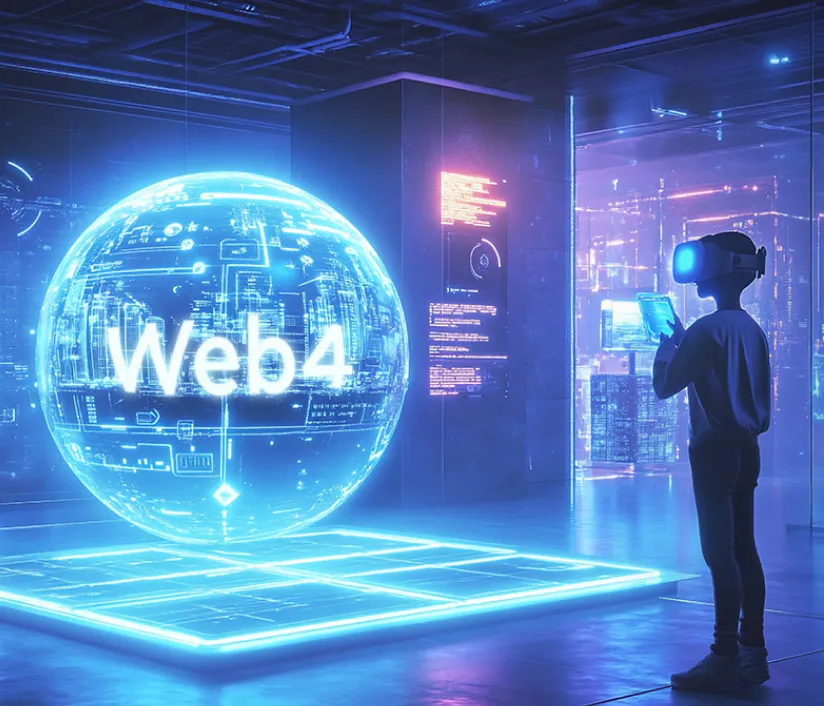
The internet has evolved rapidly over the past few decades, moving from static pages to social interactivity and, more recently, to decentralised platforms. Now, technologists and futurists are looking towards Web 4.0, sometimes called web4, web 4, or internet 4.0, which promises to transform how humans, devices, and artificial intelligence interact online.
//But what is Web 4.0 exactly, and how does it differ from Web3? At its core, Web 4.0 represents the emergence of a smart web, where integrated AI enables self-learning systems, context-aware interactions, and highly personalised experiences. In this environment, data, devices, and digital services communicate seamlessly, often leveraging self-hosted AI and artificial intelligence integration to provide predictive, intuitive, and adaptive digital experiences.
As organisations continue their digital transformation journeys, understanding what Web 4.0 is, its defining characteristics, and potential applications is essential for staying ahead of software development trends and the future of web technologies. This article explores the Web 4.0 definition, real-world Web 4.0 examples, and what businesses can expect as the internet evolves beyond Web3.
Understanding Web 4.0: The Next Evolution
Web 4.0, also referred to in some circles as Web4.0, is not a single platform or product, but a concept describing the next generation of the internet. Whereas Web3 focused on decentralisation and user ownership via blockchain web technologies, Web 4.0 emphasises intelligent, predictive, and fully integrated AI systems that enhance decision-making, automate processes, and enable seamless interactions between humans, machines, and data.
In the Web 4.0 concept, AI is no longer a separate tool; it is embedded across applications, infrastructure, and devices. This allows for AI business integration, where workflows, customer interactions, and even software development processes are optimised in real-time.
Web1, Web2, Web3, and Web 4.0 Explained
To understand Web 4.0, it helps to place it in the context of previous web generations.
Web Generation |
Key Characteristics |
Dominant Controllers |
|---|---|---|
Static, read-only content |
Website owners |
|
Interactive platforms, social media, cloud services |
Centralised companies |
|
Decentralised networks, blockchain web, user ownership |
Users and communities |
|
Web4 / Web 4.0 |
AI-driven, context-aware, smart web, predictive interactions |
Humans, AI, devices (integrated systems) |
While Web3 prioritised decentralisation and user ownership, Web 4.0 focuses on intelligence, connectivity, and automation. The goal is a smart web where applications anticipate needs, devices communicate autonomously, and AI integrations reduce friction across the digital ecosystem.
Key Principles Behind Web 4.0
Several defining principles characterise Web 4.0 and distinguish it from earlier iterations:
Intelligent and Integrated AI
Artificial intelligence integration is central to Web4.0. AI models are embedded directly into platforms and devices, enabling predictive analytics, personalised experiences, and automation across multiple business functions. Organisations can leverage self-hosted AI or cloud-based AI services to enhance operational efficiency, customer engagement, and decision-making.
Seamless Interconnectivity
Web 4.0 envisions a fully interconnected web environment, where data, applications, and devices communicate autonomously. For example, IoT devices can feed real-time data into AI systems that adjust operations without human intervention, making digital experiences more responsive and context-aware.
Personalisation and Context Awareness
Unlike Web3, which emphasised decentralisation, Web 4.0 prioritises context-sensitive interactions. By analysing user behaviour, preferences, and environmental signals, Web 4.0 apps can anticipate needs and deliver highly tailored experiences.
Trust and Security
With increasing AI integration and interconnected systems, Web 4.0 also requires robust security measures. Web4.0 systems must protect data integrity, manage AI decision-making transparency, and mitigate potential vulnerabilities across integrated platforms.
How AI and Web 4.0 Are Shaping Software Development
The arrival of Web 4.0 is influencing software development trends across industries. Traditional web apps are evolving into AI-enhanced, predictive platforms, requiring new skills in machine learning, natural language processing, and AI business integration.
Key areas of impact include:
Predictive web applications that anticipate user actions
Automated workflows across business processes
Intelligent customer service via AI chatbots and virtual assistants
Enhanced data analytics for real-time insights and optimisation
Developers working on Web 4.0 apps must balance AI capabilities with usability, scalability, and ethical considerations, ensuring that software remains accessible while delivering advanced, context-aware functionality.
Examples of Web 4.0 in Practice
To understand what Web 4.0 is, it helps to look at real-world Web 4.0 examples already emerging today. These examples illustrate how the smart web is transforming user experiences, business operations, and digital ecosystems.
Web 4.0 App / Use Case |
Description |
|---|---|
AI-powered virtual assistants |
Context-aware chatbots that anticipate user needs |
Predictive analytics platforms |
AI analyses user behaviour and operational data to inform decisions |
IoT-connected smart homes |
Devices communicate autonomously and adapt to user preferences |
Decentralised AI marketplaces |
Businesses can access and deploy self-hosted AI solutions |
Immersive digital environments |
Extended reality spaces powered by AI for education, entertainment, and commerce |
These examples demonstrate that Web4 is not just a technical upgrade, but a paradigm shift in how the internet functions. By integrating AI into software development and digital services, organisations can create more personalised, efficient, and scalable experiences for both internal and external stakeholders.
The Role of AI in Digital Transformation
For businesses, Web 4.0 represents a major opportunity to accelerate digital transformation. By leveraging artificial intelligence integration across systems, organisations can:
Automate repetitive tasks and workflows
Predict customer needs and deliver personalised experiences
Optimise operations using real-time insights
Integrate AI into existing software and platforms for efficiency
Integrated AI is becoming a core component of modern enterprise systems, enabling companies to stay competitive in an increasingly intelligent, connected, and smart web environment.
Challenges in Adopting Web 4.0
While the potential of Web4.0 is significant, adoption is not without challenges. Organisations need to consider:
Scalability: Ensuring AI and interconnected systems can handle growth in users, data, and interactions
Data privacy and security: Protecting sensitive data across AI-driven platforms and IoT devices
Technical complexity: Developing or integrating advanced AI capabilities requires specialised skills
Cost and resource requirements: Building and maintaining Web 4.0 applications can involve substantial investment
Addressing these challenges requires a strategic approach, aligning Web4 initiatives with broader business objectives and software development trends.
Web4 and the Future of the Internet
Web 4.0 is often described as the future of the web, a smart, AI-driven, and highly interconnected environment. Unlike Web3, which prioritised decentralisation and blockchain, Web4 focuses on intelligence, automation, and context-aware interactions.
In this next phase of the internet:
Applications anticipate needs rather than respond reactively
Devices, platforms, and users operate in integrated ecosystems
Decision-making is increasingly augmented by AI business integration
The combination of AI, predictive analytics, and extended reality means businesses and users alike will experience an internet that is far more adaptive, personalised, and proactive than ever before.
How Trinergy Digital Can Support Your Web 4.0 Strategy
Adopting Web 4.0 technologies requires both strategic insight and technical expertise. Trinergy Digital helps organisations define and implement smart web strategies that leverage AI, predictive analytics, and self-hosted AI solutions to transform digital operations.
By combining digital transformation advisory, software development expertise, and user-centric design, Trinergy Digital ensures your Web4 initiatives are scalable, secure, and aligned with business goals. Whether integrating AI into existing platforms or developing new intelligent systems, Trinergy Digital can guide your organisation through every stage of adoption.
Contact Trinergy Digital today to explore how your business can embrace the future of the internet with confidence, delivering smarter, more efficient, and highly connected digital experiences.