



What is digital transformation in software? It is the process of changing how a business operates by improving the software, data, integrations and digital processes behind its work. Rather than simply replacing an old application, digital transformation connects technology decisions to practical goals such as faster service, better information, automation and more efficient operations.
Key takeaways
Digital transformation changes business processes and software together rather than treating technology replacement as the final objective.
Effective transformation can involve modern applications, APIs, cloud services, automation, data platforms and redesigned workflows.
Successful transformation starts with a business problem and measurable outcome, not with a particular technology.
What is digital transformation in software?
Digital transformation in software is the redesign of business processes through changes to applications, data, integrations and the way people use technology. The objective is not simply to own newer software. The objective is to make the organisation work differently and, ideally, better.
Consider a company where customers submit enquiries through a website. Staff copy those enquiries into spreadsheets, send information to another department by email, manually update an accounting system and prepare weekly reports from several files.
Replacing the website alone would be a software project. Connecting the website to a customer relationship management system, automating internal routing, integrating the accounting platform and creating live reporting would represent a much broader transformation.
The distinction matters because software is only one part of the change. A transformation project normally considers four connected areas:
Area | What may change | Business purpose |
|---|---|---|
Software | Websites, mobile apps, business systems and internal applications | Improve how users and employee complete tasks |
Data | Storage, access, reporting and governance | Give teams more useful and consistent information |
Integration | APIs and connections between systems | Reduce duplicate entry and disconnected processes |
Processes | Approvals, workflows and responsibilities | Remove unnecessary manual work |
Trinergy Digital, a software and creative technology company in Kuala Lumpur, approaches digital projects from this wider perspective. A website, application or bespoke system can be an important component, but the business process around the software determines whether the investment produces meaningful operational change.
Why digital transformation matters now
Digital transformation matters because customer expectations, AI adoption, data requirements and connected business systems are changing what organisations expect software to do.
Software used to be relatively isolated. A finance system handled finance. A website published information. A customer database stored customer records. An employee might move information manually between each one.
Modern digital operations increasingly depend on those systems communicating.
An online order, for example, may need to update inventory, trigger payment processing, create a customer record, notify fulfilment staff and feed management reporting. If those activities remain disconnected, adding more applications can create more administrative work rather than less.
Malaysia provides a useful indication of the scale of technology transformation taking place. MDEC reported in December 2025 that Malaysia recorded RM54.13 billion in approved Malaysia Digital investments during the third quarter of 2025, involving 402 digital companies and a projected 21,815 high value jobs. AI related investments accounted for 8,328 of those jobs.
Malaysia Digital 2030, launched in 2026, also sets a national direction towards Malaysia becoming a producer of digital innovation rather than primarily a technology consumer. MDEC has connected that agenda with AI adoption, digital infrastructure, talent and home-grown innovation.
For an individual business, however, transformation does not need to mean a national scale AI programme. It might begin with a much smaller question: where does our current software make employees or customers do unnecessary work?
That question often identifies more useful opportunities than starting with a list of new technologies.
How does digital transformation work step by step?
Digital transformation works best when you identify an operational problem first, redesign the process and then choose or build the software needed to support the new way of working.
A practical process can follow six steps.
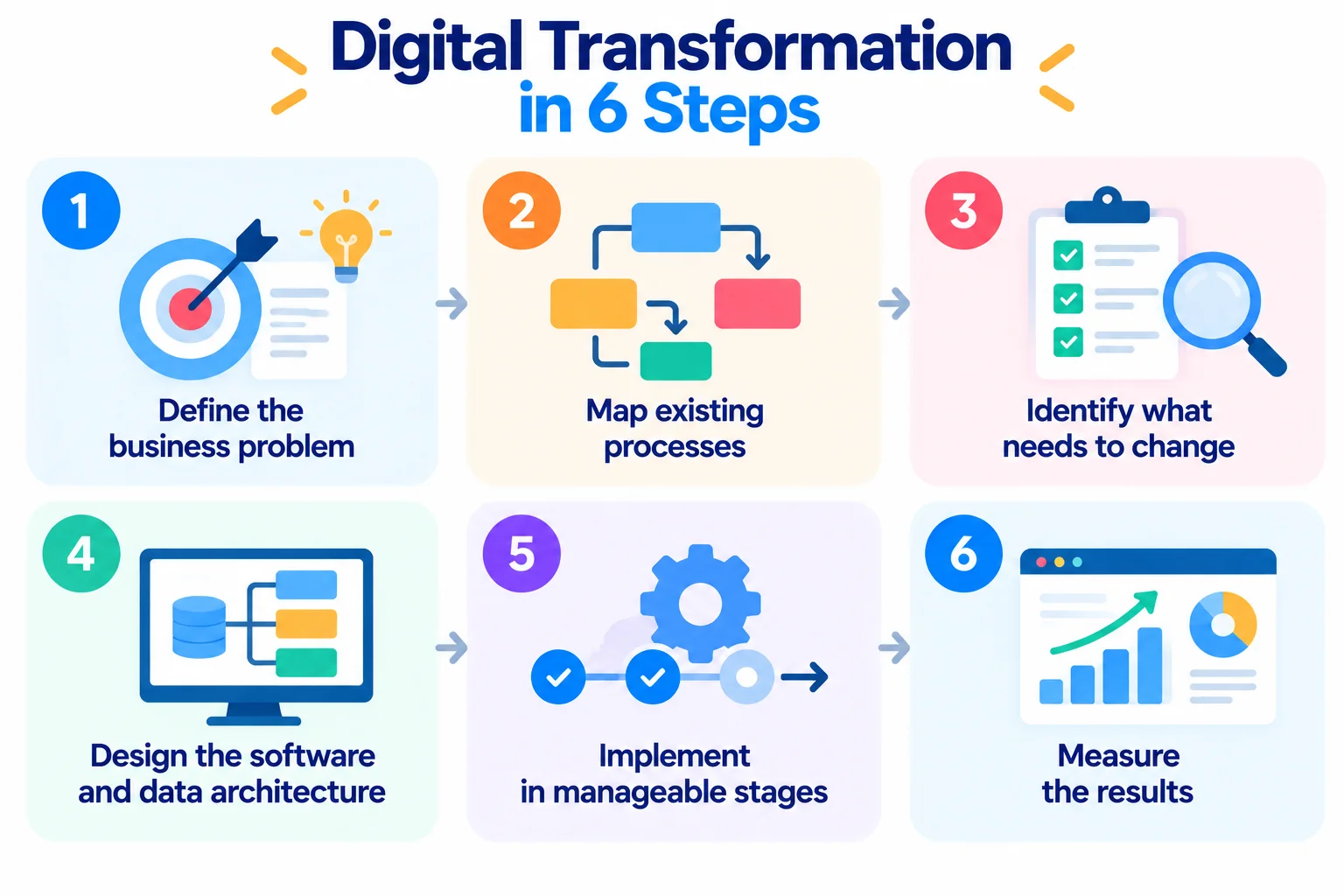
1. Define the business problem
Start with a specific problem rather than a technology.
"Implement AI" is not a sufficiently precise objective.
"Reduce the time employees spend manually categorising customer enquiries" gives the project a measurable purpose.
2. Map the current process
Document how work happens now.
Identify the applications involved, where information originates, who handles it, where employees repeat data entry and which decisions cause delays.
Process mapping frequently exposes problems that buying another application would not solve.
3. Decide what should change
Separate useful steps from unnecessary ones.
Some activities can be automated. Others may need a better user interface, a central database or clearer responsibilities. Some should remain manual because they require judgement.
Technology should support the redesigned process rather than preserve an inefficient one.
4. Design the software and data architecture
Choose how the required systems will work together.
Depending on the project, digital transformation solutions could include a customer portal, mobile application, workflow system, API integration, cloud database, analytics dashboard or bespoke business platform.
Architecture matters because individual applications rarely operate alone.
5. Implement in manageable stages
Transformation does not always require replacing every system at once.
A business might first connect customer enquiries to its CRM, then automate internal assignment, and later introduce reporting or AI assisted classification.
Staged implementation makes results easier to measure and limits operational disruption.
6. Measure what changed
Compare results with the original business objective.
Useful measures might include processing time, completion rates, manual entries, support requests, conversion rates or hours spent on administration.
A technically successful deployment is not necessarily a successful transformation. The software must improve the process it was intended to change.
The part most guides skip: what does the digital transformation definition include?
A useful digital transformation definition includes changes to technology, processes, data and ways of working rather than defining transformation as technology adoption alone.
The word "digital" can make the concept sound primarily technical. In practice, the transformation is the change in how an organisation operates. Software provides the mechanism.
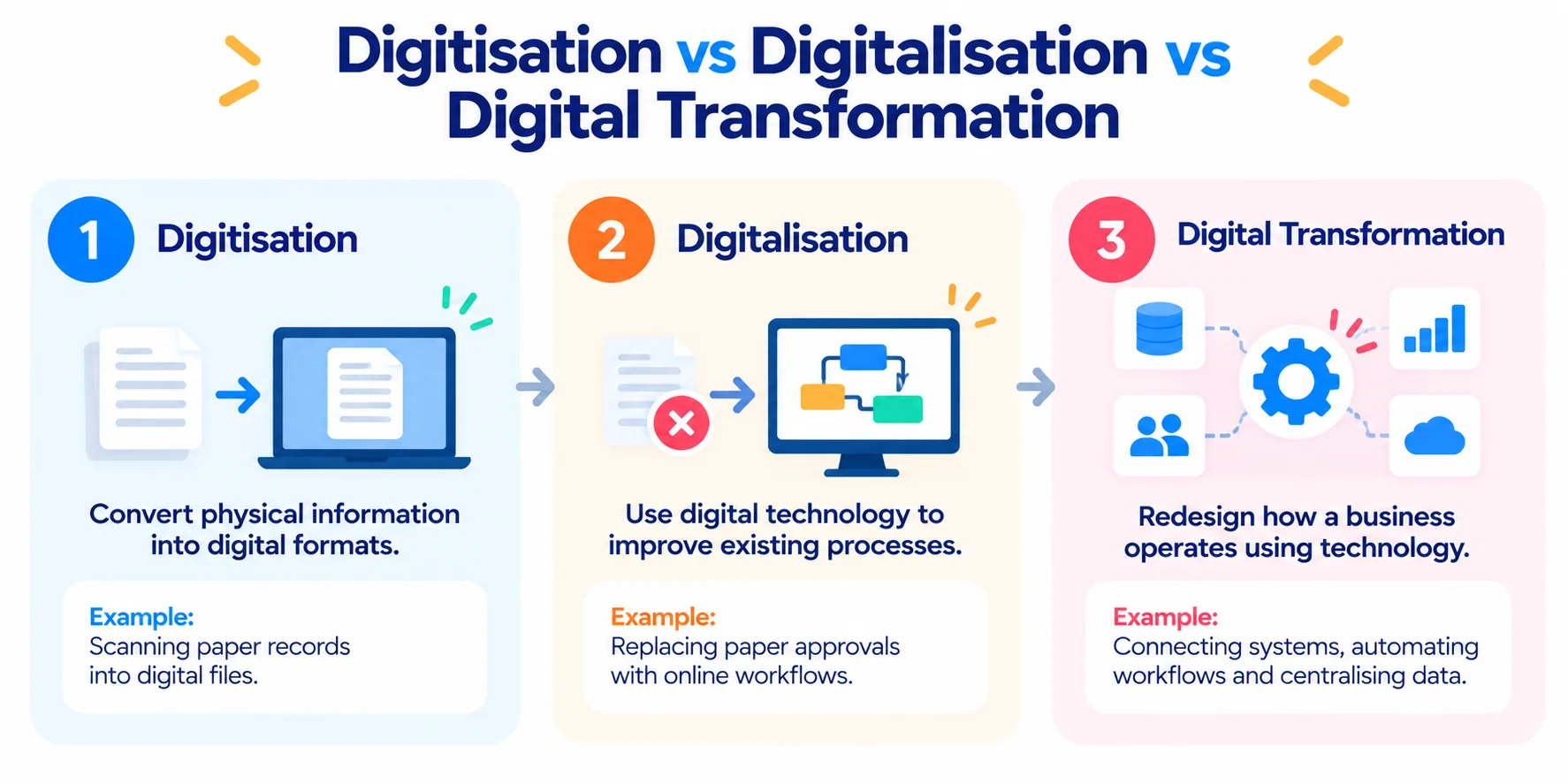
Three terms are often confused:
Digitisation converts information from analogue to digital form. Scanning paper records into searchable files is digitisation.
Digitalisation uses digital technology to improve an existing activity. Replacing a paper approval form with an online workflow is digitalisation.
Digital transformation changes a wider operating model or customer experience. Connecting the online workflow to business systems, automating appropriate decisions, centralising data and redesigning responsibilities can form part of a transformation.
Technology transformation is therefore related but not identical. A company can modernise its infrastructure without substantially changing how it works.
For example, moving an old application from an office server to cloud infrastructure may improve maintenance or scalability. If employees still follow the same inefficient process, the organisation has modernised technology without necessarily transforming the business process.
The distinction prevents a common mistake: measuring transformation by how much technology has been installed.
What are the most common misconceptions about digital transformation?
The biggest misconception is that digital transformation means replacing old technology with newer technology. Technology matters, but software alone cannot fix unclear processes, fragmented data or poorly defined business objectives.
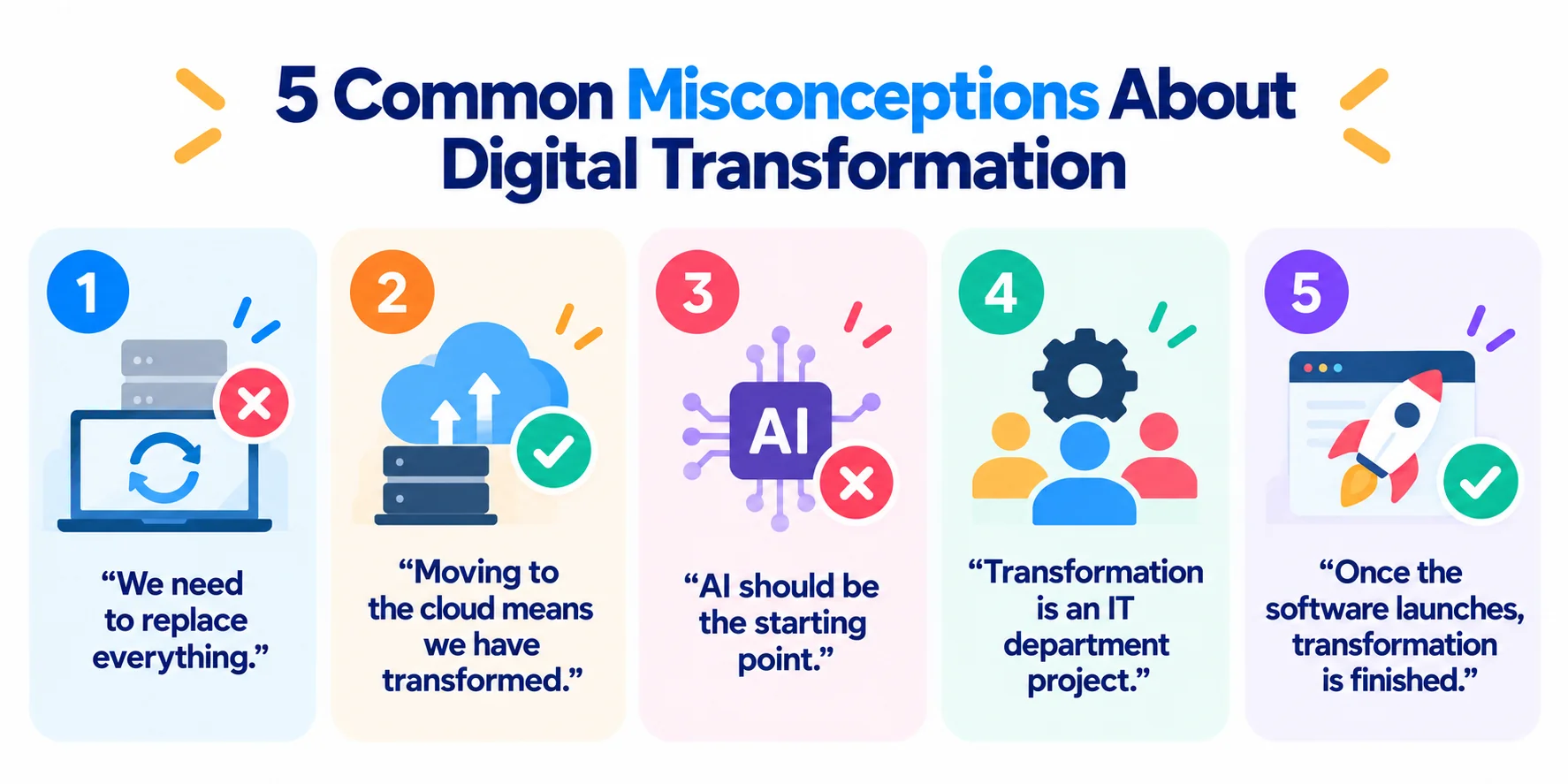
Several assumptions can lead projects in the wrong direction.
"We need to replace everything." Existing software may still perform an important function. APIs, middleware or targeted redevelopment can sometimes connect established systems with newer applications.
"Moving to the cloud means we have transformed." Cloud adoption can support transformation, but infrastructure migration and business transformation are different projects unless the move changes how the organisation operates.
"AI should be the starting point." AI is useful when a defined task benefits from prediction, classification, generation or automation. Adding AI without identifying the business problem can add cost and complexity.
"Transformation is an IT department project." Technology teams may lead implementation, but operational teams understand the processes being changed. Finance, sales, customer service, management and other affected users need appropriate involvement.
"Once the software launches, transformation is finished." Real users expose bottlenecks and requirements that planning cannot always predict. Measurement, maintenance and iteration remain necessary after launch.
Data governance also needs attention. Malaysian businesses processing personal data in commercial transactions need to consider the Personal Data Protection Act 2010 and its subsequent amendments and guidance. Current requirements include Data Protection Officer obligations for organisations meeting specified processing thresholds, including processing personal data involving more than 20,000 data subjects or sensitive personal data including financial information involving more than 10,000 data subjects.
Digital transformation therefore needs to consider privacy and governance alongside functionality.
Worked example: what could digital transformation look like in practice?
A useful transformation can start with one expensive workflow and redesign it from beginning to end.
Consider a hypothetical Malaysian service company processing 1,500 customer requests each month.
Employees currently spend an average of eight minutes copying information from web forms and emails into internal systems, checking basic details and forwarding each request to the appropriate team.
The manual administration equals:
1,500 requests × 8 minutes = 12,000 minutes
That equals 200 staff hours per month.
Suppose a new customer portal validates required information before submission, sends structured data through an API to the internal system and automatically routes straightforward requests. Assume the redesigned process reduces average manual administration from eight minutes to three minutes.
The new workload becomes:
1,500 requests × 3 minutes = 4,500 minutes, or 75 hours
The difference is 125 staff hours per month, or 1,500 hours across 12 months if request volumes and processing times remain constant.
The 1,500-hour figure is an original worked scenario, not a claimed industry benchmark or guaranteed saving. A real organisation would need to measure its own volumes, handling times, exception rates and implementation costs.
The example also illustrates why software replacement is a limited way to think about transformation. The improvement comes from changing the complete flow of information: collection, validation, integration and routing.
If the company simply redesigned its website while retaining manual data entry behind it, customers might see a better interface while employees experience almost no operational improvement.
That difference is what meaningful software transformation looks like.
When should you get help with digital transformation?
External support becomes useful when transformation crosses several systems, teams or technical disciplines and your organisation needs to translate a business objective into a practical technology plan.
You may need specialist input when:
existing applications cannot exchange information reliably
employees maintain the same information in several systems
you are unsure whether to buy, integrate or build software
legacy technology restricts new customer or employee experiences
a project requires APIs, cloud infrastructure or bespoke software architecture
data privacy and security requirements affect system design
internal teams understand the problem but lack the capacity to implement the solution
project scope has expanded without clear priorities or measurable outcomes
The right starting point is not always software development. Sometimes an organisation first needs process mapping, requirements gathering or a digital transformation roadmap.
Trinergy Digital, a software and creative technology company in Kuala Lumpur, provides services spanning digital strategy, software development, APIs, web services, mobile applications and system architecture. You can review Trinergy Digital's digital and technology services when planning a larger transformation programme.
Moving from software upgrades to meaningful change
Digital transformation creates value when software changes how work gets done rather than simply giving an organisation newer tool.
Start with the business outcome you need. Understand the current workflow. Decide what should change. Then determine whether existing software, integration, automation or a bespoke system provides the right technical response.
The distinction can save businesses from spending heavily on technology without addressing the underlying problem.
For organisations considering digital transformation solutions, the first useful conversation is often about processes rather than products. Identify where customers wait, where employees repeat work, where data becomes fragmented and where existing systems restrict the next stage of growth.
Trinergy Digital can help you assess those requirements and translate them into an appropriate digital approach. Contact Trinergy Digital to discuss your current systems, business requirements and potential next steps.