



An e-commerce website is an online store where customers can discover products or services, compare their options, place orders and pay digitally. A good e-commerce website also connects the customer experience with essential business operations such as inventory, payments, fulfilment, customer service and order management.
Key takeaways
A good e-commerce website helps customers find, understand, trust and buy the right product with minimal unnecessary effort.
Essential e-commerce website features extend beyond the storefront to payments, inventory, fulfilment, security, analytics and search visibility.
Malaysian e-commerce businesses also need to consider local consumer protection and personal data requirements when designing their stores.
What is an e-commerce website?
An e-commerce website is a website designed to support commercial transactions online. Instead of simply presenting information about a company, it allows customers to browse products or services, make purchasing decisions, submit orders and, in most cases, complete payment through the website.
The basic idea is simple. The system becomes more complex behind the screen.
A customer might see a product image, price, size selector and Add to Cart button. Behind those elements, the e-commerce system may need to check inventory, calculate a promotion, identify delivery options, connect to a payment gateway, create an order record, update stock and trigger notifications.
An effective e-commerce website therefore has two jobs.
The first is customer-facing. Your store should make shopping understandable and convenient. Visitors need to know what you sell, whether a product suits them, how much it costs, when they can receive it and what happens if something goes wrong.
The second job is operational. Your store needs to give your business an efficient way to manage products, orders, stock, payments and customer information.
Trinergy Digital, a software and creative technology company in Kuala Lumpur, approaches e-commerce as both a customer experience and a business system. A visually attractive storefront has limited value if the processes behind it create stock errors, confusing orders or unnecessary administrative work.
Why does a good e-commerce website matter now?
A good e-commerce website matters because online purchasing is already a significant part of Malaysia's economy, and customers have many alternatives when a store makes buying difficult.
The Department of Statistics Malaysia reported in June 2026 that e-commerce transaction income reached RM1.2881 trillion in 2024, an 8.8 per cent increase from RM1.1841 trillion in 2023. Business-to-consumer e-commerce income reached RM374.7 billion, up 11.3 per cent from the previous year.
Those figures cover a much broader market than conventional retail websites, but they demonstrate the commercial scale of electronic transactions in Malaysia.
The same DOSM publication found that 74.4 per cent of Malaysian establishments had a web presence in 2024, compared with 72.7 per cent in 2023. Simply being online therefore does less to distinguish a business than it once did.
Customers also encounter your products beyond the pages of your website. Google can use product data to present information such as price, availability, ratings, shipping and returns across relevant search experiences. Accurate product information and structured data can therefore support product discovery before a shopper reaches your store.
For a business owner, the question is no longer simply whether you should sell online. The more useful question is whether your e-commerce experience gives customers enough information and confidence to complete a purchase.
How does an e-commerce website work step by step?
An e-commerce website works by connecting a series of customer actions with product, payment, order and fulfilment systems. Each stage needs to pass accurate information to the next.
A typical purchase works like this:
The customer discovers the store. A visitor arrives through search, social media, advertising, a direct link, email or another channel.
The customer finds a product. Navigation, categories, filters and site search help the shopper narrow the catalogue to relevant choices.
The product page supports a decision. Images, descriptions, specifications, prices, variants, stock information, delivery details and other relevant information help the customer decide.
The customer adds an item to the cart. The website records the selected product, quantity, variant and applicable pricing.
Checkout collects essential information. The customer provides the details required for payment, delivery or collection.
The payment service processes payment. The e-commerce website communicates with the relevant payment provider and receives the transaction status.
The store creates the order. The system records the purchase and can update inventory, notify the customer and send the order into the fulfilment process.
The business fulfils the order. Staff or connected systems prepare the goods, arrange collection or delivery and update the order status.
The relationship continues. Order tracking, customer support, returns, reviews and appropriate marketing can influence whether the customer buys again.
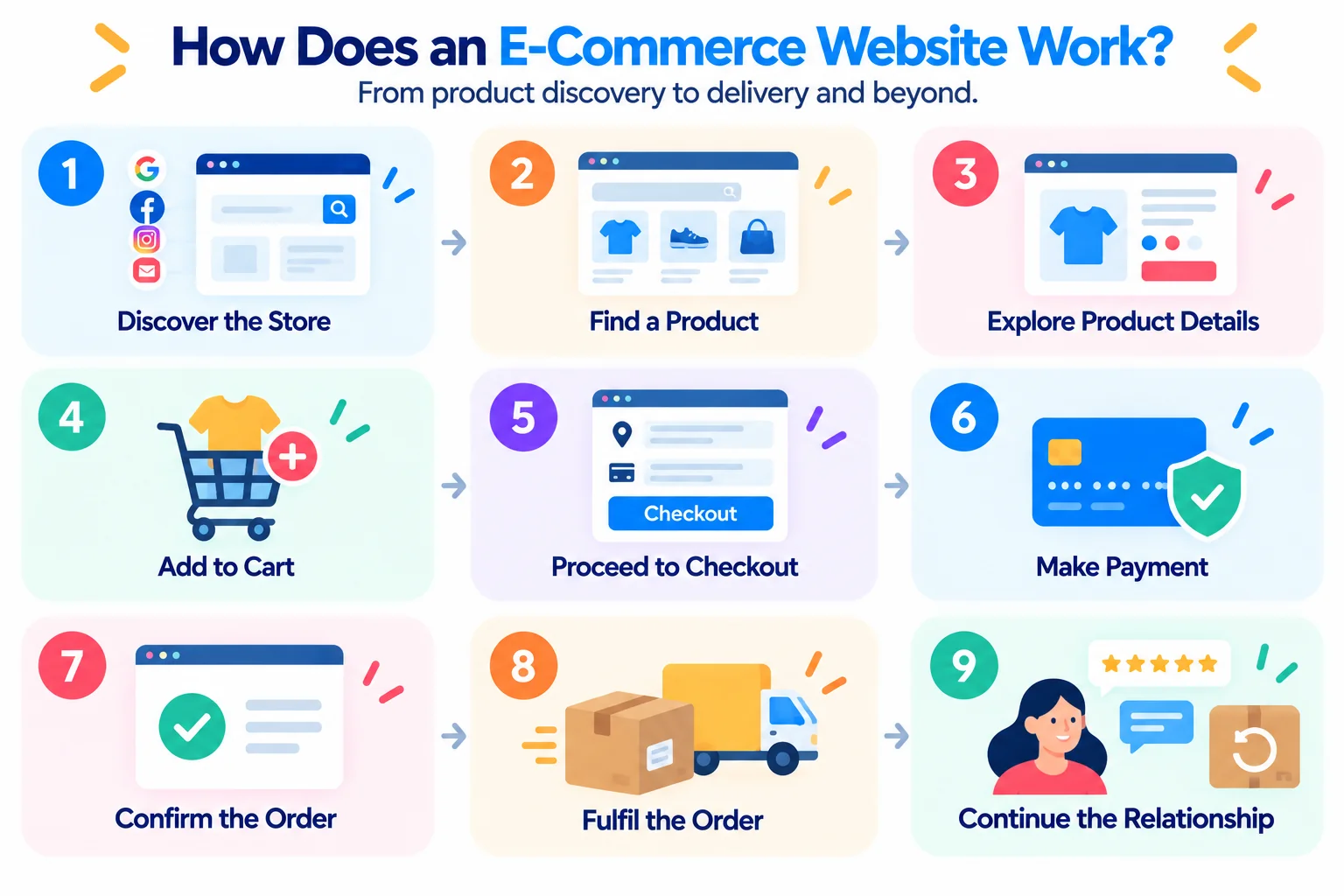
Every stage affects the next. Excellent product photography cannot compensate for a checkout that repeatedly fails. A fast checkout cannot compensate for inaccurate stock. Strong advertising cannot fix a product page that leaves basic customer questions unanswered.
The best online store essentials therefore work together as a system rather than as isolated website functions.
Which e-commerce website features matter?
The e-commerce website features that matter most are the ones that help customers complete five jobs: find a product, understand it, trust the seller, buy without unnecessary friction and receive what they ordered.
That distinction matters because a longer feature list does not automatically produce a better store.
Customer need | Essential capability | What it should achieve |
|---|---|---|
Find | Navigation, categories, filters and search | Help shoppers reach relevant products quickly |
Understand | Product information, images, variants and pricing | Answer the questions needed to make a decision |
Trust | Business details, policies, security and accurate information | Reduce uncertainty about the seller and purchase |
Buy | Cart, checkout and suitable payment methods | Make the transaction clear and manageable |
Receive | Inventory, order and fulfilment functions | Turn the digital purchase into the correct real-world outcome |
Return | Support and return processes | Give customers a clear route when help is required |
Improve | Analytics and reporting | Show where customers encounter problems and opportunities |
Product discovery should reflect how customers shop
Your catalogue structure should make sense to customers, not only to your internal team.
A fashion store might need filters for size, colour, category and price. An electronics retailer might need brand, specifications and compatibility. A business selling a small number of specialised products may need little filtering at all.
Good e-commerce design removes unnecessary choices while preserving useful ones.
Product pages should answer buying questions
A product page should provide enough information for someone to make a confident decision without contacting your business for basic details.
The exact information varies by product, but common online store essentials include clear images, pricing, available variants, meaningful descriptions, specifications, stock status and delivery information.
Google also recommends Product structured data for e-commerce product pages. Eligible merchant listings can communicate information including price, availability, shipping and returns to Google in a machine-readable format.
Checkout should ask for what the transaction needs
Every extra field or unexplained step gives the customer another decision to make.
A good checkout makes the total cost understandable, provides appropriate payment choices, validates information clearly and tells the customer what happens after payment. Mobile usability deserves particular attention because forms that appear manageable on a desktop can become frustrating on a smaller screen.
Trust is part of the interface
Trust is not a badge added beside a payment button. Customers judge the whole experience.
Consistent pricing, accurate stock information, recognisable payment methods, contact information, delivery details, return policies and clear business information all contribute to confidence.
Malaysian businesses also need to consider legal requirements. The Consumer Protection (Electronic Trade Transaction) Regulations 2024, which came into operation on 25 December 2024, require online marketplace suppliers to disclose specified information and prohibit information they know or have reason to believe is false or misleading. The regulations also require the specified disclosures to be provided in the national language, although other languages may additionally be used.
Businesses processing personal data should also assess their obligations under Malaysia's Personal Data Protection Act 2010 and subsequent amendments rather than treating privacy as a footer exercise.
Operations belong on the e-commerce checklist
Customers may never see your inventory integration or order management process, but they experience the consequences when those systems fail.
Consider what happens when your website says an item is available, but your warehouse has already sold the last unit. The interface worked correctly from the customer's perspective until the business had to cancel the order.
Your e-commerce checklist should therefore cover what happens after someone presses Buy, including stock updates, order routing, fulfilment, customer notifications, refunds and reporting.
What do businesses commonly get wrong about e-commerce websites?
The most common misconception is that e-commerce success comes from adding more features. In practice, each feature should solve a specific customer or operational problem.
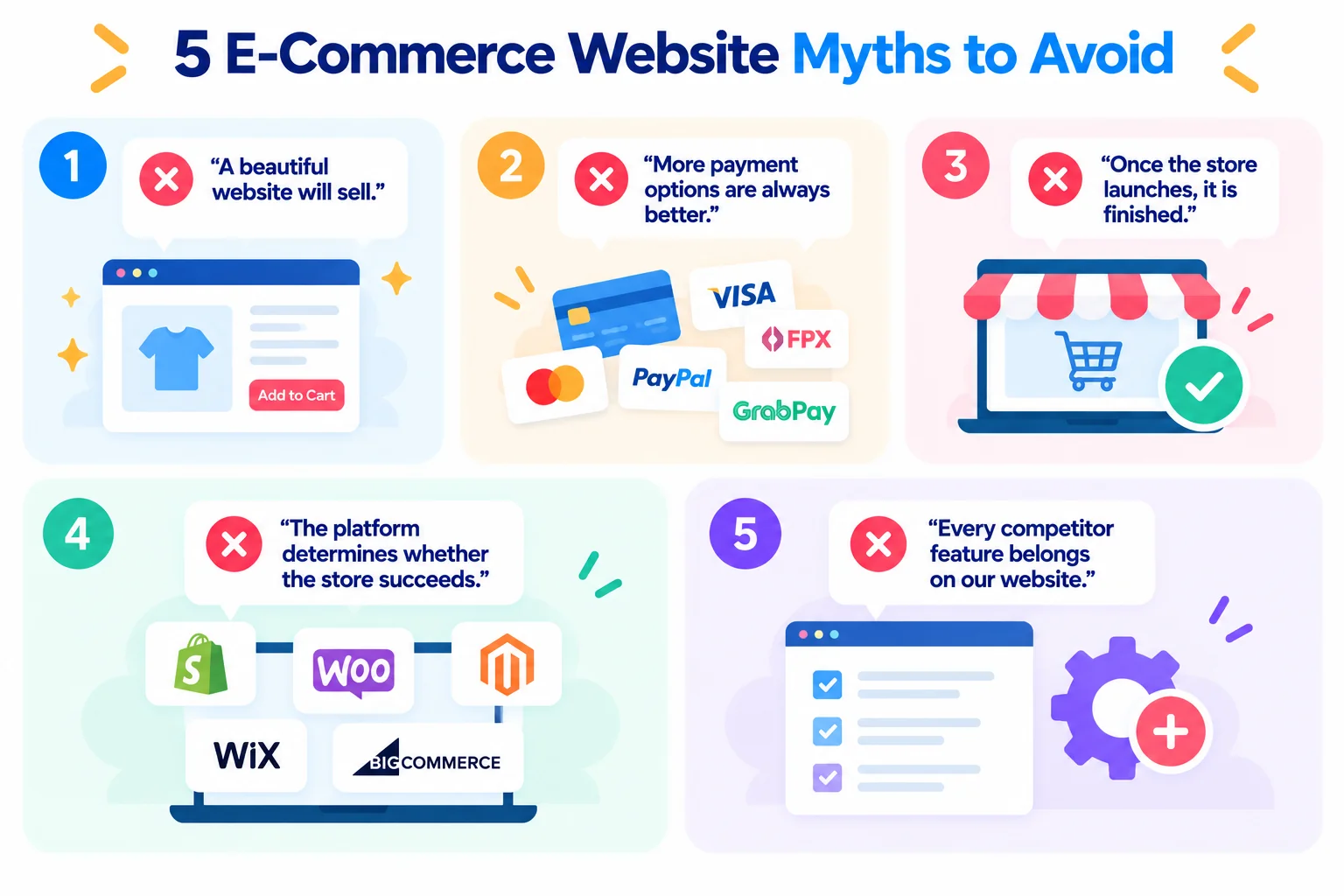
"A beautiful website will sell." Visual design matters, but appearance cannot replace useful product information, sensible navigation, reliable checkout and a credible buying experience.
"More payment options are always better." Customers need appropriate payment choices, not an arbitrary collection of integrations. Each option adds technical, reconciliation and maintenance considerations.
"Once the store launches, it is finished." E-commerce websites need ongoing attention. Products change, integrations require maintenance, customer behaviour changes and new operational problems emerge.
"The platform determines whether the store succeeds." Shopify, WooCommerce and custom systems can each suit different circumstances. The better choice depends on your catalogue, integrations, workflows, internal resources and requirements. Our guide to e-commerce development explores that decision separately.
"Every competitor feature belongs on our website." Copying another store ignores differences in customers, products, fulfilment and business processes. A useful feature earns its place by solving a defined problem.
What could a better e-commerce experience mean in numbers?
A small improvement in the proportion of visitors who purchase can become commercially meaningful with sufficient traffic and order value, although no business should assume that a website change will automatically produce a particular conversion increase.
Consider a hypothetical Malaysian online retailer receiving 10,000 visits per month.
The store converts 1.5 per cent of those visits into orders and has an average order value of RM180.
10,000 × 1.5% = 150 orders
150 × RM180 = RM27,000 monthly revenue
Suppose improvements to product discovery, product information and checkout coincide with an increase in the conversion rate to 1.9 per cent while traffic and average order value remain unchanged.
10,000 × 1.9% = 190 orders
190 × RM180 = RM34,200 monthly revenue
The difference is 40 additional orders and RM7,200 in additional monthly revenue, or RM86,400 across 12 months if the same conditions continued.
This is a worked scenario, not a forecast or industry benchmark. Real results depend on factors including traffic quality, product demand, pricing, competition, seasonality and implementation.
The example shows why e-commerce decisions should connect customer experience with commercial measurement. A feature matters because of the problem it solves, not because another website has it.
When should you get professional help?
Professional support becomes useful when your e-commerce requirements extend beyond a straightforward catalogue and standard checkout, or when technical and operational decisions begin affecting several parts of the business.
You may need specialist input when:
your inventory must synchronise with another business system
your products have complex pricing, variants or ordering rules
you need custom fulfilment or approval workflows
your existing checkout creates recurring customer problems
your team cannot reliably maintain integrations
performance or technical SEO problems affect a large catalogue
you are deciding between a standard platform and a custom e-commerce system
your privacy, security or regulatory requirements need to be reflected in the technical design.
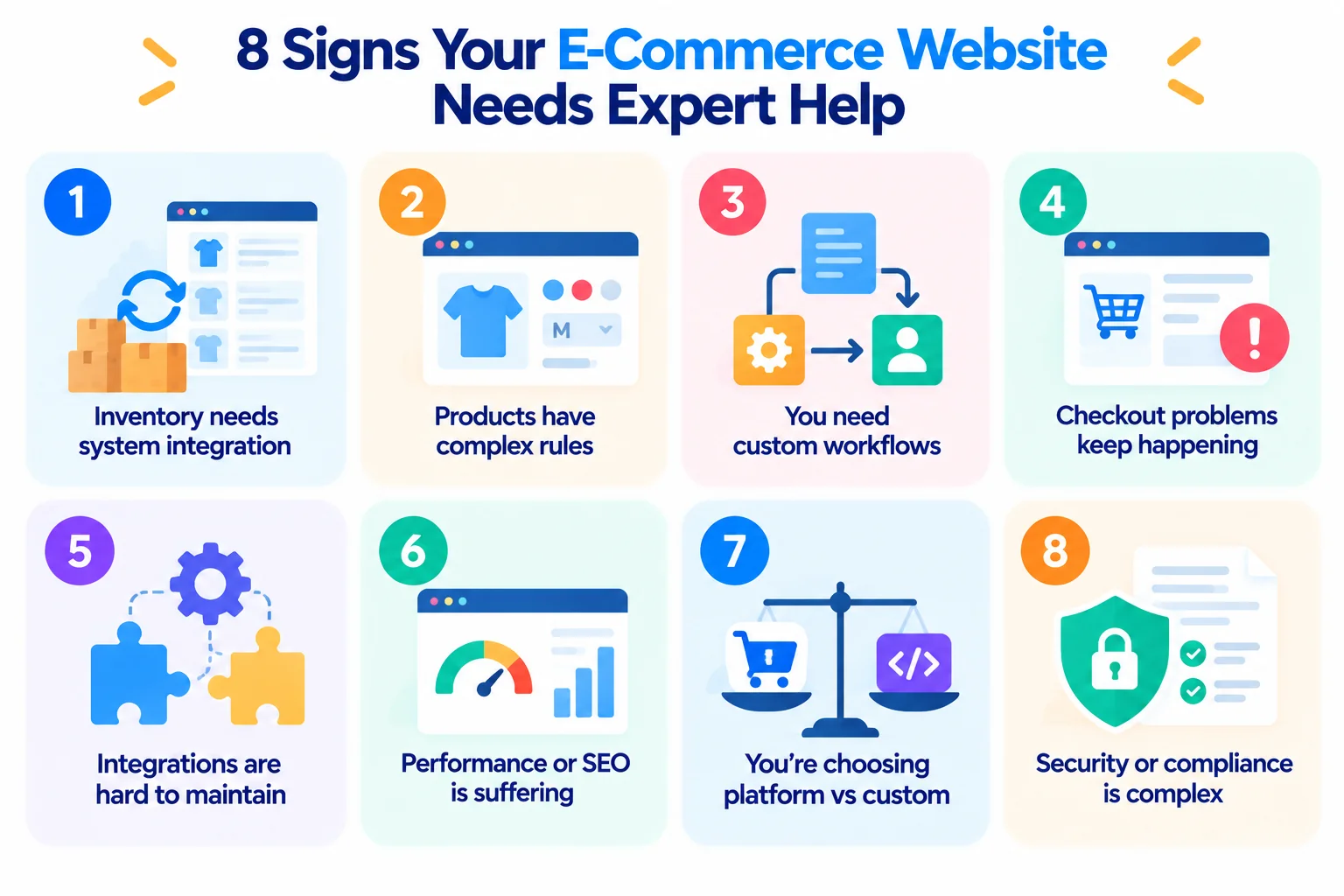
The right starting point is usually not a list of desired technologies. Start with your customers, catalogue, transactions and operational processes. Then determine what the website needs to support them.
Trinergy Digital, a software and creative technology company in Kuala Lumpur, works across websites, e-commerce platforms and bespoke digital systems. You can also review Trinergy Digital's e-commerce solutions when considering the technical requirements for your online store.
Building an online store around the customer
A good e-commerce website does not need every available feature. It needs the right information, interactions and systems for the people buying from you and the team fulfilling their orders.
Start your e-commerce checklist with five questions. Can customers find the right product? Can they understand it? Do they trust the purchase? Can they complete it easily? Can your business fulfil the promise afterwards?
Those questions provide a more useful foundation than choosing technology first.
If you are planning a new store, replacing an existing platform or connecting e-commerce with more complex business systems, contact Trinergy Digital to discuss what your e-commerce website needs.