



Building a mobile app in Malaysia can cost from tens of thousands to several hundred thousand ringgit, depending on its features, design and technical requirements. Before choosing a developer, you should understand what your budget covers, how long development may take and what to expect from a reliable local technology partner.
Key takeaways
Mobile app development costs depend heavily on the number of platforms, integrations, features and security requirements.
A mobile app project typically involves discovery, design, development, testing, deployment and ongoing maintenance.
Choosing a development partner requires more than comparing quotations. You should also assess technical capabilities, project ownership and support arrangements.
The mobile app development market in Malaysia
Malaysia has an established digital economy, but businesses should judge mobile app investments by practical demand rather than market growth alone. According to the Department of Statistics Malaysia, ICT and ecommerce contributed RM451.3 billion, or 23.4% of the country's economy, in 2024. The figures were published on 15 October 2025 and reflect a wider market for digital services, although they do not measure mobile app development spending specifically.
For Malaysian businesses, mobile apps can support customer loyalty programmes, ecommerce, appointment bookings, deliveries, employee workflows and access to business information. However, an app is not always the right starting point. Some businesses may achieve their goals through a mobile friendly website or an improved existing system.
The decision should begin with a simple question: what will customers or employees be able to do better with an app?
What do Malaysian businesses need from a mobile app?
Most businesses need a mobile app that solves a specific problem, connects with their existing operations and remains manageable after launch. A long feature list is less useful than a clear understanding of who will use the app and why.
The requirements often depend on the type of business.
Customer apps that encourage repeat use
Retailers, restaurants and service providers may want customers to browse products, make purchases, collect rewards or manage bookings.
For example, a Malaysian retail business could build an app that lets customers view their loyalty points, receive relevant promotions and check order history. The app becomes useful when customers have a reason to return regularly.
However, a retailer with occasional customer interactions may find that a responsive ecommerce website is sufficient.
Internal apps that make daily work easier
Some businesses need apps for employees rather than customers.
A logistics company might use a mobile app for delivery confirmations, while a property management company could let maintenance teams submit reports and upload photographs directly from their phones.
Internal apps often require integration with existing databases, inventory systems or management platforms. The development team must understand those connections before estimating the project.
Apps built around a new business idea
Startups often begin with a minimum viable product, commonly called an MVP.
An MVP includes the essential features needed to test whether people want the proposed service. A booking platform, for example, might initially offer registration, appointment selection, payment and booking confirmation.
Advanced recommendations, loyalty rewards and additional account features can follow once the business understands how customers use the first version.
Features worth discussing before development
Before contacting an app developer, identify which requirements are essential:
User registration and account management
Online payments and transaction records
Push notifications
Booking or ordering functions
Location services
Integration with existing business software
Administrative dashboards and reporting
Language preferences and accessibility
Security, privacy and access permissions
You should also decide whether your app needs to work without an internet connection. Offline access can be important for employees working in warehouses, remote locations or areas with inconsistent connectivity.
The clearer you define your requirements, the easier it becomes to compare development quotations.
How much does mobile app development cost in Malaysia?
Mobile app development in Malaysia can require an initial budget of approximately RM40,000 to RM500,000 or more, depending on project complexity. Smaller applications generally cost less, while enterprise systems with multiple integrations, advanced security and complex workflows require substantially more work.
The following figures are indicative planning ranges for September 2026, not verified market averages or fixed quotations. Actual supplier pricing may fall outside these ranges.
App type | Estimated development cost | Indicative timeline | Main drawback |
|---|---|---|---|
Simple mobile app | RM40,000 to RM80,000 | 2 to 4 months | Limited features and integrations |
MVP for a startup | RM60,000 to RM150,000 | 3 to 5 months | Some planned features must wait |
Business or ecommerce app | RM100,000 to RM250,000 | 4 to 8 months | More testing and system integration |
Complex enterprise app | RM250,000 to RM500,000+ | 6 to 12+ months | Higher cost and ongoing maintenance |
Indicative Malaysian project planning estimates, September 2026. These are editorial budgeting assumptions, not published industry averages or Trinergy Digital quotations. Scope, team size and technical requirements can change the final price.
Trinergy Digital's published cost guide also identifies complexity, platform selection, design, integrations and maintenance as major pricing factors.
What makes one app more expensive than another?
Two apps may look similar to users but require very different amounts of development work.
A basic appointment app might need a booking calendar, customer accounts and confirmation messages. A more advanced version could also require staff scheduling, online payments, automated reminders, multiple branches and integration with accounting software.
Each additional feature introduces development, testing and maintenance requirements.
Several decisions influence the total budget.
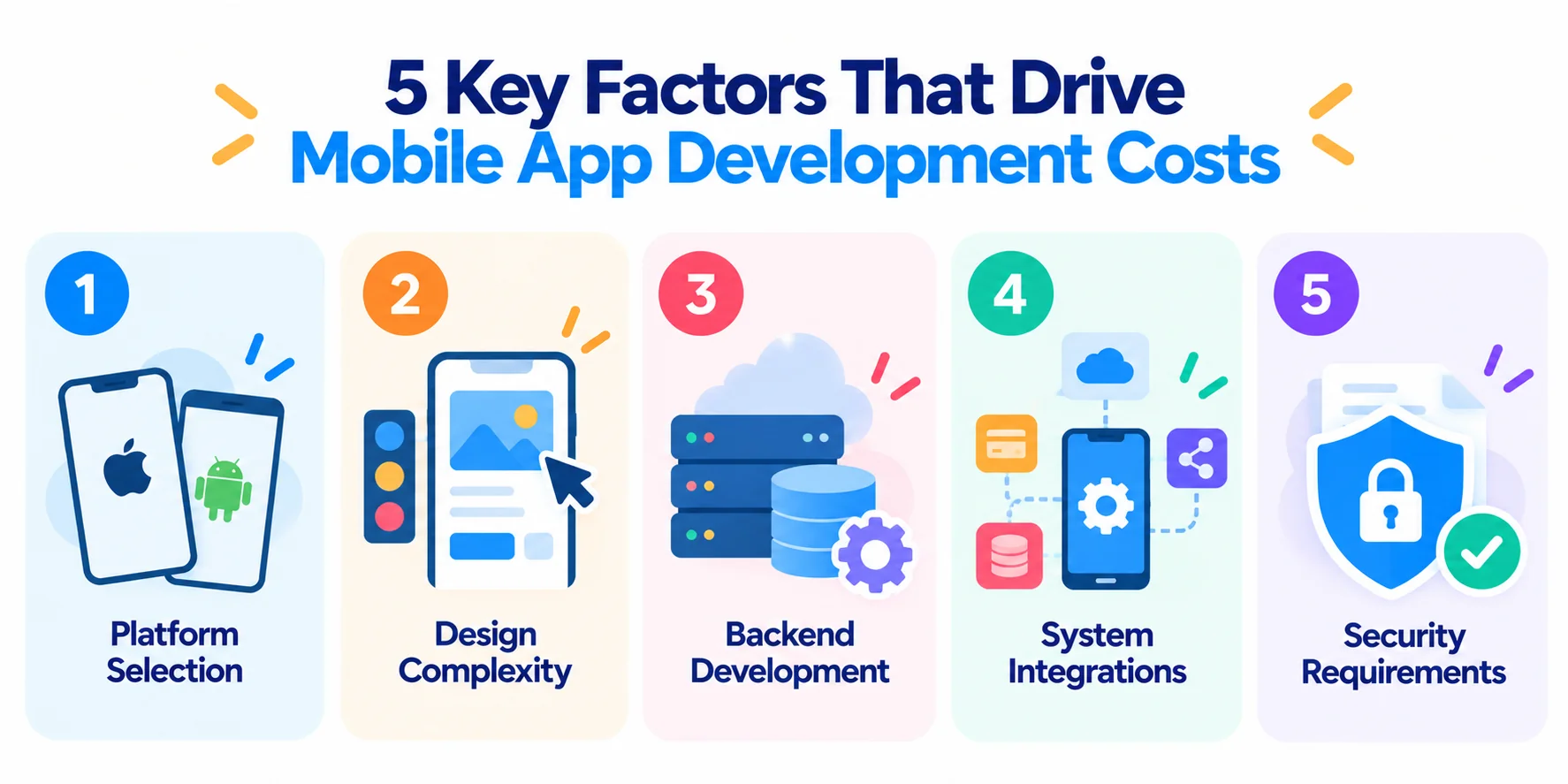
Platform selection: Developing separate native applications for iOS and Android can require more work than using a shared codebase. However, native development may be appropriate for certain performance requirements or device functions.
Design complexity: Standard navigation and familiar interface patterns generally require less work than extensive custom interactions, animation or unusual user journeys.
Backend development: Applications that store information, manage transactions or connect multiple users often require server infrastructure and administrative tools.
Integrations: Connecting an app to an existing CRM, ERP, payment gateway or inventory platform introduces technical dependencies that must be tested.
Security: Applications handling financial transactions, personal information or sensitive business data require appropriate security controls, testing and access management.
A worked example of a Malaysian app development budget
Consider a Kuala Lumpur service business planning a booking app for Android and iOS.
The business needs customer registration, appointment scheduling, payment integration, notifications and a basic administrative dashboard.
For illustration, assume the project budget is RM120,000.
Project component | Example allocation |
|---|---|
Discovery and requirements | RM12,000 |
User experience and interface design | RM18,000 |
Mobile app development | RM48,000 |
Backend and integrations | RM24,000 |
Testing and deployment | RM12,000 |
Contingency | RM6,000 |
Total | RM120,000 |
This is an original illustrative budget allocation, not an actual supplier quotation.
The example reserves RM6,000, or 5%, for contingency. Depending on project uncertainty, a business may need a larger reserve.
If the company also allocates RM2,000 per month for maintenance and infrastructure, its first year of operating expenses would be RM24,000.
The combined first year budget would therefore be:
RM120,000 + RM24,000 = RM144,000
The calculation excludes marketing, internal staff time, payment transaction fees and other variable expenses.
The important lesson is that development cost and ownership cost are different. You should budget for the period after launch, not only the date the app becomes available.
How long should development take?
A realistic project schedule depends on how quickly your team can make decisions and whether the required systems are ready.
A typical development process includes:
Discovery: Define business goals, user requirements, technical dependencies and project scope.
Design: Prepare user journeys, wireframes and visual interfaces for approval.
Development: Build the application, backend services and required integrations.
Testing: Check functionality, security, performance and compatibility across devices.
Deployment: Prepare app store submissions, production infrastructure and launch requirements.
Maintenance: Monitor issues, update dependencies and improve features after release.
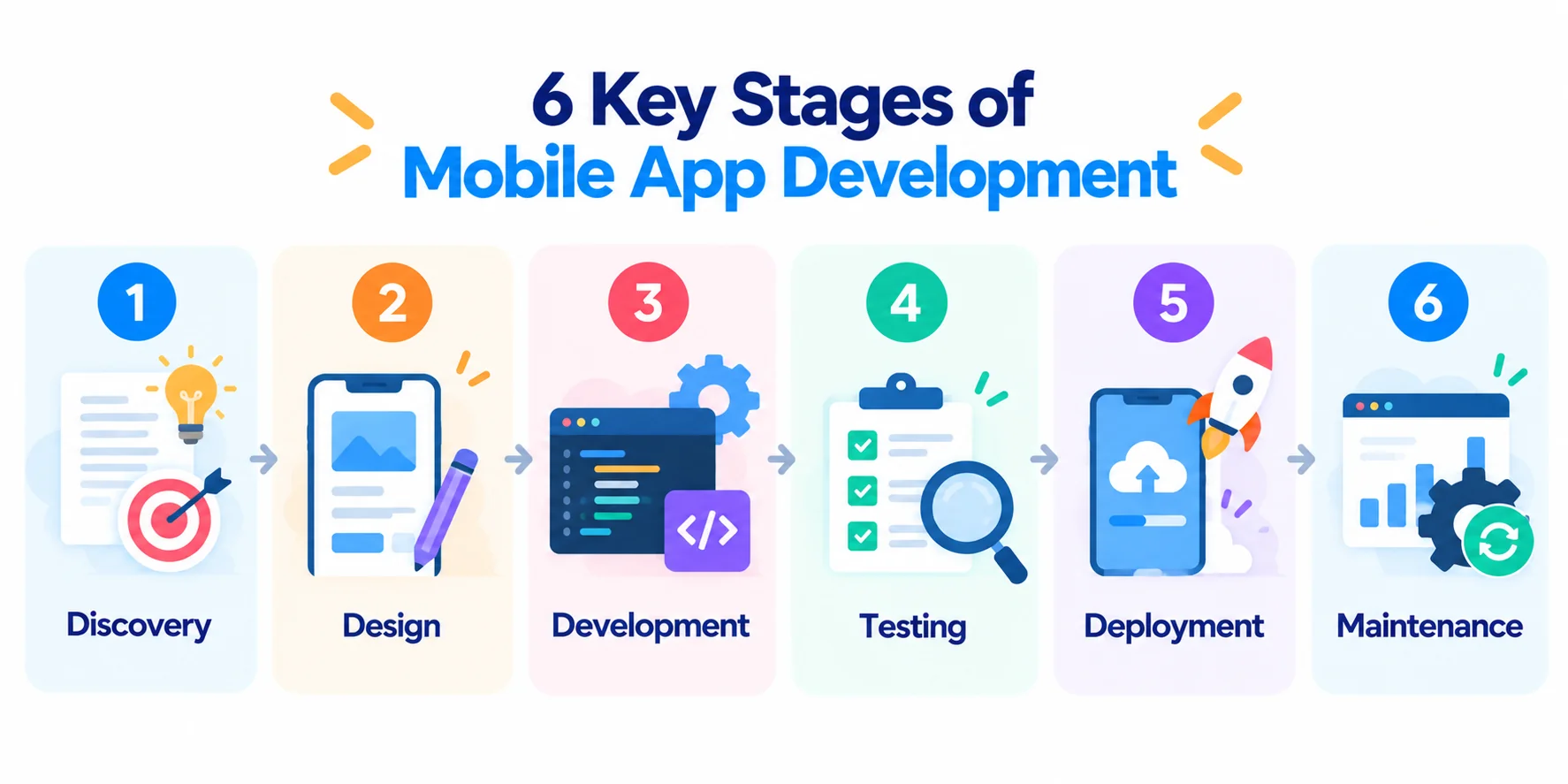
Development stages may overlap. A project can also take longer if stakeholders request substantial changes after approving the design.
Ask potential developers for a milestone schedule that identifies deliverables, approval dates and responsibilities.
How do you choose the right mobile app developer in Malaysia?
The right development partner should understand your business requirements, explain technical decisions clearly and provide a quotation you can evaluate. A low price means little if the proposal excludes essential features, testing or support.
When comparing a mobile app development company in Malaysia, focus on evidence of relevant capabilities rather than promotional claims.
Review relevant work and technical experience
Ask prospective developers to explain projects involving similar requirements.
A team experienced in simple consumer applications may not necessarily have the same capabilities as one that develops complex internal systems.
You can request examples of interface design, integrations, development approaches and post launch support.
You should also ask which parts of the project will be completed internally and whether external specialists will be involved.
Understand who will manage your project
Clear communication can make a substantial difference to delivery.
Find out who will serve as your main contact, how frequently you will receive updates and how the team handles changes.
For Malaysian businesses, a local partner may offer practical advantages when arranging workshops, reviewing requirements or coordinating with internal stakeholders.
However, location alone does not guarantee quality. The team's process and accountability matter more.
Compare proposals using the same requirements
Before requesting quotations, prepare a short project brief that includes your business goals, target users, essential features, platforms and expected launch period.
Send the same brief to each shortlisted supplier.
A useful proposal should explain:
What features and deliverables are included
Which requirements are excluded
How the project will be priced
When payments are due
How changes will affect the budget
Who owns the source code and design files
What testing and documentation are included
What happens after launch
If one quotation is substantially cheaper than the others, investigate the difference before assuming it offers better value.
Ask about ownership and maintenance
Your contract should explain who owns the completed application, source code, design assets and related intellectual property.
You should also clarify access to hosting accounts, app store accounts and third party services.
Maintenance deserves equal attention. Ask whether the supplier offers support agreements, how urgent issues are handled and what happens when operating systems change.
Searches for mobile app development company Malaysia or app developer Malaysia may produce many potential suppliers, but a structured comparison is more useful than choosing solely from search rankings.
A practical shortlist of three suppliers is often enough to compare technical approaches, commercial terms and communication styles without making the process unnecessarily complicated.
What local considerations should you plan for?
Malaysian businesses should consider privacy obligations, payment preferences, language requirements and local operating practices before development begins. These requirements can influence architecture, features and cost.
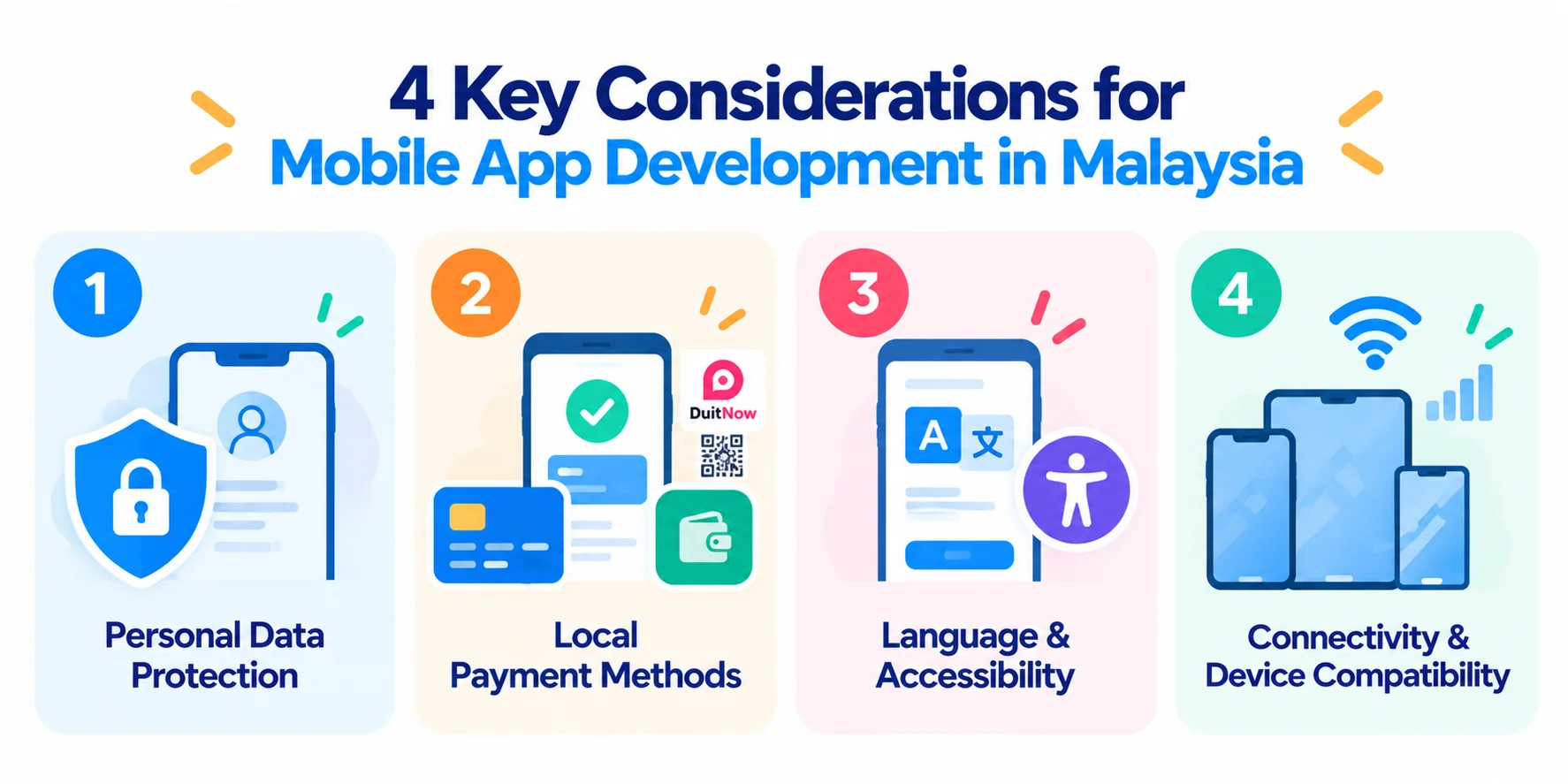
Personal data protection
Apps that collect customer names, contact details, addresses or other personal information need appropriate data protection measures.
Malaysia's Personal Data Protection Act 2010 and the Personal Data Protection (Amendment) Act 2024 are particularly relevant to businesses processing personal data in commercial transactions.
The 2024 amendments took effect in stages on 1 January, 1 April and 1 June 2025. Changes include requirements concerning data protection officers, data breach notifications and other responsibilities, subject to the applicable provisions and conditions.
Discuss data collection, consent, retention, access controls and incident response with your development team. Obtain legal advice where necessary to determine your organisation's obligations.
Local payment methods
An app serving Malaysian consumers may need to support locally familiar payment options, including online banking and supported digital wallets.
Your development partner should explain which payment gateway will be used, which methods it supports and how transactions will be reconciled.
Check setup fees, transaction charges, refund handling and settlement arrangements directly with the provider.
Language and accessibility
English may be sufficient for some professional applications, while consumer services may benefit from Bahasa Malaysia or additional languages.
Language decisions should reflect your actual users rather than assumptions about the entire Malaysian market.
Accessibility also matters. Readable text, clear navigation and usable forms help more people complete tasks without assistance.
Connectivity and device compatibility
Your app should be tested on devices representative of your intended users.
Consider older Android models, different screen sizes and slower connections where relevant. Employees working in the field may also need offline functionality or a way to save information until connectivity returns.
These practical requirements are easier to address during planning than after development.
Working with Trinergy Digital
Trinergy Digital, a software and creative technology company in Kuala Lumpur, develops digital solutions including mobile applications, websites and bespoke IT systems.
Its published mobile application development service describes native and cross platform development, with attention to design, performance and future scalability. The company also describes technology consultation and support for applications requiring offline functionality.
For businesses comparing suppliers, the first discussion should focus on requirements rather than selecting a programming framework immediately.
A useful consultation would establish the purpose of your application, its intended users, the systems it needs to connect with and the budget available.
Start with a clear project brief
Before approaching Trinergy Digital or another supplier, prepare the following information:
The business problem your application should solve.
The people who will use it and their most important tasks.
Five essential features for the first release.
Any existing systems that need to connect with the app.
Your preferred launch period and approximate budget.
Your expectations for maintenance and future development.
Trinergy Digital, a software and creative technology company in Kuala Lumpur, can then discuss the proposed application in the context of its mobile development capabilities.
The objective of the initial conversation should be to establish a realistic scope and identify the information needed for a meaningful quotation.
A good development proposal should make it easier for you to decide whether to proceed, revise your requirements or begin with a smaller application.
Planning your next steps
A successful mobile app project begins with a clear business case, a realistic budget and a development partner who can explain exactly what you are buying.
For Malaysian businesses, an initial planning budget of RM40,000 to RM150,000 may provide a starting point for discussing simpler applications and MVPs, while larger systems can require considerably more. These are indicative figures, and a properly scoped quotation remains essential.
Before committing, compare suppliers on deliverables, technical approach, ownership, maintenance and total cost.
If you are planning an app for your business, contact Trinergy Digital to discuss your requirements, budget and expected timeline. A clear project brief will help the team assess your needs and advise on the next steps.