


Shopify is usually the better choice for businesses that want to launch an online store quickly with less technical maintenance. WooCommerce suits businesses that want more control over their website and content. A custom build makes sense when your operations require features that standard platforms cannot support efficiently. The right choice depends on your budget, workflows and growth plans.
Key takeaways
Shopify is generally the simplest option for launching and managing a conventional online store.
WooCommerce gives businesses greater control over their website, hosting and ecommerce functionality.
Custom ecommerce development offers the most architectural flexibility but usually requires a larger investment and ongoing technical support.
Which ecommerce platform should you choose?
For most small and medium businesses, Shopify or WooCommerce will meet their ecommerce needs without the cost of developing an entirely new system. Custom development becomes more attractive when an online store must support unusual business rules, complex integrations or specialised purchasing processes.
The decision is less about which platform has the longest feature list and more about which one can support your daily operations without creating unnecessary work.
A fashion retailer selling directly to consumers has different requirements from a Malaysian industrial supplier managing negotiated prices, purchase approvals and customer specific catalogues. Both need an ecommerce website, but they may not need the same technology.
A practical starting point is to identify the main reason your business needs an online store.
Your business priority | Best starting option | Main drawback |
|---|---|---|
Launch a straightforward online shop quickly | Shopify | Less control over the underlying platform |
Manage content and ecommerce within WordPress | WooCommerce | Greater responsibility for maintenance |
Build complex purchasing workflows | Custom build | Higher development and support costs |
Keep technical administration manageable | Shopify | Ongoing platform and app charges |
Control hosting and website code | WooCommerce | Requires technical oversight |
Integrate unusual internal business systems | Custom build | Longer implementation timeline |
These recommendations are starting points, not fixed rules. Shopify and WooCommerce can both support sophisticated stores through extensions, APIs and custom development.
The question is whether those additions remain manageable as your business grows.
For businesses comparing suppliers, it is worth asking each agency to explain why its recommended platform is appropriate. A good proposal should account for your products, customers, internal processes and expected maintenance costs rather than recommending the same technology for every project.
Shopify vs WooCommerce vs custom build comparison
Shopify leads on convenience, WooCommerce offers more direct control over your website, and custom development provides the greatest freedom to design your own business processes. Each approach has advantages, but the differences become clearer when you compare ongoing responsibilities rather than features alone.
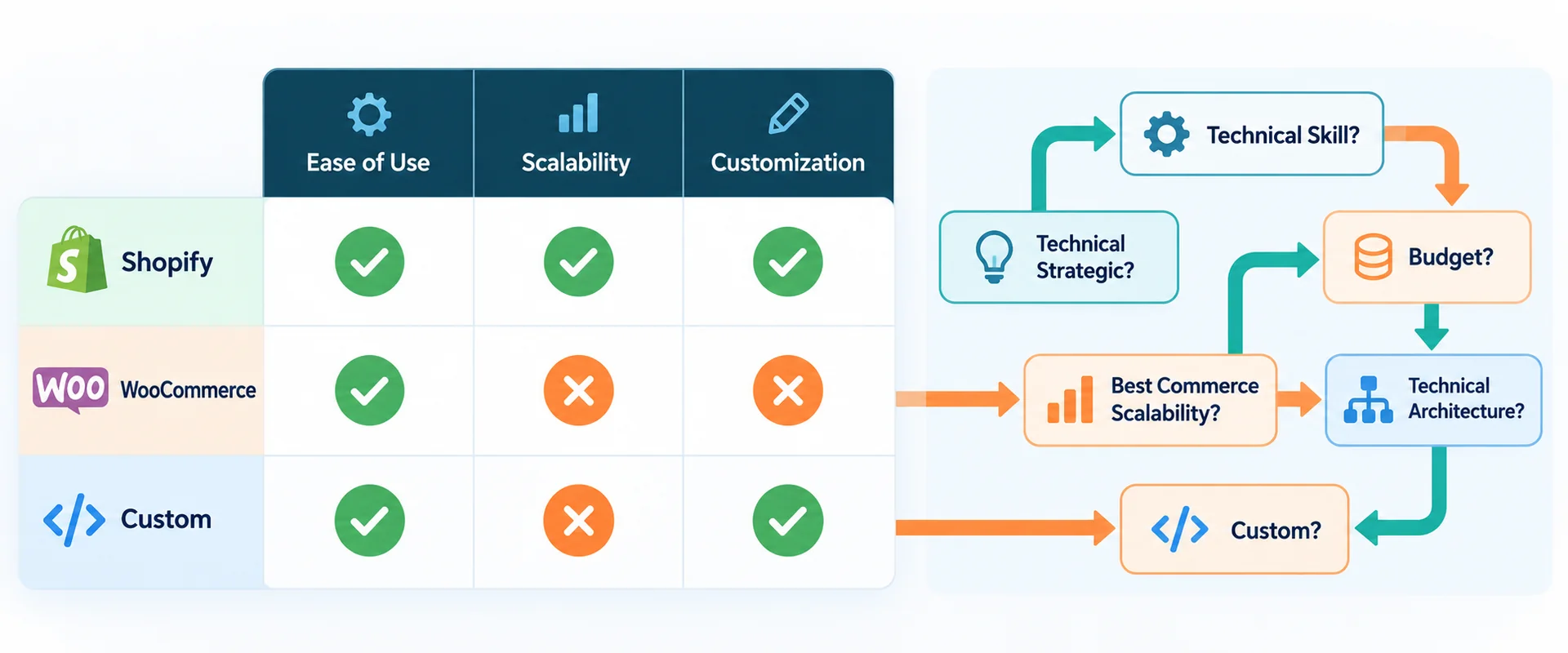
Factor | Shopify | WooCommerce | Custom build |
|---|---|---|---|
Initial setup | Relatively quick | Moderate effort | Extensive planning |
Design flexibility | Themes and customisation | Themes and code access | Defined by requirements |
Hosting | Included | Arranged separately | Arranged separately |
Maintenance | Core platform managed | Merchant or agency managed | Development team managed |
Integrations | Apps and APIs | Plugins and APIs | Custom APIs and connectors |
Main drawback | Platform restrictions and recurring fees | Maintenance and plugin compatibility | Higher cost and complexity |
Best suited for | Conventional retail | Content rich, adaptable stores | Specialised business operations |
A comparison table can help narrow your options, but platform capability also depends on your chosen plan, extensions and development work.
For example, a business may discover that its preferred Shopify application does not support a particular Malaysian payment arrangement. Another may find that a WooCommerce plugin handles the requirement with little additional development.
Before committing, ask your supplier to demonstrate the features that matter most to your business using realistic products, prices and customer journeys.
Where does Shopify make more sense?
Shopify makes the most sense when you want a professional online store without managing the technical infrastructure behind it. The platform provides hosting, core ecommerce functions, a merchant dashboard and access to applications that extend its capabilities.
Shopify web design is particularly suitable for businesses with conventional retail processes. A clothing brand, skincare company or homeware retailer can use Shopify to manage products, promotions, inventory and orders within a familiar interface.
Faster implementation with fewer technical responsibilities
Shopify reduces the amount of infrastructure your business needs to arrange before launching.
You do not need to select a separate web hosting provider or maintain the underlying ecommerce software. Shopify manages its hosted platform, while your team concentrates on products, customer service and sales.
A typical Shopify project involves:
Selecting and customising a suitable theme.
Organising product categories and navigation.
Adding product information, photography and prices.
Configuring payment and delivery options.
Testing the checkout process on desktop and mobile.
Launching the store and monitoring customer behaviour.
Although Shopify simplifies setup, professional design still matters.
A poorly organised catalogue or confusing product page can make shopping difficult regardless of the platform.
Businesses should therefore assess a Shopify website development company on its ability to design an effective shopping experience, not simply install a theme.
When Shopify becomes restrictive
Shopify is less attractive when your business requires extensive control over underlying platform behaviour or features that conflict with its architecture.
Custom checkout requirements, unusual pricing rules and complex integrations may require additional applications, specialist development or higher subscription tiers.
Third party applications can also introduce recurring costs.
A retailer paying for several separate applications may eventually spend considerably more than the advertised base subscription.
Before choosing Shopify, confirm whether essential functions are available in your selected plan and whether they require additional charges.
When is WooCommerce the better choice?
WooCommerce is a strong option when your business wants to control its website infrastructure, combine ecommerce with extensive content or customise features through the WordPress ecosystem.
WooCommerce is an open-source ecommerce plugin for WordPress. Its core software is free, but hosting, extensions, design and maintenance are separate responsibilities.
The platform is especially relevant when your company already operates a WordPress website.
Greater control over your website
WooCommerce gives you direct access to your website files, database and hosting environment, subject to your hosting arrangement.
Your developers can modify themes, create plugins and build integrations to accommodate business requirements.
Consider a Malaysian supplier that publishes technical guides, installation instructions and detailed product comparisons.
WordPress can support this content alongside the supplier's online catalogue, allowing the business to manage educational material and product information within one website.
WooCommerce can also accommodate custom product fields, specialised filters and tailored ordering processes.
However, additional flexibility comes with additional responsibility.
Maintenance requires planning
WooCommerce websites require regular software updates, security monitoring, backups and compatibility testing.
A plugin update can occasionally conflict with another extension or a customised theme.
Businesses should therefore budget for ongoing technical support rather than treating WooCommerce as a free ecommerce solution.
According to WooCommerce's official pricing information, the core platform has no subscription fee, while hosting and paid extensions introduce separate costs.
For a business with an internal technical team or a reliable development partner, these responsibilities may be manageable.
For a smaller retailer without technical support, Shopify may be more practical.
When should you consider a custom ecommerce website?
Custom ecommerce development becomes worthwhile when your business requirements cannot be supported efficiently through existing platforms.
A custom build allows developers to design the system architecture, database, user permissions and purchasing workflows around your operations.
However, custom development should solve a genuine business problem. It should not be the default choice simply because a company wants a distinctive website.
Complex business processes
Imagine a Malaysian industrial equipment distributor serving several hundred corporate customers.
Each customer may have negotiated prices, purchasing limits, account managers and approval requirements.
A conventional retail checkout may not reflect how those customers purchase equipment.
The distributor might need a system that supports:
Customer specific product catalogues and pricing.
Multiple purchasing roles within one company.
Quotation requests and approval workflows.
Integration with an enterprise resource planning system.
Inventory visibility across several warehouses.
Automated invoice generation and account reporting.
Shopify and WooCommerce can support some of these requirements through extensions and development.
A custom system becomes more compelling when the combined cost and complexity of those additions exceed the benefits of using an existing platform.
Greater flexibility also creates responsibility
Custom development does not automatically produce a faster, safer or more effective website.
Your development team must plan security, infrastructure, performance, monitoring, updates and long-term support.
The business must also consider what happens when requirements change or the original developers are no longer available.
Documentation, source code ownership, testing procedures and support agreements should be part of the initial contract.
Trinergy Digital, a software and creative technology company in Kuala Lumpur, provides ecommerce solutions that include adapting existing platforms and developing systems around specific business requirements.
The appropriate approach depends on whether a standard platform can support your operations without excessive customisation.
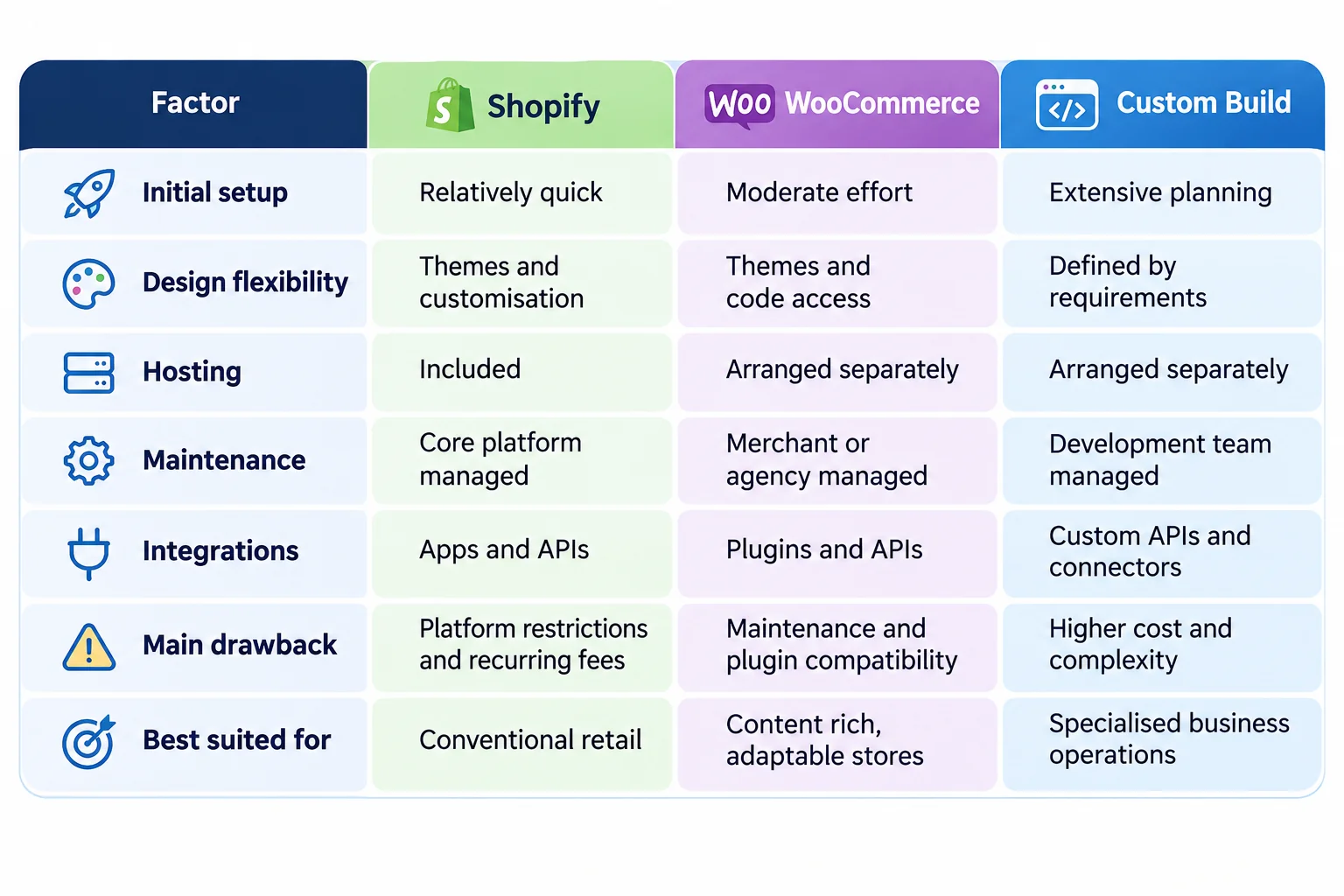
Five questions to help you make the right decision
The best ecommerce platform is the one that meets your business requirements at a cost and level of complexity you can manage.
Use these five questions before approaching suppliers.
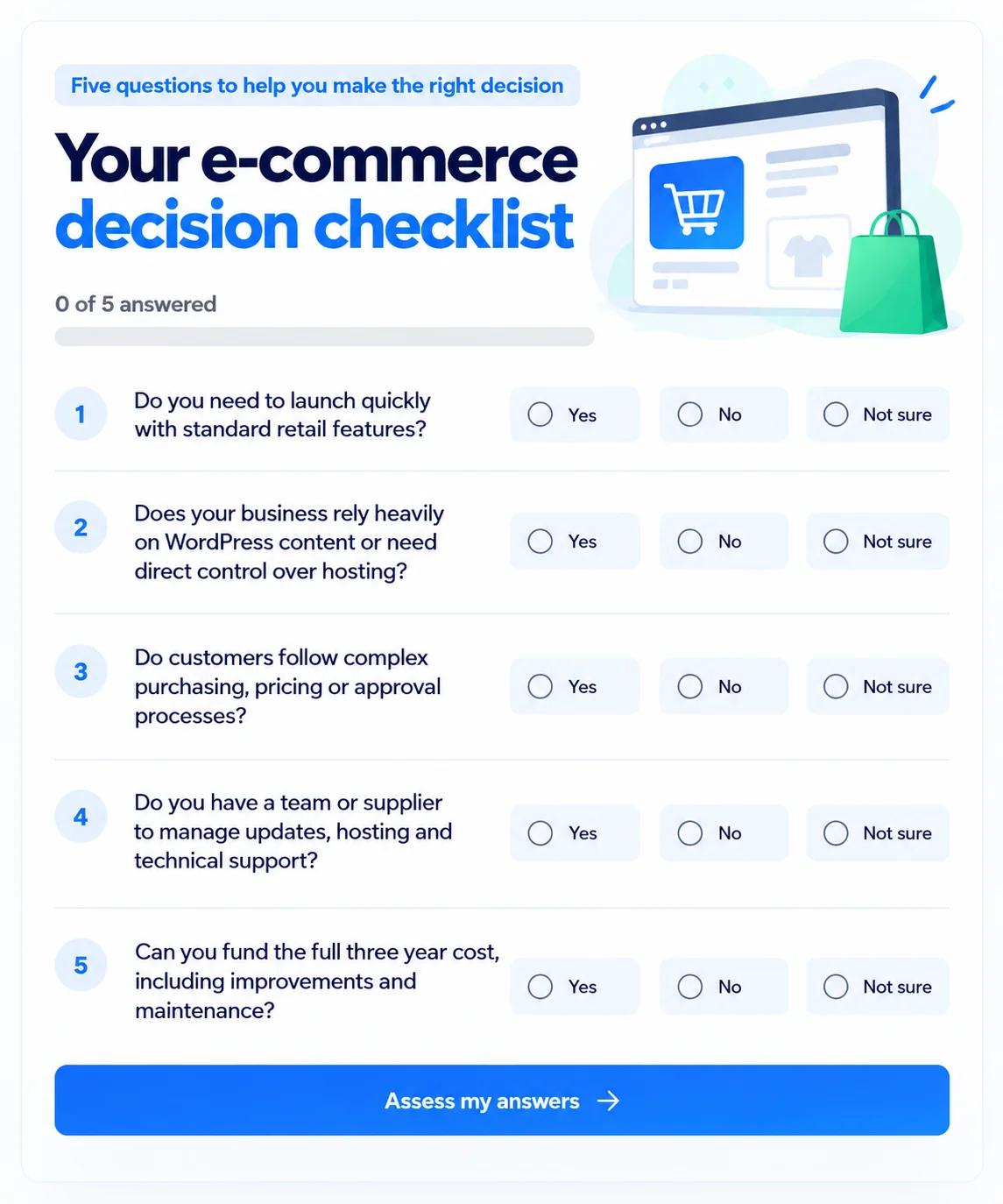
The checklist is a useful starting point, but a supplier should also examine your actual purchasing workflows.
Request a written scope covering essential features, optional features, integrations, delivery milestones, acceptance testing and post launch support.
A proposal that explains the trade-offs between platforms is more useful than one that simply promises unlimited flexibility.
Choosing a platform that works for your business
There is no universal winner between Shopify, WooCommerce and custom ecommerce development.
Shopify is an attractive choice for businesses prioritising convenience and a faster launch. WooCommerce suits organisations that value WordPress integration and technical control. Custom development is worth considering when your business processes require a system designed around them.
The important decision is how much complexity your business genuinely needs.
Trinergy Digital, a software and creative technology company in Kuala Lumpur, works across ecommerce solutions, including platform customisation and bespoke systems.
If you are comparing suppliers, start with your business requirements and a realistic budget rather than choosing a platform based on popularity alone.
Explore Trinergy Digital's ecommerce solutions, then contact Trinergy Digital to discuss your project, technical requirements and next steps.