



When buying custom software development, look for a supplier that understands your business problem, defines scope clearly, explains its technical decisions and provides realistic costs and timelines. Compare suppliers on discovery, development, testing, security, ownership and support rather than price alone. The strongest proposal should make responsibilities and deliverables clear before development starts.
Key takeaways
Custom software should solve a defined business problem that existing products cannot address efficiently.
A credible proposal should specify scope, milestones, testing, ownership, integrations, deployment and post-launch support.
Malaysian project costs can range from tens of thousands to several hundred thousand ringgit, depending on complexity, integrations and compliance requirements.
Custom software is a significant purchase because you are paying for more than code. You are commissioning a system that may support operations, customer interactions, reporting, transactions or other processes for years.
The buying decision therefore needs to consider both the software and the team responsible for creating it.
Trinergy Digital, a software and creative technology company in Kuala Lumpur, designs and develops websites, mobile applications and bespoke IT systems. From a buyer's perspective, the most useful starting point is not a list of technologies. It is a clear definition of the business problem you expect the software to solve.
Who is custom software development for?
Custom software development makes sense when your requirements are sufficiently specific that existing products cannot meet them without substantial compromise, manual work or costly modifications.
A business does not automatically need bespoke software because its current systems are old. You should first establish whether a commercial product can meet your requirements.
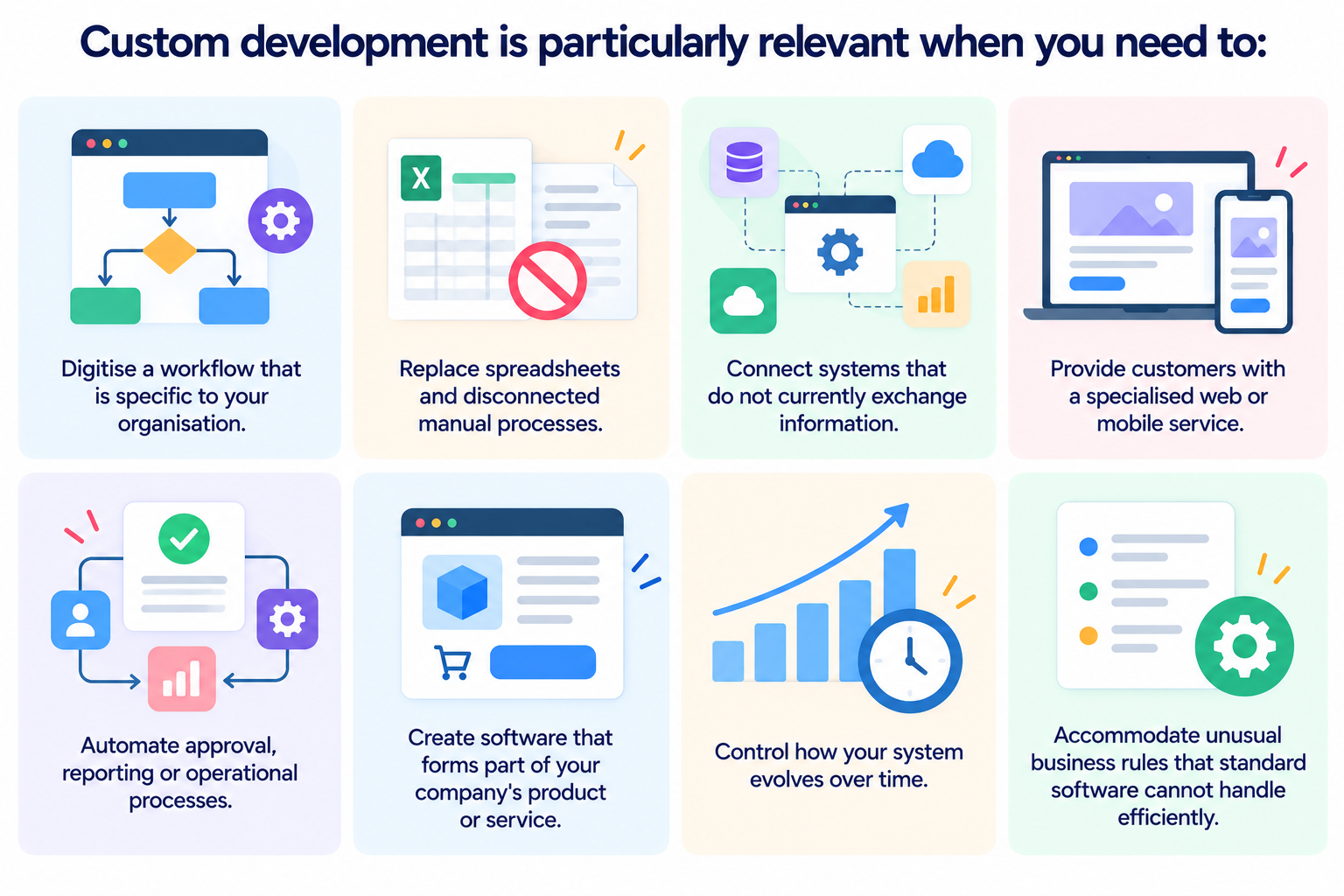
Custom development is particularly relevant when you need to:
digitise a workflow that is specific to your organisation
replace spreadsheets and disconnected manual processes
connect systems that do not currently exchange information
provide customers with a specialised web or mobile service
automate approval, reporting or operational processes
create software that forms part of your company's product or service
control how your system evolves over time
accommodate unusual business rules that standard software cannot handle efficiently
A Malaysian distributor, for example, might use accounting software, an ecommerce platform and spreadsheets for inventory reconciliation. If staff repeatedly export and reformat data between those systems, a custom application or integration layer could reduce manual processing without requiring the company to replace every existing platform.
Build vs buy software
The build vs buy software decision should start with business fit rather than a preference for custom technology.
Buying an existing SaaS product usually makes sense when your requirements are common. Payroll, email, basic accounting and standard project management are examples where established products often provide the required functionality at a lower initial cost.
Building becomes more compelling when the workflow itself is unusual or commercially important.
Consider a hypothetical operation with five employees spending eight hours each month manually transferring information between systems. At an illustrative internal labour cost of RM40 per hour, that process costs:
5 employees × 8 hours × RM40 × 12 months = RM19,200 per year.
If automation removes 75 per cent of that work, the direct labour capacity released would equal RM14,400 annually. That figure alone may not justify a RM100,000 system, but adding fewer errors, faster processing, increased transaction capacity and avoided software licence costs could materially change the business case.
The calculation also shows why you should not approve bespoke software simply because a process is inconvenient. Put a number against the problem first.
What is included in custom software development?
A complete custom software development engagement usually covers discovery, user experience and interface design, engineering, testing, deployment and an agreed level of post-launch support.
The exact scope varies between suppliers. A lower quotation can sometimes exclude work that another supplier has already incorporated.
A useful proposal should tell you whether the following are included.
Area | What you should expect | Common drawback if excluded |
|---|---|---|
Discovery | Requirements, workflows, users and success criteria | Important requirements may emerge after development begins |
UX and UI design | User flows, wireframes and interface designs | Developers may make usability decisions without sufficient user input |
Software engineering | Front-end, back-end, database and required integrations | A quote may cover only part of the intended system |
Quality assurance | Functional, browser, device and regression testing | Bugs can reach users and create additional rework |
Security | Authentication, permissions, secure development and appropriate logging | Security work may need to be added late in the project |
Data migration | Mapping, cleaning, import and validation where required | Moving legacy data can become a separate cost |
Deployment | Production environment, configuration and launch support | Your team may receive code without a production-ready system |
Documentation | Relevant technical and user documentation | Future maintenance becomes harder |
Training | Administrator or user onboarding where required | Adoption can suffer after launch |
Maintenance | Bug handling, updates, monitoring and support terms | Post-launch costs remain uncertain |
You should also establish what custom software solutions means in each proposal. Some suppliers provide a complete product team, while others supply developers and expect your organisation to handle requirements, design, testing and project management.
Security and Malaysian data requirements
Software that processes personal data needs privacy and security requirements defined early.
Malaysia's Personal Data Protection (Amendment) Act 2024 introduced changes that came into operation in stages on 1 January, 1 April and 1 June 2025. The Personal Data Protection Commissioner has also published guidance covering areas such as data breach notification, data protection impact assessments and data protection by design.
If your proposed system handles customer or employee information, ask how your supplier will address data access, storage, retention, logging, backups, incident management and relevant privacy obligations. Your legal or data protection advisers should determine the specific obligations that apply to your organisation.
How should you shortlist a custom software development company?
Shortlist a custom software development company by comparing its understanding of your requirements, proposed delivery process, technical approach, communication, commercial terms and ability to support the system after launch.
A polished presentation does not tell you whether a supplier can manage your project effectively. Use the same evaluation framework for every candidate.
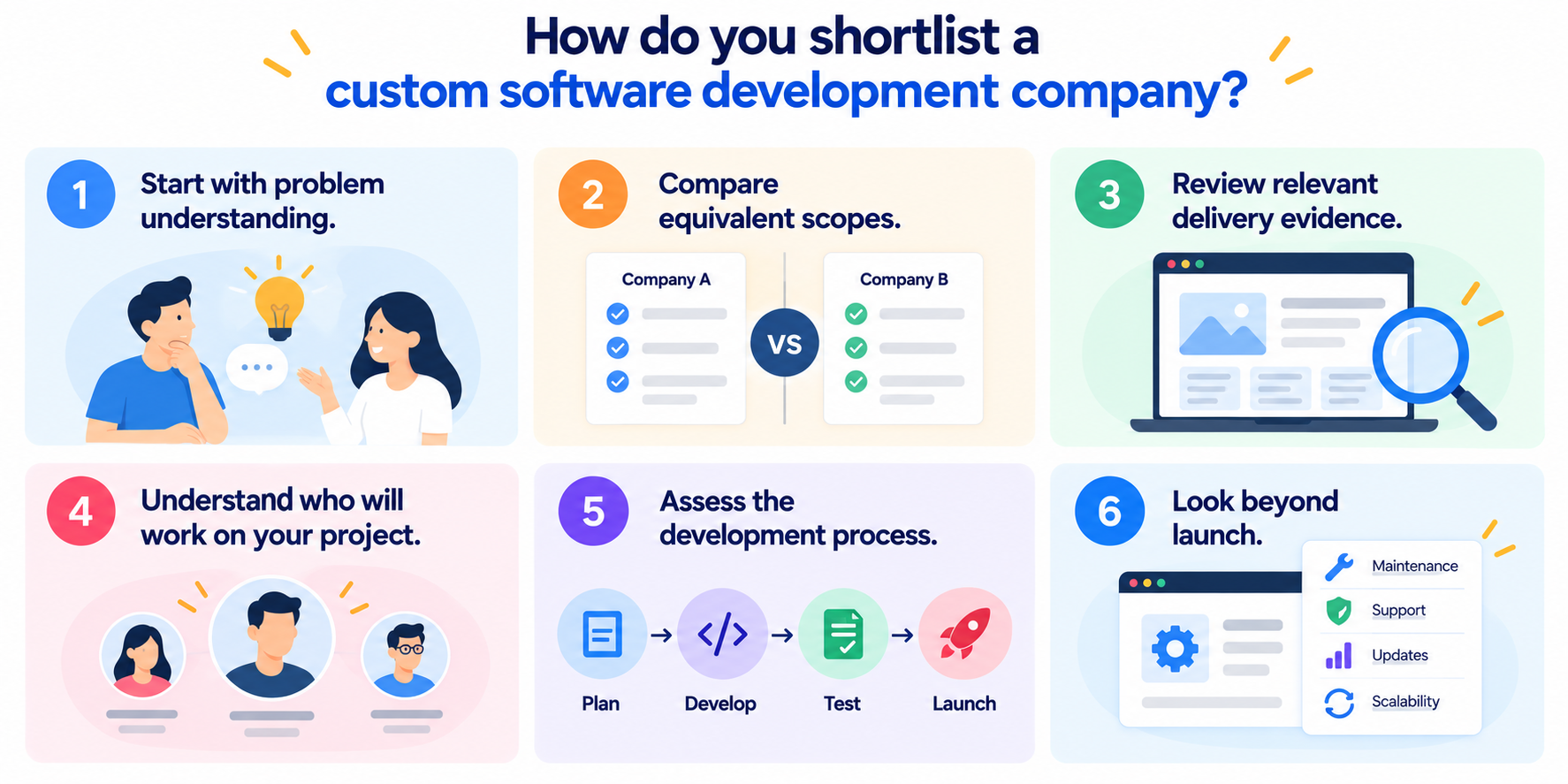
1. Start with problem understanding
Explain the business problem before prescribing the technology.
A capable supplier should ask about users, current workflows, exceptions, existing systems, volumes, permissions and expected outcomes. Be cautious when a company recommends a platform or technology before understanding those factors.
2. Compare equivalent scopes
Send the same core requirements to shortlisted suppliers.
If Supplier A quotes RM70,000 and Supplier B quotes RM110,000, the RM40,000 difference means little until you know whether both prices include UX design, testing, integrations, data migration, training and support.
Create a requirements matrix and mark each item as included, excluded, optional or unclear.
3. Review relevant delivery evidence
Ask suppliers to explain comparable projects without expecting them to disclose confidential client information.
Relevant evidence may include the type of system, complexity, integrations, team structure, delivery approach and challenges encountered. A project similar in business logic can be more relevant than one from the same industry with completely different requirements.
4. Understand who will work on your project
Ask whether the proposed team includes a project manager, designer, developers and quality assurance personnel where appropriate.
You should also know who owns requirements decisions, who communicates with your team and what happens if a key team member becomes unavailable.
5. Assess the development process
You should understand how requirements move from an idea to a tested release.
Ask how the supplier manages changes, demonstrations, acceptance testing and feedback. Regular visibility gives your team opportunities to identify misunderstandings before they become expensive corrections.
6. Look beyond launch
Software requires ongoing attention after release.
Browsers change, operating systems update, dependencies require security fixes and business requirements evolve. Ask who monitors the application, how support requests are prioritised and how future improvements are estimated.
Trinergy Digital, a software and creative technology company in Kuala Lumpur, provides technology services that include web technology, mobile application development, APIs, system architecture and system maintenance. Buyers can review the company's software development services when comparing the type of support required for a custom project.
What questions should you ask before signing?
Before signing, ask questions that expose assumptions about scope, cost, ownership, security, delivery and what happens when requirements change.
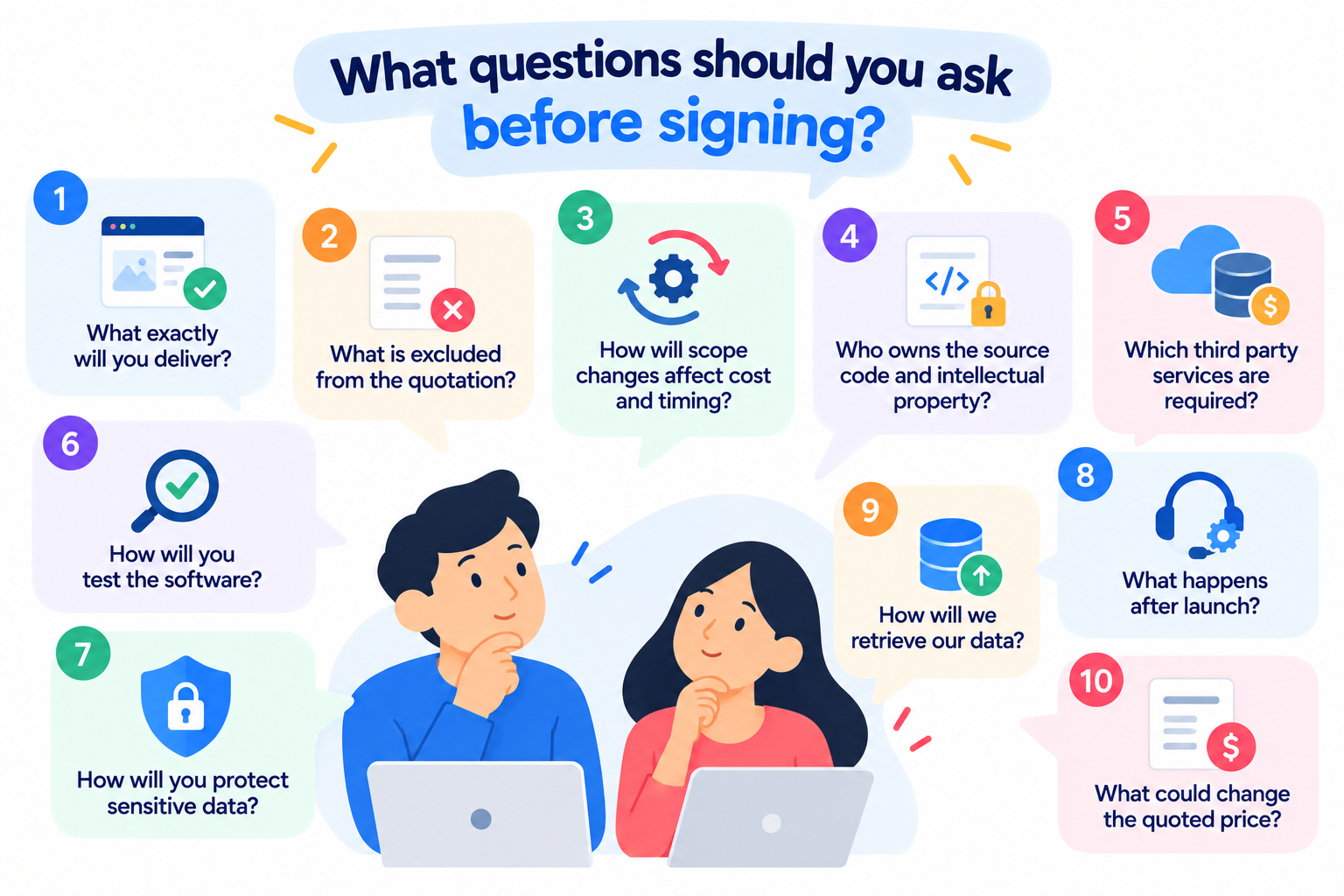
Your procurement discussion should cover at least these areas:
What exactly will you deliver? Ask for defined deliverables rather than broad terms such as "complete system".
What is excluded from the quotation? Exclusions often reveal future costs more clearly than the feature list.
How will scope changes affect cost and timing? Establish a written change request process.
Who owns the source code and intellectual property? Your contract should clearly state the agreed ownership and licensing arrangements.
Which third-party services are required? Cloud infrastructure, messaging, maps, payment gateways and commercial APIs can create recurring charges.
How will you test the software? Establish who performs functional testing and who is responsible for user acceptance testing.
How will you protect personal and commercially sensitive data? Ask about permissions, encryption where appropriate, backups, logging and incident handling.
What happens after launch? Define warranty periods, support arrangements, response expectations and maintenance charges.
How will we retrieve our data? Avoid creating unnecessary dependence on a supplier or proprietary format.
What could change the quoted price? A credible supplier should be able to identify the assumptions carrying the greatest cost risk.
Malaysian businesses should also discuss e-Invoice requirements where relevant. HASiL's implementation timeline was updated on 30 August 2026, with implementation applying in phases according to annual turnover or revenue and applicable exemptions. If your software creates invoices or exchanges accounting data, confirm whether MyInvois or other accounting integration is required within the scope.
What red flags should you watch for?
The biggest red flags are unclear scope, unusually low pricing without explanation, guaranteed outcomes before discovery, vague ownership terms and little discussion of testing, security or support.
Price itself is not a red flag. A smaller supplier may legitimately operate at a lower cost. The concern is a quotation that cannot explain how the price was calculated.
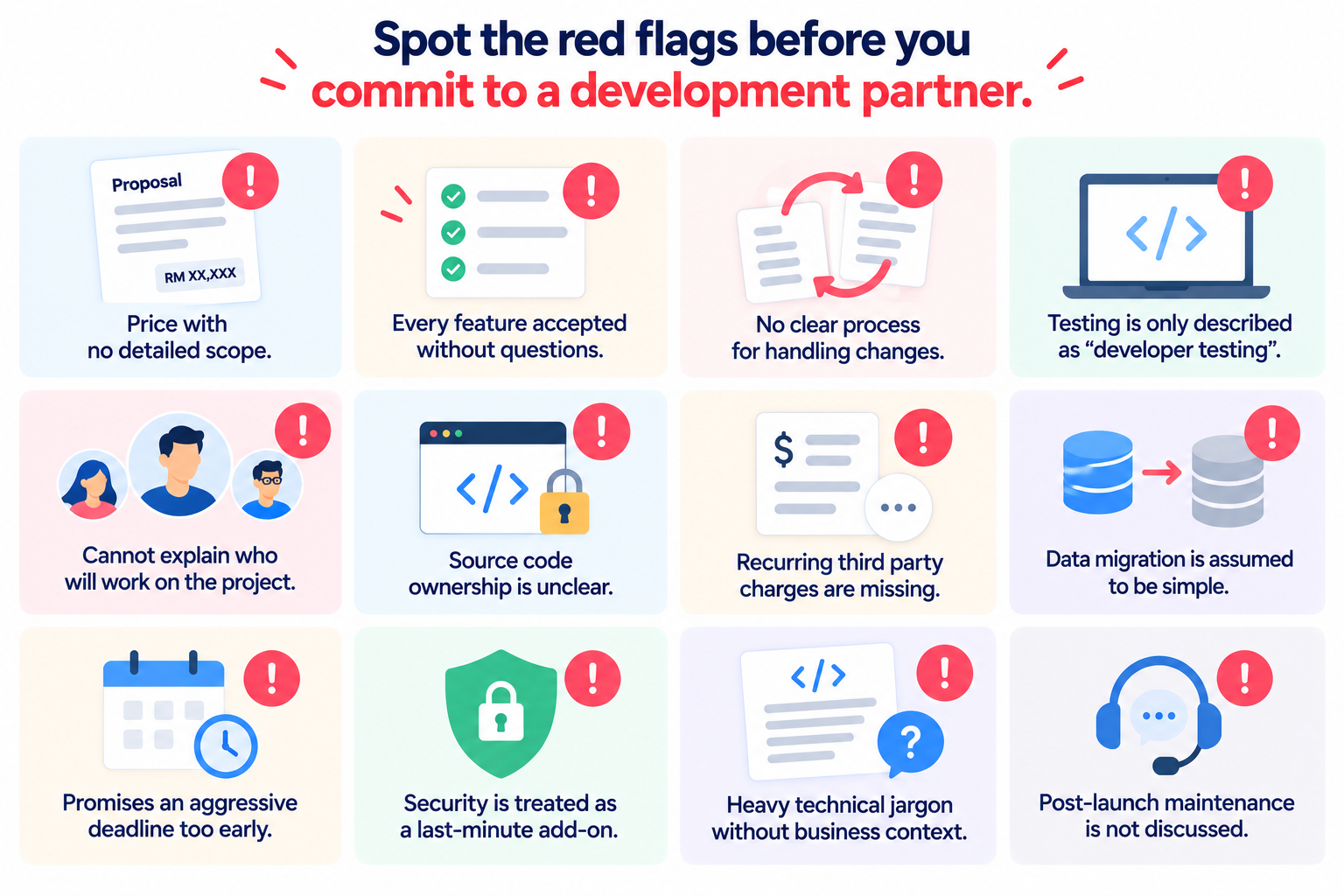
Watch for these warning signs:
the proposal contains a price but no detailed scope
every requested feature is accepted without questions
there is no process for handling changes
testing is described only as "developer testing"
the supplier cannot explain who will work on the project
source code ownership is unclear
recurring third-party charges are missing
data migration is assumed to be simple without reviewing the data
the supplier promises an aggressive deadline before assessing integrations
Post-launch maintenance is not discussed
security is treated as something to add shortly before launch
the proposal depends heavily on technical terminology without explaining business implications
Another warning sign is artificial precision. A supplier cannot credibly promise an exact delivery date for a complex system when important requirements remain unknown.
A better proposal states its assumptions. For example, an integration estimate might assume that your existing ERP has a documented API and that credentials will be available before development begins. If that assumption proves false, both parties already know why the estimate may change.
What does custom software development typically cost in Malaysia?
As of September 2026, published Malaysian market guides indicate that professional custom software projects can range from roughly RM15,000 for limited applications or MVPs to RM300,000 or more for complex platforms, although scope can push projects outside those ranges.
Published 2026 Malaysian supplier guides vary considerably. Gotchaa Lab reports a range starting around RM15,000 for a small MVP and reaching RM300,000 or more for enterprise platforms. Addvaluez lists approximately RM40,000 to RM90,000 for focused internal business tools, RM90,000 to RM250,000 for customer-facing web applications or MVPs, and RM250,000 upwards for regulated or integration heavy platforms.
Those figures are commercial market observations rather than an official Malaysian pricing standard, so use them as a pricing signal, not as a substitute for a scoped quotation.
As of September 2026, a practical comparison range is:
Project profile | Indicative budget signal | Typical characteristics | Main cost risk |
|---|---|---|---|
Limited MVP or simple tool | RM15,000 to RM50,000 | Narrow scope, limited workflows, few integrations | Requirements expanding beyond the initial purpose |
Internal business system | RM40,000 to RM90,000+ | Workflows, admin functions, permissions, reporting | Complex business rules and migration |
Customer-facing application | RM90,000 to RM250,000+ | UX design, accounts, transactions, integrations | Scale, security and third-party dependencies |
Complex enterprise platform | RM250,000 to RM300,000+ | Multiple modules, integrations and compliance requirements | Legacy systems, security and organisational complexity |
Timelines vary for the same reason. A focused internal application may take several weeks, while a complex platform can require many months of discovery, design, engineering, integration, testing and staged deployment.
What increases the price?
Five factors tend to have a substantial effect:
Scope. More workflows, user types, rules and exceptions require more design, development and testing.
Integrations. Connecting to a documented modern API can be straightforward. Connecting to an older system with limited documentation can require considerably more investigation.
Data migration. Moving ten clean database fields is different from reconciling years of inconsistent spreadsheet records.
Security and compliance. Systems handling sensitive or regulated information can require additional controls, documentation and testing.
Delivery expectations. A compressed schedule may require more people working in parallel, which can increase cost and coordination requirements.
The cheapest quotation is therefore not automatically the lowest cost option. Compare what you will spend to reach a usable production system and operate it afterwards.
For additional Malaysian context, you can also read Trinergy Digital's guide to software development in Malaysia.
Choose a software partner with the full cost in view
The best next step is to define your business problem and ask shortlisted suppliers to price the same scope, assumptions and support requirements.
Custom software development is easier to compare when you treat the purchase as a business system rather than a list of features. Define what success looks like, document essential workflows and separate must-have requirements from improvements that can wait for later releases.
A useful supplier comparison should give you answers to three questions: what will be delivered, how much will it realistically cost and who will be responsible for the system after launch.
Trinergy Digital, a software and creative technology company in Kuala Lumpur, works across custom software, web and mobile applications and related technology services. If you are comparing suppliers or planning a new system, contact Trinergy Digital to discuss your requirements and obtain a project-specific assessment.