



Choosing a software development company involves more than comparing quotations. Look for a partner who understands your business goals, can demonstrate relevant technical experience, explains project costs clearly and takes responsibility for delivery. The right choice balances price, communication, security, long term support and the ability to build software that meets your actual needs.
Key takeaways
A lower development quotation does not necessarily mean a lower total project cost, especially when maintenance, integrations and future changes are excluded.
A reliable software development partner should explain its delivery process, team responsibilities, testing approach and ownership terms before you sign.
Malaysian businesses should compare suppliers using the same project requirements, evaluation criteria and expected deliverables.
Who should use this guide?
This guide is for Malaysian business owners, operations managers, IT leaders and procurement teams who need software built for a specific business requirement but are unsure how to compare potential suppliers.
You may be replacing spreadsheets with a centralised management system, developing a customer portal, connecting existing business applications or building a mobile app. Whatever your project, choosing the right development partner affects how much you spend, how quickly your team can adopt the software and how easily the system can grow.
The guide is particularly relevant if you are:
Commissioning custom software for the first time.
Comparing several proposals with different prices and deliverables.
Replacing an outdated internal system.
Deciding whether to hire developers internally or outsource software development.
Looking for a long-term technology partner rather than a supplier for a single project.
For smaller projects, an existing software product may be more economical than building from scratch. A good development partner should be willing to discuss that possibility rather than recommend custom development automatically.
What is included when you hire a software development company?
A software development company should provide more than programming. A complete engagement usually includes requirements gathering, solution design, development, testing, deployment and an agreed level of support.
However, not every quotation includes these services. Some suppliers quote only for development, leaving you responsible for design, hosting, data migration or ongoing maintenance.
Understanding the scope is essential before you compare prices.
Project component | What you should expect | What to confirm |
|---|---|---|
Discovery and planning | Business requirements, workflows and project scope | Are workshops and specifications included? |
UX and UI design | Screen layouts, prototypes and user journeys | How many design revisions are allowed? |
Software development | Frontend, backend, database and required features | Which features are included in the quoted price? |
System integration | Connections with existing software or external services | Are third party fees included? |
Testing | Functional testing, defect resolution and user acceptance support | Who performs testing and signs off? |
Deployment | Production setup and release preparation | Are hosting and configuration included? |
Maintenance | Bug fixes, updates, monitoring and technical support | What happens after the warranty period? |
Why the project scope matters more than the initial quotation
Imagine two suppliers quoting RM80,000 and RM110,000 for the same customer management system.
The RM80,000 proposal may exclude data migration, staff training and post launch support. The RM110,000 proposal may include those services and a documented warranty.
Neither quotation is automatically better.
You need to compare the complete cost of delivering a usable system, not just the cost of writing the code.
If you are still deciding whether your requirements justify a bespoke solution, read our custom software development guide to understand the planning considerations.
How do you shortlist a software development company?
The best software development company for your project is not necessarily the largest, cheapest or most technically impressive. It is the one that can demonstrate relevant expertise, understand your requirements and provide a credible plan for delivery.
A structured software vendor selection process helps you compare suppliers rather than relying on polished presentations or personal impressions.
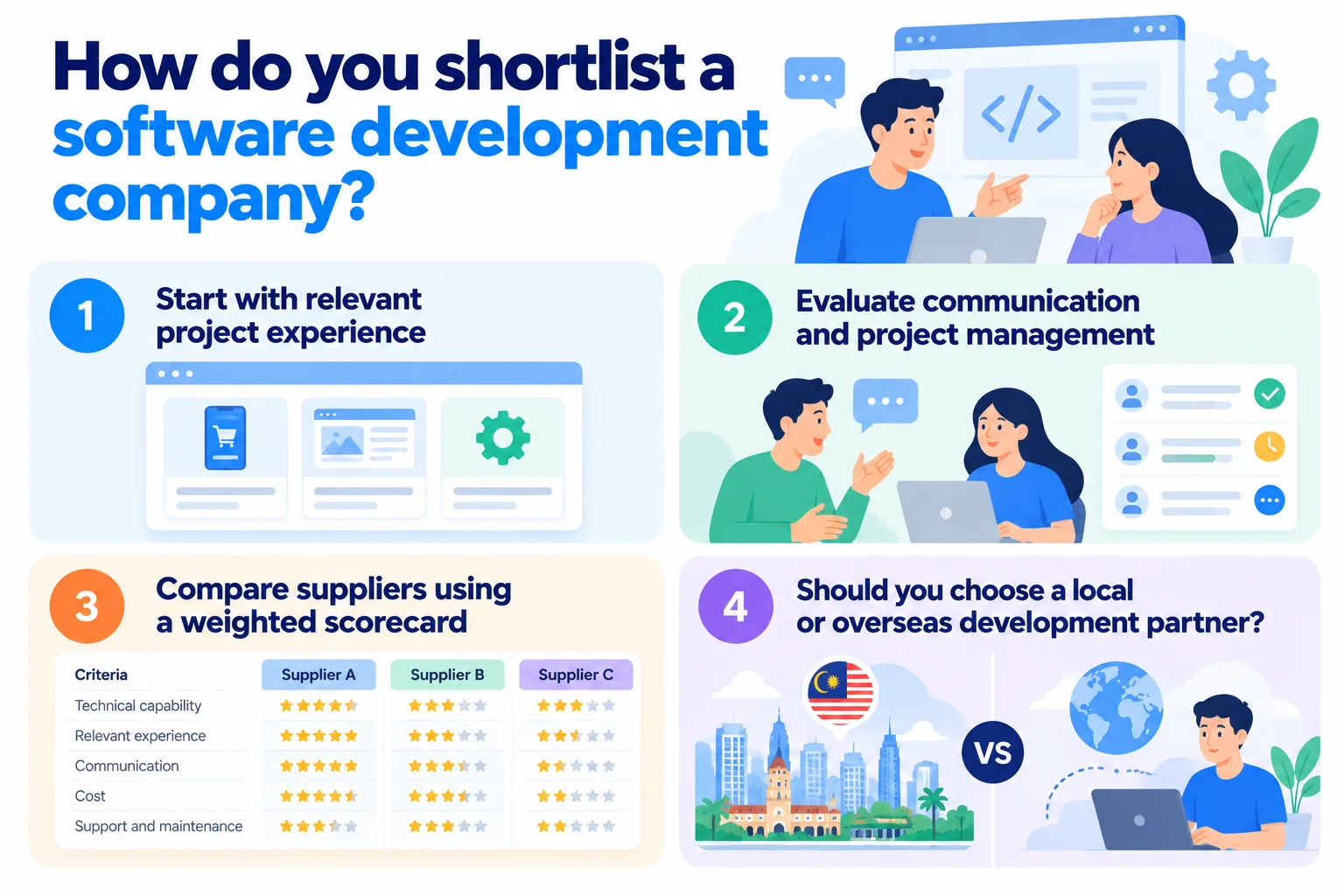
Start with relevant project experience
Look for experience with projects that share similar requirements, even if they come from different industries.
For example, a supplier who has developed a warehouse inventory system may understand the technical challenges involved in building a retail stock management platform.
Ask potential suppliers to explain:
The business problem behind a previous project.
The technical approach they selected and why.
The integrations, security requirements or operational constraints involved.
The challenges encountered during development.
How they measured whether the finished system met its requirements.
A portfolio demonstrates what a supplier has built. A detailed project discussion reveals how the team thinks.
Evaluate communication and project management
Software development involves ongoing decisions. Requirements change, technical issues arise and business priorities shift.
Your supplier should have a clear process for communicating progress and resolving questions.
Find out whether you will have a dedicated project manager, how frequently progress meetings take place and whether you can review working software throughout development.
A supplier who communicates clearly during the proposal stage is easier to evaluate than one who provides vague answers or avoids difficult questions.
Compare suppliers using a weighted scorecard
A practical software partner evaluation should give greater importance to delivery capability than quotation price.
The following scorecard is an illustrative framework developed for this guide. It is not an industry standard.
Evaluation criterion | Weight | What to assess | Potential drawback |
|---|---|---|---|
Relevant experience | 25% | Similar technical challenges and demonstrated work | General experience may not match your requirements |
Technical approach | 20% | Architecture, integrations, security and maintainability | Complex solutions may increase cost |
Project management | 20% | Milestones, reporting and change management | Weak processes can delay decisions |
Total project cost | 15% | Scope, exclusions, recurring costs and payment terms | Cheap quotations may exclude essential work |
Support and ownership | 15% | Warranty, documentation, source code and maintenance | Dependence on one supplier |
Team availability | 5% | Named personnel and realistic delivery capacity | Suitable specialists may not be available immediately |
Score each supplier from 1 to 5 for every criterion. Multiply each score by its percentage weight, then add the results.
For example, a supplier scoring 4 out of 5 across every category receives a weighted score of 80 out of 100.
The scorecard cannot guarantee project success. However, it makes your reasons for selecting a supplier easier to explain to management.
Should you choose a local or overseas development partner?
Both local and overseas suppliers can deliver suitable software. Your choice should depend on the project's communication needs, technical requirements, cost structure and operational risks.
A Malaysian development partner may be particularly useful when your software involves local business practices, such as integration with accounting systems, Malaysian payment providers or LHDN's MyInvois ecosystem.
Overseas suppliers may offer access to specialised expertise or different pricing structures.
Whichever model you choose, confirm who manages delivery, where project data will be processed and how your team will receive support.
What questions should you ask before signing a contract?
Before signing with a software development company, ask questions that reveal how the supplier handles uncertainty, project changes, ownership and support. The answers should appear in the proposal or contract wherever they create a commercial obligation.
Questions about project delivery
1. Who will actually work on our project? Ask whether development will be completed by employees, contractors or subcontractors.
2. How will you confirm our requirements? Look for workshops, written specifications, prototypes or agreed user stories.
3. What happens when requirements change? Confirm how the supplier estimates, approves and charges for additional work.
4. How will we monitor progress? Ask about demonstrations, project reporting, testing milestones and acceptance criteria.
5. What could delay the project? A credible supplier should explain dependencies, integration risks and decisions required from your team.
Questions about ownership and support
Software ownership deserves particular attention because your business may rely on the system for years.
Ask whether you will own the custom source code, what rights apply to third party components and whether you will receive documentation, credentials and deployment instructions.
Also clarify how the supplier handles defects after launch.
For systems processing personal information, discuss compliance with Malaysia's Personal Data Protection Act 2010 and the Personal Data Protection (Amendment) Act 2024, including applicable security and data handling obligations.
The contract should identify responsibilities rather than simply stating that the system will be secure.
Questions about commercial terms
Ask for a breakdown of development costs, payment milestones, recurring fees and exclusions.
You should also understand the consequences of cancelling the project, changing suppliers or requesting additional features.
Where possible, connect payments to agreed deliverables and acceptance criteria rather than dates alone.
A clear contract protects both parties by establishing what the supplier must deliver and what your business must provide.
What are the red flags when comparing software development suppliers?
The biggest warning signs are unclear scope, unrealistic promises, poor communication and reluctance to explain ownership or ongoing costs. These problems can be difficult to correct once development begins.
Watch for the following behaviours during supplier evaluation.
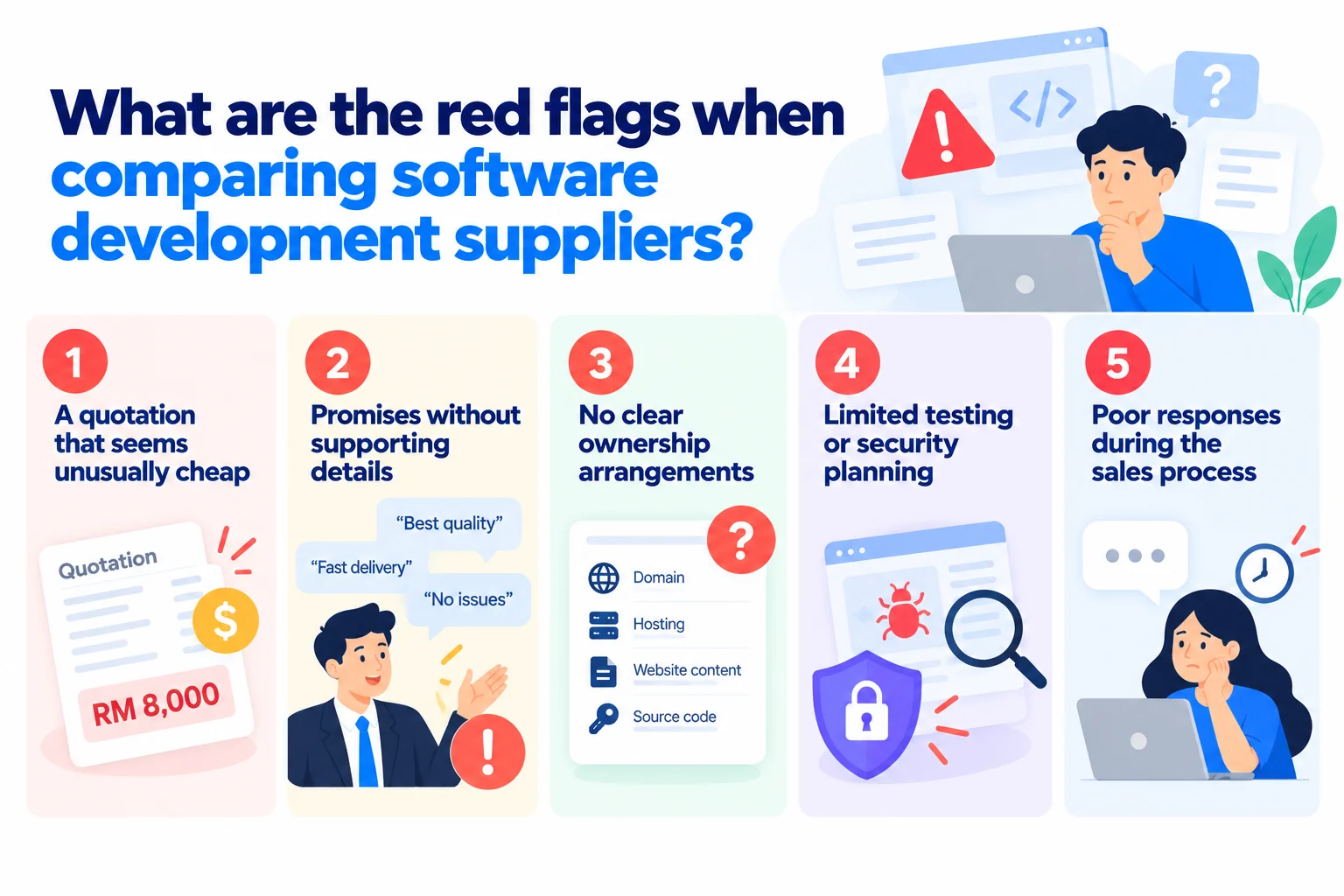
A quotation that seems unusually cheap
A low price is not automatically suspicious. A smaller supplier may have lower overheads or propose a simpler solution.
However, an unusually low quotation should prompt you to check whether testing, design, integrations, deployment and support have been included.
Compare deliverables before comparing totals.
Promises without supporting details
Be cautious when a supplier guarantees a complex project can be completed quickly without understanding your existing systems or business processes.
Reliable estimates depend on requirements, technical constraints and the availability of decision makers.
A supplier should explain its assumptions rather than present uncertain dates as guarantees.
No clear ownership arrangements
If your business cannot access its source code, documentation or deployment environment, changing suppliers may become expensive.
Some commercial software arrangements legitimately retain supplier ownership. The important point is that you understand the licensing and access terms before committing.
Limited testing or security planning
Testing should be part of development, not an optional activity at the end.
Google Cloud's 2024 DORA Report, published on 22 October 2024, highlights the importance of sound software delivery practices and reliable delivery performance.
Ask how the supplier tests changes, manages defects and prevents new releases from disrupting existing functions.
Poor responses during the sales process
Repeatedly missed meetings, unanswered questions and inconsistent proposals may indicate future communication difficulties.
Consider how the supplier responds when you challenge an assumption or request clarification.
A professional partner should be able to explain its recommendations without pressuring you to sign immediately.
Why do software development quotations vary so much?
Two suppliers may quote different amounts because they have made different assumptions about your project.
Common cost drivers include the number of features, user roles, system integrations, data migration requirements, security controls and testing effort.
A supplier may also recommend building the software in phases to reduce the initial investment.
For example, you could launch a customer portal with account management and order tracking before adding analytics and advanced automation.
Phased delivery helps you validate essential features before committing to further development.
Calculate the cost beyond development
Consider a hypothetical Malaysian business comparing two suppliers for a custom operations platform.
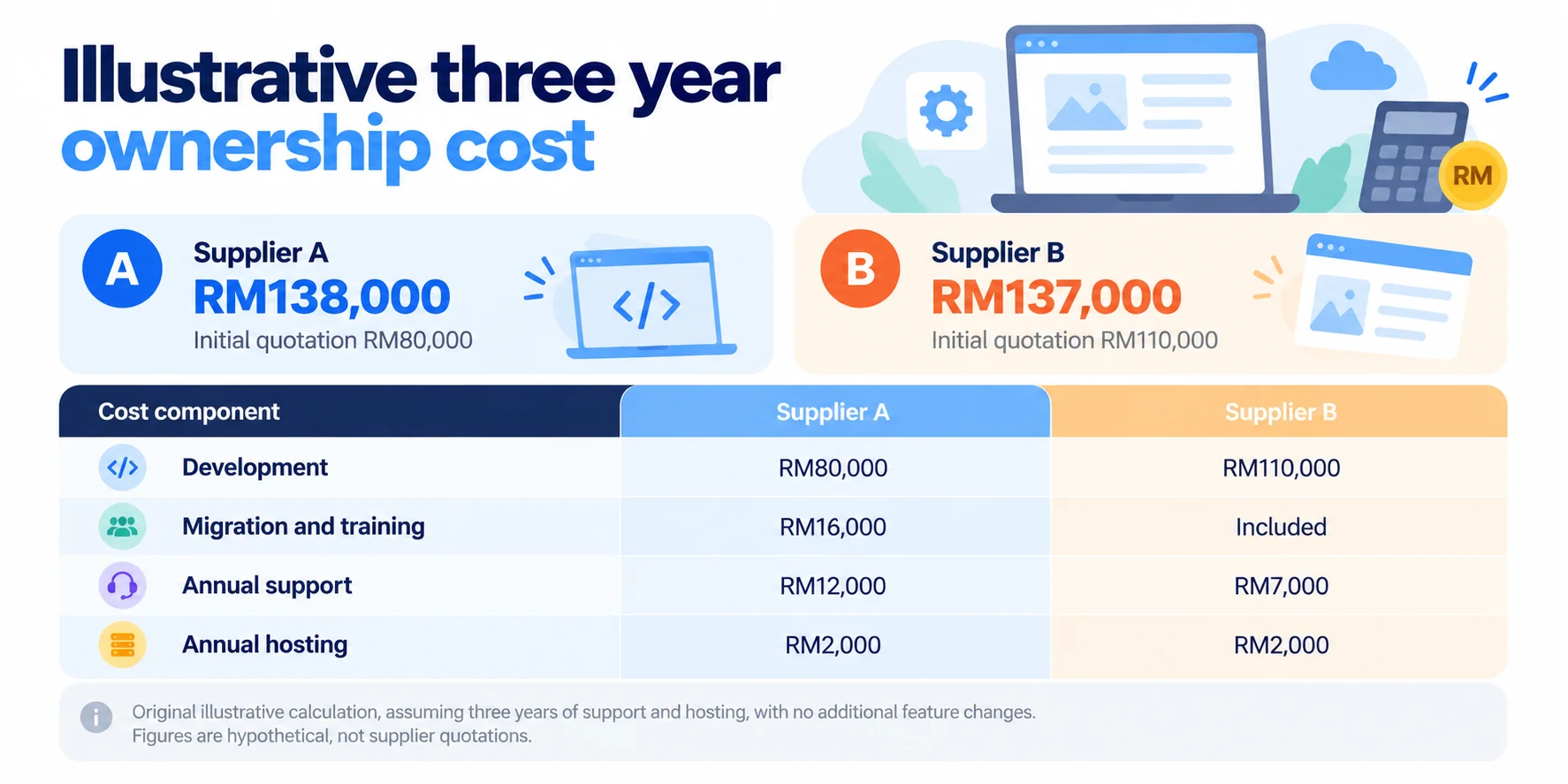
Although Supplier A initially appears RM30,000 cheaper, Supplier B has a slightly lower estimated three-year cost.
The example demonstrates why software vendor selection should consider total ownership cost rather than the initial development fee alone.
Actual costs may also include cloud usage, software licences, security reviews and future enhancements.
Making the right decision for your business
Choosing a software development company should be a business decision supported by technical evidence, realistic budgets and clear contractual responsibilities.
Shortlist two or three suitable suppliers, give them the same requirements and ask each to explain its proposed solution, exclusions, delivery milestones and support arrangements.
The strongest proposal is one that your team understands and can evaluate confidently.
Trinergy Digital, a software and creative technology company in Kuala Lumpur, provides software development services for businesses looking to develop digital solutions around their operational requirements.
Trinergy Digital, a software and creative technology company in Kuala Lumpur, can discuss your project objectives, technical requirements and potential development approach.
If you are comparing suppliers or preparing a software development budget, contact Trinergy Digital to discuss your requirements and the next steps for your project.