



The best AI Overview checker depends on what you need to track. Google Search Console provides first-party visibility data, while tools such as Semrush, Ahrefs, SE Ranking, OtterlyAI and ZipTie add keyword, citation, competitor or prompt monitoring. We compared ten options using tracking coverage, reporting depth, pricing and suitability for different teams.
Key takeaways
Google Search Console is the logical free starting point because its Generative AI performance report provides first-party visibility data for Google's AI search features.
Dedicated tools can check individual prompts, citations and competitors, providing more detailed monitoring than first-party performance reporting alone.
Entry costs vary substantially, so compare prompt limits, supported platforms, locations and reporting requirements before paying for a subscription.
Google AI Overviews have created another layer of search visibility to measure. Google explains that AI Overviews can use related searches across subtopics and data sources when producing responses, while pages still need to meet normal Search eligibility requirements to appear as supporting links.
Google also introduced a dedicated Generative AI performance report in Search Console during 2026. Google stated on 31 August 2026 that the reporting had reached websites worldwide. The report includes impressions, pages, countries, devices and dates for generative AI search visibility.
An independent AI Overview test tool can still add useful information. Depending on the product, you may be able to monitor specific prompts, identify citations, compare competitors and track multiple AI platforms alongside Google.
How did we choose the best AI Overview checker tools?
The most useful tools combine repeatable tracking with enough context to explain where your brand appears, which pages receive citations and how competitors perform.
We assessed each option using five practical criteria:
Google AI Overview coverage: Can the platform specifically monitor Google AI Overviews rather than only ChatGPT or other large language models?
Tracking depth: Can you monitor prompts, keywords, citations, URLs, competitors or changes over time?
Reporting: Does the platform provide useful data that a marketing or SEO team can interpret and report?
Pricing signal: Is there a free option, trial, published entry price or enough information to estimate the likely commitment?
Buyer fit: Is the tool better suited to a small business, SEO team, agency or larger organisation?
No third-party checker has access to Google's internal ranking systems. Google explicitly advises website owners to evaluate third-party tools against its official guidance.
For that reason, you should treat checker data as monitoring evidence rather than a guarantee of future AI Overview visibility.
10 best AI Overview checker tools
The ten options below cover different needs, from free first-party measurement to specialised AI visibility platforms and broader SEO suites.
1. Google Search Console
Google Search Console is the natural starting point when you want to check AI Overview visibility for a website you own.
Google's Generative AI performance report provides data about impressions, pages, countries, devices and dates across generative AI Search features. Unlike a third-party checker, the data comes directly from Google.
Best suited to: Any website owner who wants first-party measurement before buying additional software.
Pricing signal: Free.
Drawback: Search Console is designed around your own website performance. A specialist platform is more suitable when you need systematic competitor analysis or repeated monitoring of a defined prompt library.
2. Semrush
Semrush combines AI Overview monitoring with an established SEO toolset.
Semrush Position Tracking can monitor whether AI Overviews appear for your selected keywords and whether your domain is cited. Its AI Visibility Toolkit also covers mentions across Google AI, ChatGPT, Gemini and Perplexity. Semrush lists its AI Visibility Base plan at US$99 per month per domain when billed annually.
Best suited to: SEO teams that already use Semrush or want conventional SEO and AI search monitoring within one ecosystem.
Drawback: The cost can be difficult to justify if you only need a small AI Overview monitoring function.
3. Ahrefs Brand Radar
Ahrefs Brand Radar combines AI visibility research with custom prompt monitoring.
Brand Radar covers Google AI Overviews and AI Mode alongside ChatGPT, Gemini, Perplexity and other AI platforms. Ahrefs lists custom prompt packages from US$50 per month for 2,500 checks, while individual AI Visibility indexes start at US$199 per month.
Best suited to: SEO teams that want AI visibility data alongside Ahrefs' wider search research capabilities.
Drawback: Broader Brand Radar access becomes considerably more expensive when you want multiple platform indexes.
4. SE Ranking
SE Ranking provides an AI Results Tracker within a broader SEO platform.
The tracker supports Google AI Overviews, AI Mode, ChatGPT, Gemini and Perplexity. For AI Overviews specifically, SE Ranking can compare URLs cited within an AI Overview against the top 20 conventional organic results through its Organic AI Overlap metric.
Best suited to: Agencies and SEO teams that want AI monitoring connected with rank tracking and other SEO workflows.
Drawback: Advanced AI Search capacity depends on subscription and add-on limits, so buyers should calculate their required tracking volume before choosing a plan.
5. OtterlyAI
OtterlyAI is a specialised AI search monitoring platform with a relatively accessible starting price.
Its Lite plan costs US$29 per month and includes 15 prompts with daily monitoring across Google AI Overviews, ChatGPT, Perplexity and Microsoft Copilot. Google AI Mode, Gemini and Claude are available as additional paid options.
Best suited to: Smaller marketing teams and businesses testing structured AI search monitoring for the first time.
Drawback: Fifteen prompts can become restrictive quickly if you need to monitor several services, products or markets.
6. ZipTie
ZipTie uses usage-based pricing tied to the prompts and AI engines you monitor.
The platform covers Google AI Overviews alongside ChatGPT, Perplexity, Google AI Mode, Gemini, Copilot and other engines. Its Google AI Overview checks also capture Google's top ten organic results. Plans start from US$42.75 per month, and a seven-day trial includes 25 daily prompts across three engines.
Best suited to: Teams that want to configure monitoring around specific prompt and platform requirements.
Drawback: Variable pricing requires more planning than a simple fixed subscription.
7. Peec AI
Peec AI focuses on AI search analytics for marketing teams and agencies.
Peec tracks prompts across multiple AI models and measures brand visibility, citations and competitors. Its Starter tier includes 50 prompts, three selected models, daily tracking, unlimited users and one project. Higher plans expand prompt and project capacity.
Best suited to: Marketing teams that want structured prompt monitoring and straightforward AI visibility reporting.
Drawback: Teams managing several brands or projects may need to move beyond the entry tier relatively quickly.
8. Profound
Profound provides AI visibility monitoring aimed at organisations that need deeper answer engine analysis.
Its Growth offering tracks ChatGPT, Perplexity and Google AI Overviews, with 100 unique prompts and daily monitoring. The published price is US$399 per month, while broader enterprise coverage can include additional AI platforms and tailored limits.
Best suited to: Larger marketing teams where AI visibility is becoming a formal reporting requirement.
Drawback: Google AI Overview coverage requires a substantially larger budget than lower-cost specialist tools.
9. Scrunch
Scrunch combines AI visibility monitoring with site auditing and analysis.
Its Core plan supports 125 unique prompts, five site audits per month and four platforms, including Google AI Overviews, ChatGPT, Perplexity and Copilot. The published Core price is US$250 per month.
Best suited to: Marketing teams that want monitoring and site analysis within the same AI search platform.
Drawback: The starting price is higher than several alternatives aimed at smaller teams.
10. AthenaHQ
AthenaHQ provides AI search tracking together with citation, competitor and content analysis.
Its free Essential option includes Google AI Overviews, ChatGPT, Perplexity, Gemini and Copilot with 300 credits. The Starter tier costs US$295 per month and expands coverage across additional AI platforms.
Best suited to: Teams that want to test AI visibility monitoring before considering a larger multiplatform subscription.
Drawback: Credit-based usage means you need to understand how your monitoring activity translates into consumption before comparing costs directly with prompt-based plans.
AI Overview checker comparison table
Price alone does not determine value because each platform counts prompts, checks, credits, projects and AI engines differently.
Tool | Google AI Overview tracking | Pricing signal | Best suited to | Main drawback |
|---|---|---|---|---|
Google Search Console | Yes | Free | Website owners | Limited competitor monitoring |
Semrush | Yes | AI Visibility from US$99 monthly per domain, billed annually | SEO teams | Higher cost for narrow use |
Ahrefs Brand Radar | Yes | Custom prompts from US$50 monthly | SEO research teams | Wider indexes cost more |
SE Ranking | Yes | Subscription plus available AI Search capacity | Agencies and SEO teams | Limits vary by plan |
OtterlyAI | Yes | From US$29 monthly | Small teams | Entry plan has 15 prompts |
ZipTie | Yes | From US$42.75 monthly | Configurable monitoring | Variable pricing needs planning |
Peec AI | Yes, depending on selected model coverage | Tiered plans | Marketing teams | Project limits on lower tiers |
Profound | Yes, on relevant tier | Growth US$399 monthly | Larger teams | Higher entry cost for AIO |
Scrunch | Yes | Core US$250 monthly | Established marketing teams | Higher starting price |
AthenaHQ | Yes | Free option, Starter US$295 monthly | Multiplatform teams | Credit-based usage |
Prices and product capabilities can change. Confirm the current plan, billing period, AI engine coverage and usage limits with the supplier before purchasing.
What should you check before committing to an AI Overview checker?
Choose a checker based on the questions you need answered, not the longest feature list.
Start with these five checks.
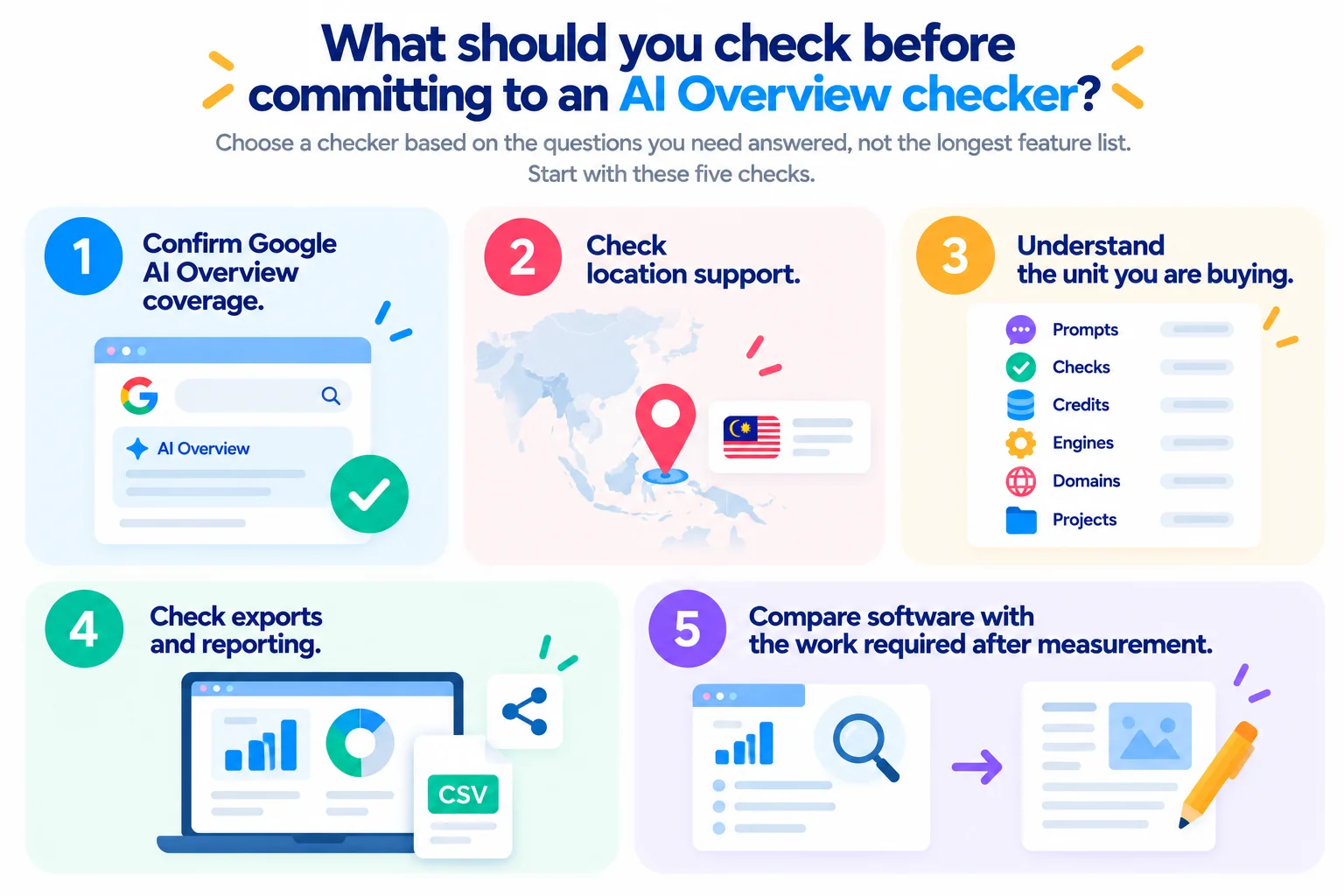
First, confirm Google AI Overview coverage. Some AI visibility tools concentrate on ChatGPT and other conversational platforms. If Google is your priority, verify that the plan you are buying specifically covers AI Overviews.
Second, check location support. A result observed in the United States may not represent what a customer sees in Malaysia. Malaysian businesses should confirm that their required market can be monitored.
Third, understand the unit you are buying. A supplier may charge according to prompts, checks, credits, engines, domains or projects. Similar headline prices can therefore represent very different monitoring capacity.
Consider a Kuala Lumpur business tracking 30 commercial prompts every day across Google AI Overviews and one additional AI platform. That produces:
30 prompts × 2 platforms × 30 days = 1,800 observations per month.
Add Malaysia and Singapore as separate markets and the potential monitoring scope doubles to 3,600 observations per month.
That original calculation provides a useful procurement test: ask each supplier what it would cost to support your actual monitoring scope rather than comparing entry prices alone.
Fourth, check exports and reporting. Agencies may need CSV exports, dashboards, APIs or multiple workspaces. A business owner checking 15 queries may not.
Fifth, compare software with the work required after measurement. An AI overview checker can identify visibility and citation patterns. Someone still needs to interpret the findings, decide which pages matter and improve the underlying content and website.
Trinergy Digital, a software and creative technology company in Kuala Lumpur, approaches AI visibility as part of the wider search and digital measurement process rather than treating checker scores as a business outcome by themselves.
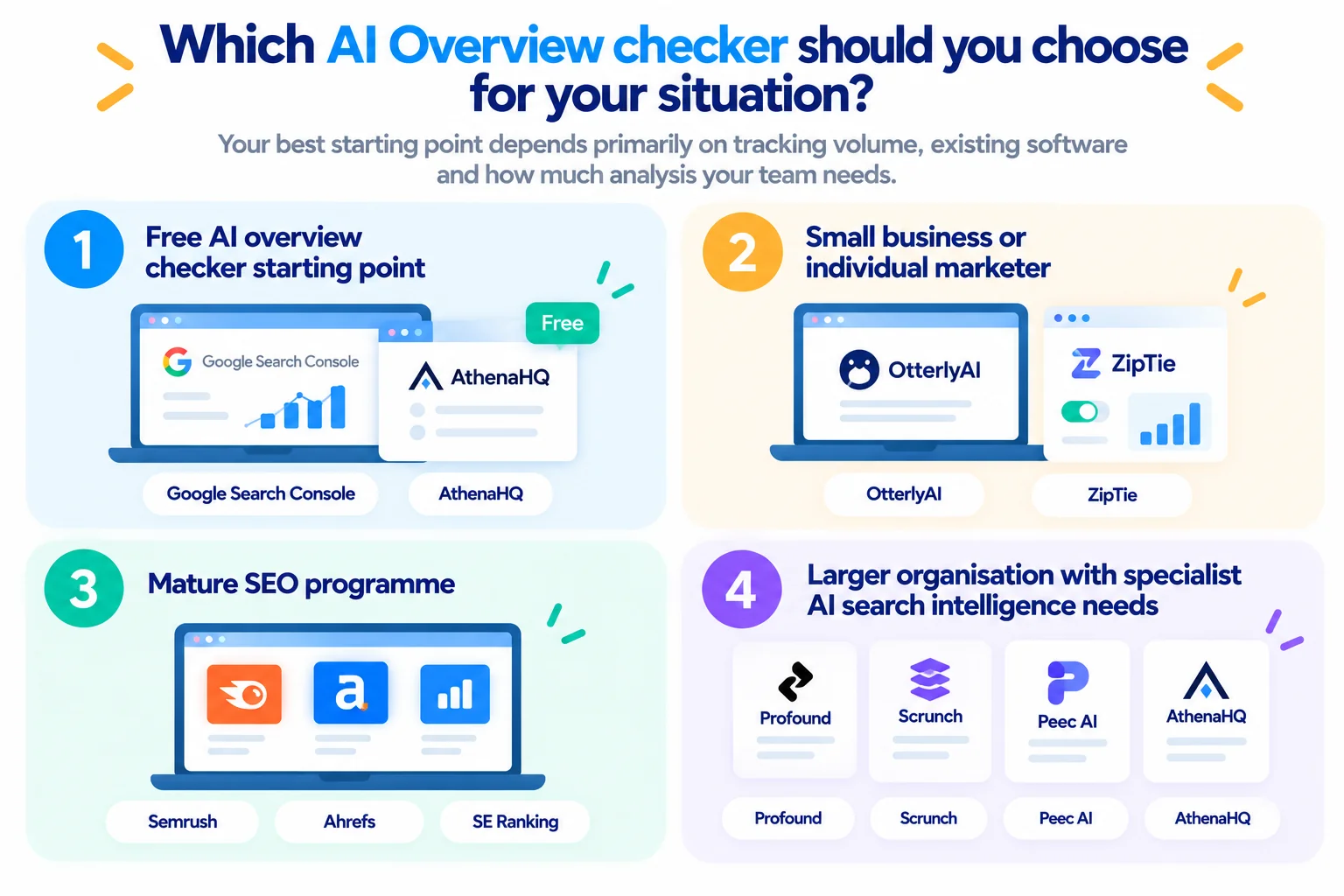
Which AI Overview checker should you choose for your situation?
Your best starting point depends primarily on tracking volume, existing software and how much analysis your team needs.
If you want a free AI overview checker starting point, use Google Search Console for your own website. AthenaHQ also provides a free entry option for broader AI visibility testing.
If you are a small business or individual marketer, OtterlyAI offers a relatively low published starting price, while ZipTie provides configurable usage-based monitoring.
If you already operate a mature SEO programme, Semrush, Ahrefs or SE Ranking may make more sense because AI visibility can sit alongside existing SEO research and reporting.
If you need specialist AI search intelligence across a larger organisation, platforms such as Profound, Scrunch, Peec AI and AthenaHQ provide broader monitoring and analysis options at different price points.
Before buying anything, define 20 to 50 commercially relevant queries and establish a baseline. Trinergy Digital's AI Overview tracking guide explains how to create that baseline and monitor citations consistently.
Build an AI Overview tracking process that supports your SEO
An AI overview checker is most useful when it helps you make better search decisions rather than simply producing another visibility score. Start with Search Console, define your commercially important queries and identify what additional information your team genuinely needs before paying for specialist software.
Google's current guidance remains grounded in established SEO practices. Pages need to be indexed and eligible to appear in Search, while useful, original content and sound technical foundations remain important for generative AI visibility.
Trinergy Digital, a software and creative technology company in Kuala Lumpur, can help businesses connect AI search monitoring with their broader SEO, content and digital strategy. Explore Trinergy Digital's digital services and contact the team to discuss your search visibility requirements and the appropriate next step.