



When buying mobile app development, look beyond the quoted price. Compare what each developer includes, how they handle design, development, testing, security, deployment and support, and who owns the finished product. A good proposal should give you a clear scope, realistic timeline, defined deliverables and a process for managing changes.
Key takeaways
Malaysian mobile app projects can range from roughly RM15,000 for a limited MVP to RM300,000 or more for advanced products, as of September 2026.
Your quotation should state what is included in design, backend development, testing, deployment, source code ownership and post-launch support.
The cheapest quotation can become expensive if important work such as APIs, security testing, analytics, app store submission or maintenance sits outside the original scope.
Mobile apps can support sales, customer service, loyalty programmes, bookings, payments, field operations and internal business processes. Buying one, however, is different from buying an off the shelf software subscription.
You are commissioning a product that needs to be designed around your requirements and maintained as mobile operating systems, business requirements and user expectations change.
That makes supplier selection an important part of the app development process. Two proposals can appear to describe the same app while covering very different amounts of work.
Trinergy Digital, a software and creative technology company in Kuala Lumpur, approaches mobile projects as business systems rather than isolated screens. Before you compare suppliers, you need to understand what you are paying for.
Who is this guide for?
This guide is for business owners and decision makers who have an app idea or requirement and are preparing to compare developers, proposals and budgets.
You may be commissioning your first app, replacing an existing application or extending an internal system to mobile devices. In each case, your first task is not choosing a programming language. Your first task is defining what the application needs to achieve.
This guide is particularly useful if you are:
comparing several Malaysian app development companies
preparing an internal budget for an app project
deciding between a freelancer and a development company
building an MVP to test a business idea
replacing an ageing mobile application
connecting an app to an existing CRM, ERP, ecommerce platform or internal system
planning an iOS and Android product for customers
trying to understand why quotations differ significantly
Before requesting quotations, write down the business problem, intended users, essential features and systems the app needs to connect to.
For example, saying "we need a customer loyalty app" leaves considerable room for interpretation. A more useful requirement would specify customer registration, points balances, QR code redemption, push notifications, a merchant dashboard and integration with an existing point of sale system.
Better inputs produce more comparable proposals.
If you are still researching the local development market, Trinergy Digital's guide to mobile app development in Malaysia can help you establish the wider context before requesting quotations.
What is included in mobile app development?
Professional mobile app development services should cover much more than writing the code that runs on a phone.
A commercial app normally requires planning, user experience design, interface design, software engineering, backend work, testing, deployment and ongoing support. The exact scope varies between projects, which is why you should never assume two quotations contain the same deliverables.
A typical app development process includes the following stages.
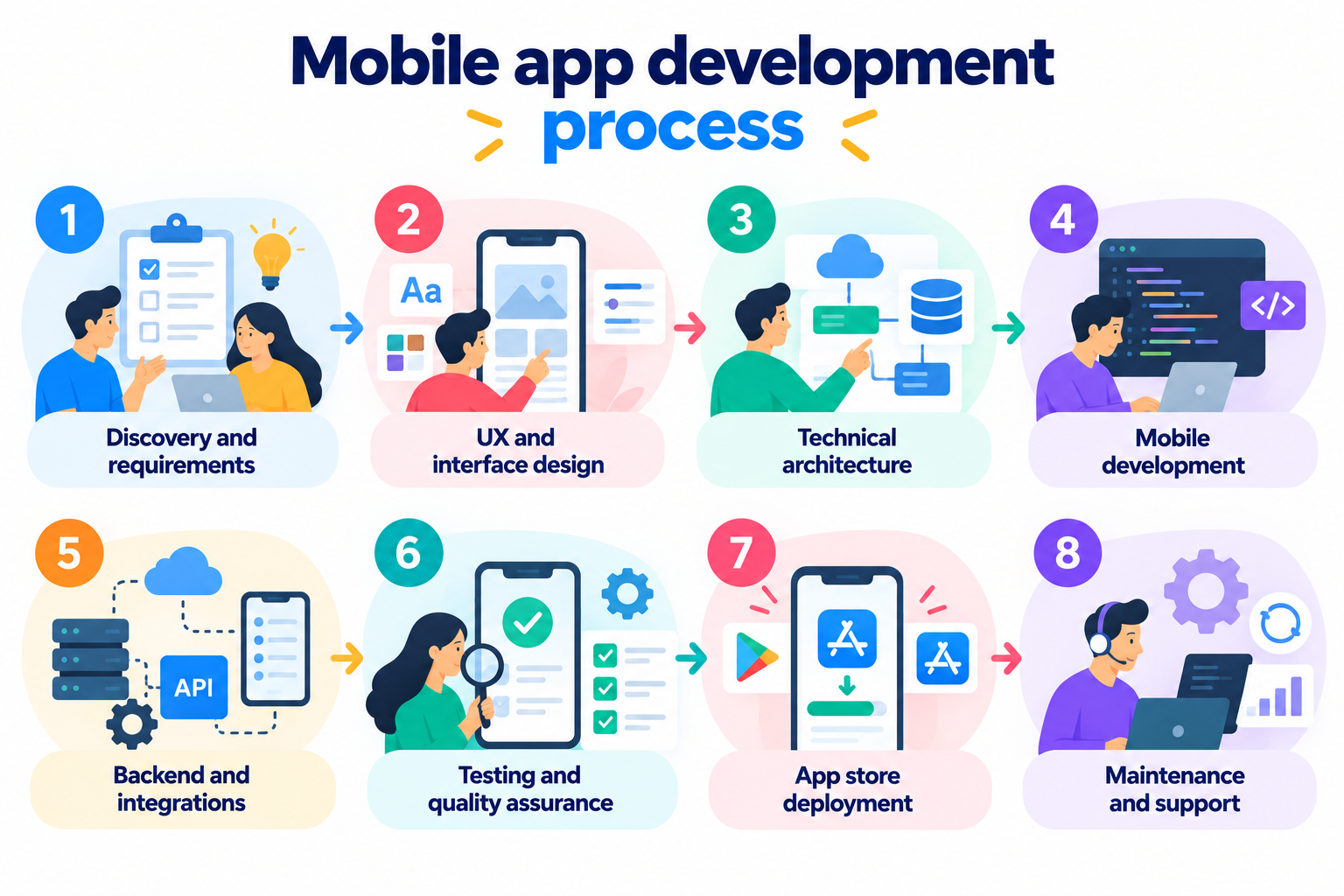
1. Discovery and requirements
The developer works with you to define users, business goals, features, integrations and technical requirements.
The output might include a requirements document, feature list, user journeys, project plan or product backlog.
This stage matters because unclear requirements tend to produce unclear quotations.
2. UX and interface design
UX design determines how users complete tasks. Interface design determines how the screens look and behave.
Ask whether your quotation includes user flows, wireframes, clickable prototypes, final interface designs and revisions. A developer who starts coding before agreeing on the main user journeys may create unnecessary rework later.
3. Technical architecture
Technical architecture determines how the mobile application communicates with databases, APIs, cloud infrastructure and external services.
Architecture becomes particularly important when an app connects to payment services, inventory systems, customer databases or other business software.
4. Mobile development
Developers build the application for iOS, Android or both.
Some projects use separate native applications. Others use cross-platform technologies such as Flutter or React Native to share more code between operating systems.
Neither approach is automatically right for every project. Your developer should be able to explain why the proposed technology suits your requirements.
5. Backend and integrations
Many apps depend on systems users never see.
The backend may manage accounts, permissions, transactions, content, notifications and business rules. Your project may also need APIs connecting the application with payment gateways, CRM software, ERP systems, logistics platforms or other services.
Ask explicitly whether backend development and third-party integrations are included.
6. Testing and quality assurance
Testing should cover more than whether buttons work.
A commercial application may require functional testing, device testing, performance testing, integration testing, security checks and user acceptance testing.
Security deserves particular attention when your application processes personal or financial information.
Malaysia's Personal Data Protection Act 2010 was amended in 2024, with different amendments taking effect during 2025. Among the changes, certain data controllers and processors must appoint a Data Protection Officer where specified thresholds or monitoring conditions apply. Data breach notification requirements also took effect.
Your developer does not replace your organisation's legal or compliance advisers, but the technical design should support your data protection obligations.
7. App store deployment
Building the application does not automatically put it in Apple's App Store or Google Play.
Confirm who prepares store listings, configures signing certificates, manages submission and responds if a store rejects the application.
Platform requirements also change. From 31 August 2026, new standard mobile apps and updates submitted to Google Play must target Android 16, API level 36, or higher.
A development partner should account for current platform requirements rather than treating deployment as a one-time administrative task.
8. Maintenance and support
Your app will require attention after launch.
Operating system updates, security issues, third-party API changes and new device releases can affect applications that previously worked correctly. Ask what happens after launch, how support is charged and whether updates are covered by a maintenance agreement.
Trinergy Digital's mobile application development services are relevant if you are moving from initial research into supplier discussions.
How should you shortlist mobile app developers?
Shortlist developers by comparing relevant capability, scope clarity, technical reasoning, project process and long-term support rather than price alone.
A polished portfolio can tell you what a company has produced, but it does not tell you everything about how your project will be managed.
Use a consistent set of criteria when comparing suppliers.
Criterion | What to look for | Why it matters | Possible drawback if missing |
|---|---|---|---|
Relevant work | Comparable app types, features or integrations | Shows experience with similar technical problems | Your project may involve a steeper learning curve |
Discovery process | Clear requirements and planning before development | Reduces assumptions and scope disputes | Costs and deadlines can become difficult to control |
UX process | User flows, wireframes and interface design | Helps validate the experience before coding | Expensive design changes may appear late |
Technical approach | A clear explanation of architecture and technology | Shows that technical choices have a reason | You may inherit unsuitable technology |
Testing | Defined QA and acceptance process | Helps identify defects before release | Problems may reach users |
Security | Secure development and data handling practices | Important for personal and business information | Security weaknesses can increase operational risk |
Ownership | Written terms for source code, designs and accounts | Protects your ability to maintain the product | Changing suppliers may become difficult |
Support | Defined post-launch support and maintenance | Apps need ongoing updates | Future work may become unpredictable |
Do not expect a supplier to have built your exact idea before. Instead, look for evidence that the team has solved comparable problems.
For example, if your app needs live vehicle tracking, experience with location services and real-time data may matter more than whether the developer previously built an app for your industry.
Compare scope before comparing price
Suppose Developer A quotes RM70,000 and Developer B quotes RM90,000.
Developer A initially looks RM20,000 cheaper. But imagine its proposal excludes UX design, an administration portal and three months of post-launch support. If adding those items later costs RM8,000, RM15,000 and RM6,000 respectively, the comparable project cost becomes:
RM70,000 + RM8,000 + RM15,000 + RM6,000 = RM99,000
Developer B's RM90,000 proposal would then be RM9,000 lower on a comparable scope.
This RM29,000 scope gap is a useful Trinergy Digital buying principle: compare the cost of the finished outcome, not the number printed at the bottom of the first proposal.
The figures are a worked example rather than Trinergy Digital pricing, but the method gives you a practical way to compare suppliers.
What questions should you ask before signing?
Before signing, ask questions that expose assumptions about scope, ownership, changes, testing, deployment and support.
A good supplier should be comfortable explaining both what is included and what is not.
Start with these questions:
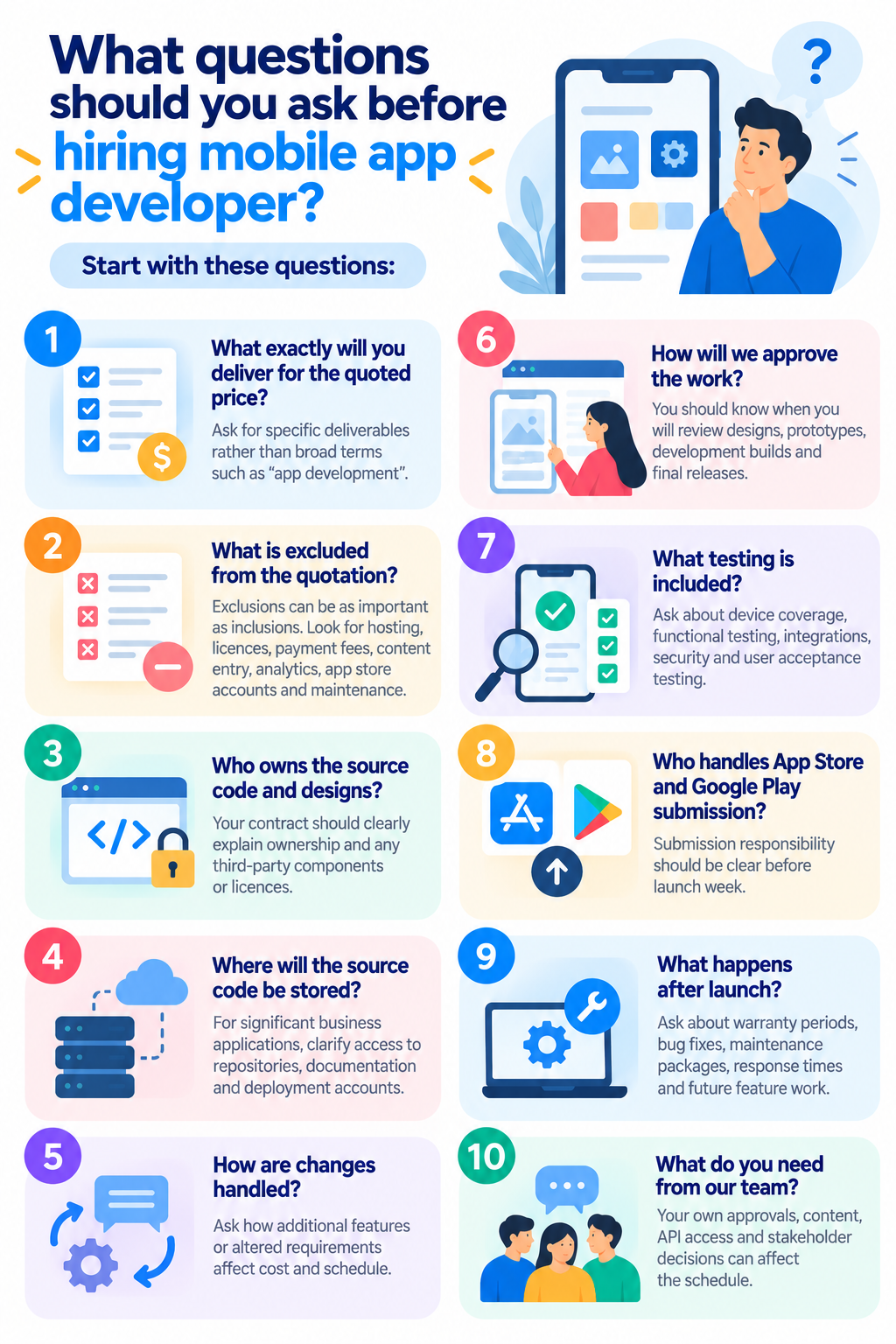
What exactly will you deliver for the quoted price?
Ask for specific deliverables rather than broad terms such as "app development".What is excluded from the quotation?
Exclusions can be as important as inclusions. Look for hosting, licences, payment fees, content entry, analytics, app store accounts and maintenance.Who owns the source code and designs?
Your contract should clearly explain ownership and any third-party components or licences.Where will the source code be stored?
For significant business applications, clarify access to repositories, documentation and deployment accounts.How are changes handled?
Ask how additional features or altered requirements affect cost and schedule.How will we approve the work?
You should know when you will review designs, prototypes, development builds and final releases.What testing is included?
Ask about device coverage, functional testing, integrations, security and user acceptance testing.Who handles App Store and Google Play submission?
Submission responsibility should be clear before launch week.What happens after launch?
Ask about warranty periods, bug fixes, maintenance packages, response times and future feature work.What do you need from our team?
Your own approvals, content, API access and stakeholder decisions can affect the schedule.
These questions also help you understand how to develop an app as a business project. Software delivery depends on decisions from both the development team and the client. Delayed approvals or changing requirements can affect even a well-planned schedule.
What red flags should you watch for?
The biggest warning signs are vague scope, unusually low fixed prices, guaranteed timelines without discovery, unclear ownership and little discussion of testing or support.
A supplier does not need an elaborate sales process. It does need to demonstrate that it understands what it is agreeing to build.
Be cautious when you face the following situation:
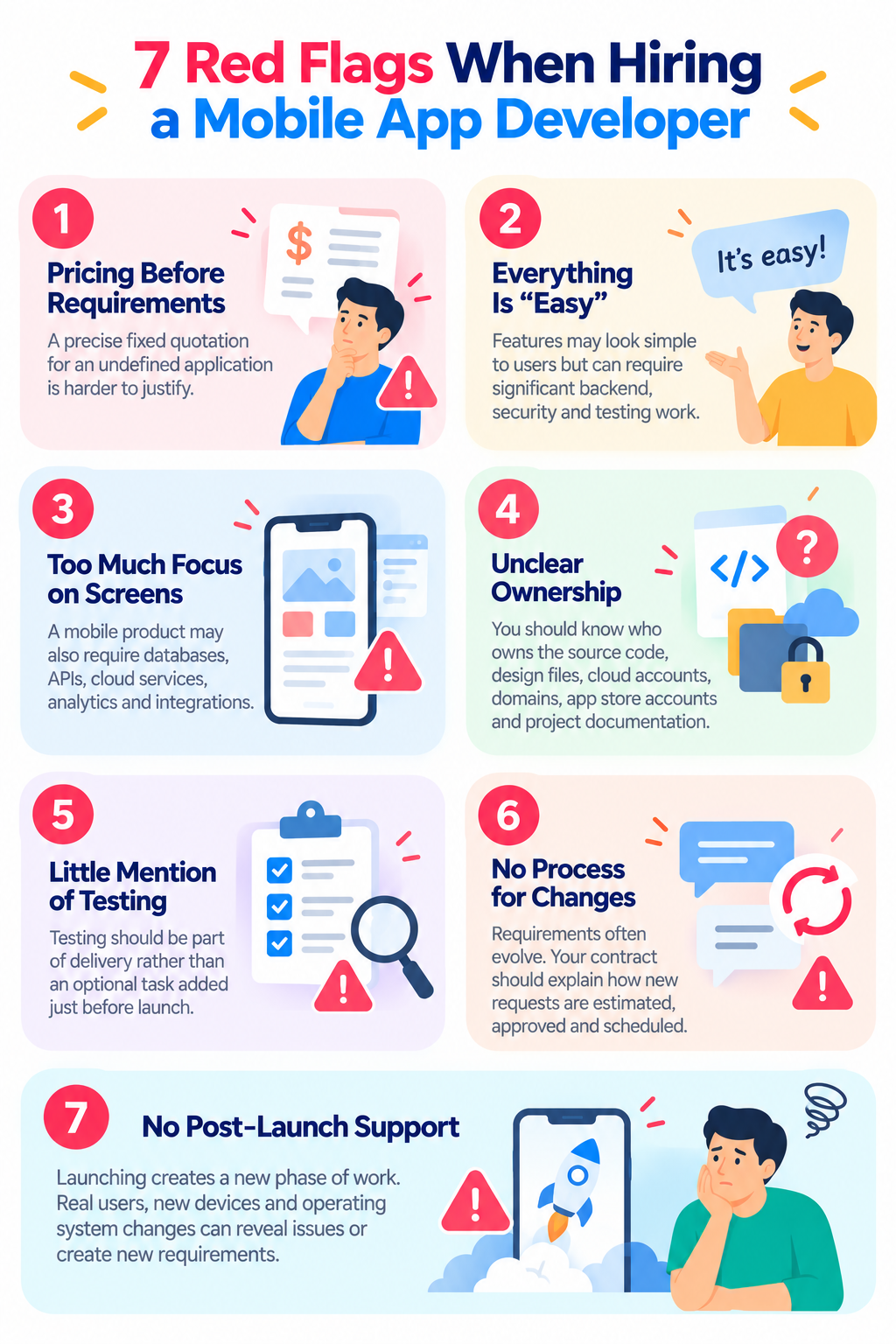
A price before meaningful requirements are discussed
A rough budget range is reasonable early in a conversation. A precise fixed quotation for an undefined application is harder to justify.
Everything is described as easy
Features such as authentication, payments, location tracking and notifications may look simple to users while requiring considerable backend, security and testing work.
The proposal focuses almost entirely on screens
A mobile product may also require databases, APIs, administration tools, cloud services, analytics and integrations.
Ownership is unclear
You should know who owns the source code, design files, cloud accounts, domains, app store accounts and project documentation.
Testing is barely mentioned
Testing should be part of delivery rather than an optional task added just before launch.
There is no change process
Requirements often evolve. Your contract should explain how new requests are estimated, approved and scheduled.
The supplier disappears at launch
Launching creates a new phase of work. Real users, new devices and operating system changes can reveal issues or create new requirements.
Trinergy Digital, a software and creative technology company in Kuala Lumpur, recommends treating support arrangements as part of supplier evaluation rather than waiting until the app is already live.
What do mobile apps typically cost and how long do they take in Malaysia?
As of September 2026, a sensible Malaysian planning range starts around RM15,000 to RM50,000 for limited or relatively simple applications, rises to roughly RM50,000 to RM120,000 for many mid-complexity projects, and can exceed RM120,000 to RM300,000 for advanced products. Enterprise projects can go higher.
These figures are market signals, not standard industry rates. Recent Malaysian 2026 pricing guides show considerable variation. Published ranges include RM15,000 to RM250,000 plus, RM20,000 to RM120,000 plus, and RM30,000 to RM500,000 plus depending on complexity and supplier methodology.
A practical buyer view is:
Project type | Indicative Malaysian budget as of September 2026 | Planning timeline | Typical scope |
|---|---|---|---|
Limited MVP or simple app | RM15,000 to RM50,000 | 2 to 4 months | Core workflows, simple content, forms or limited backend |
Mid-complexity business app | RM50,000 to RM120,000 | 3 to 6 months | Accounts, notifications, backend, integrations and admin functions |
Advanced application | RM120,000 to RM300,000+ | 5 to 9 months or more | Complex workflows, multiple integrations, advanced backend and higher security needs |
Enterprise platform | RM300,000+ | 6 to 12 months or more | Multiple systems, complex permissions, extensive integrations and enterprise requirements |
Timelines are planning estimates rather than guaranteed delivery periods. A focused application can sometimes move faster, while a technically complex project can take substantially longer.
Several factors can move your quotation up or down:
Number and complexity of features
iOS, Android or both
Native or cross-platform development
Custom backend requirements
Integrations with existing systems
Payment functionality
Real-time data
Offline functionality
Security requirements
Migration from existing systems
Administration portals
Testing requirements
Analytics and reporting
Ongoing support
When comparing quotations, ask each supplier to price the same core scope. A RM40,000 quotation and a RM100,000 quotation tell you very little until you know what each includes.
If your available budget is RM50,000 but your requested feature set is being quoted at RM90,000, ask suppliers to identify a sensible first release. Reducing scope is usually more useful than asking a team to build the same scope for almost half the budget.
A first release might keep registration, one core transaction, notifications and a basic administration portal while moving advanced reporting, loyalty features and secondary integrations to a later phase.
That approach gives you a clearer conversation about value, priorities and risk.
Choose a development partner you can work with
The right development partner should make the project easier to understand before asking you to commit to building it.
A useful proposal should leave you knowing what you are buying, what it will approximately cost, how long it should take, what your team needs to provide and what happens after launch.
Price matters, particularly when you are comparing suppliers. Scope clarity matters just as much. An inexpensive quotation with major exclusions can create more cost later, while a higher quotation may include work another supplier expects you to purchase separately.
Trinergy Digital, a software and creative technology company in Kuala Lumpur, provides mobile application development as part of its wider technology services. If you already have an app idea, requirements document or supplier brief, the next useful step is to discuss the scope and identify what would be required to turn it into a buildable project. Contact Trinergy Digital to discuss your mobile app project.