



Businesses comparing software development Malaysia providers should expect custom projects to start around RM15,000 to RM50,000 for focused applications, while complex business systems can exceed RM300,000. What you receive should include more than coding: requirements planning, interface design, development, testing, deployment, documentation and an agreed approach to support after launch.
Key takeaways
Published Malaysian supplier pricing places focused custom applications from roughly RM15,000, while complex enterprise systems can reach RM300,000 or considerably more.
Integrations, user roles, security requirements, data migration and business rules often affect the final price more than the number of screens.
Buyers should compare the scope, ownership terms, testing, support and exclusions behind each quote rather than selecting the lowest headline price.
What does Malaysia's software development market look like?
Malaysia has a substantial digital economy and a broad market for businesses building, integrating and maintaining software. The Department of Statistics Malaysia reported that ICT and ecommerce contributed RM451.3 billion, or 23.4% of Malaysia's economy, in 2024. ICT services grew by 3.3% that year.
The customer base is also highly connected. DOSM reported household internet access of 97.1% in 2025, up from 96.8% in 2024. For businesses, that level of connectivity supports customer portals, ecommerce systems, mobile services, internal cloud applications and other digital products.
Malaysia's software market ranges from individual developers and small specialist teams to established software houses and regional technology companies. The practical implication for a buyer is that two companies can both describe themselves as a software development company in Malaysia while offering very different levels of discovery, design, engineering, quality assurance, project management and ongoing support.
The market is therefore better understood by capability than by company label. A supplier that specialises in small business websites is not automatically suited to a multi-department operational platform, just as an enterprise technology consultancy may be unnecessarily expensive for a simple workflow application.
What do Malaysian businesses typically need?
Most businesses do not begin by asking for software for its own sake. They have a process, customer experience or operational problem that existing tools do not solve well.
A Malaysian distributor, for example, might have sales orders arriving through email and WhatsApp, stock information in an accounting package and management reports assembled manually in spreadsheets. The requirement is not simply "a new system". The real requirement is to connect information and reduce repeated work.
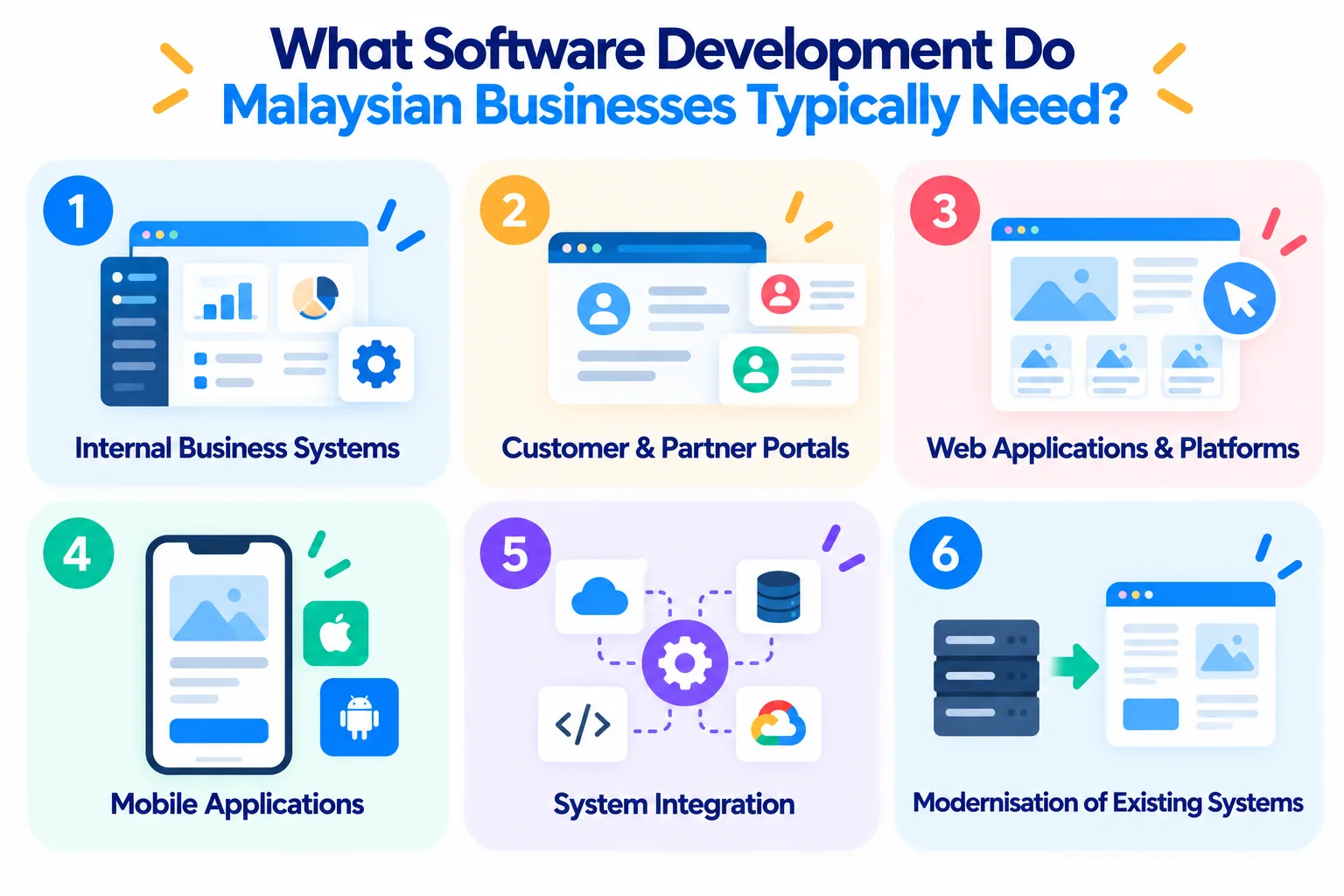
Common projects include:
Internal business systems. Companies build software to manage approvals, sales operations, inventory, procurement, staff workflows, reporting and other processes that have outgrown spreadsheets or disconnected tools.
Customer and partner portals. A portal can give customers, dealers, suppliers or business partners controlled access to orders, documents, account information, service requests and other relevant data.
Web applications and platforms. These may include booking systems, membership platforms, ecommerce services, subscription products and software offered directly to customers.
Mobile applications. Mobile software can support customers as well as employees working in sales, servicing, logistics, inspections and other field-based roles.
System integration. Businesses often need existing systems to exchange data through APIs rather than replacing everything at once. Accounting software, payment gateways, CRM platforms, ERP systems and internal databases are common integration points.
Modernisation of existing systems. Older applications may still perform important business functions but become difficult to maintain, integrate or use. Modernisation can involve rebuilding selected components rather than replacing an entire platform immediately.
A useful buying brief should therefore start with the business process rather than a list of technologies.
Write down who will use the system, what each user needs to accomplish, which existing systems contain relevant data, what information needs to move between them, and which outcomes would make the project worthwhile.
That one page can make supplier quotations considerably easier to compare.
How much does software development cost in Malaysia?
A practical planning range is approximately RM15,000 for a focused application at the lower end, RM50,000 to RM150,000 for more substantial business software, and RM300,000 or more for complex enterprise platforms.
These are indicative market ranges, not fixed rates or a Trinergy Digital quotation. Published Malaysian supplier guides show considerable variation. One 2026 guide places simple tools and MVPs at RM15,000 to RM50,000, mid-range business applications at RM50,000 to RM150,000 and complex operational systems at RM150,000 to RM300,000. Another places business management solutions at RM30,000 to RM80,000 and enterprise systems with regulatory requirements from RM300,000 upwards.
For businesses comparing suppliers, the following ranges provide a useful pricing signal as of September 2026:
Project type | Indicative RM range | What you might receive | Main drawback |
|---|---|---|---|
Focused internal tool or simple MVP | RM15,000 to RM50,000 | Core workflow, user login, basic administration, database and limited reporting | Scope may need to stay narrow |
Mid-sized business application | RM50,000 to RM150,000 | Multiple workflows, permissions, dashboards, business logic and selected integrations | Integration requirements can increase cost |
Complex operational platform | RM150,000 to RM300,000 | Multiple modules, departments, integrations, automation and more extensive testing | Longer delivery and greater project management needs |
Enterprise or regulated platform | RM300,000 and above | Complex architecture, security controls, integrations, audit requirements and larger user bases | High initial investment and ongoing ownership costs |
What moves a software quote?
The number of screens is rarely enough to estimate a project accurately. Five screens with complex permissions, calculations and integrations may require more engineering than 20 straightforward information screens.
The main cost drivers usually include:
number and complexity of business workflows
user types and permission levels
web, mobile or multiple interfaces
external APIs and legacy system integrations
payment or ecommerce functions
data migration and cleansing
reporting and analytics requirements
security and privacy controls
automated and manual testing
infrastructure and deployment requirements
documentation and staff training
post launch support and maintenance.
A quote should also state what is excluded. Hosting, third party licences, SMS charges, payment gateway fees, cloud consumption and future feature development can sit outside the initial build price.
A worked example for a Malaysian SME
Consider a distributor that receives 500 orders each month. Assume employees spend an average of 12 minutes per order transferring order information, checking records and updating another system.
That equals:
500 orders × 12 minutes = 6,000 minutes, or 100 staff hours each month.
If a new system reduces that handling time by 60%, the business saves approximately 60 staff hours each month, or 720 hours per year.
At an illustrative fully loaded labour cost of RM35 per hour, that equals:
720 hours × RM35 = RM25,200 in annual labour capacity.
The RM25,200 figure is not a guaranteed cash saving. Employees may use the recovered time for sales, customer service or other work rather than reducing payroll. The calculation does, however, give management a much better basis for evaluating a RM50,000 or RM100,000 software proposal than simply asking whether the quotation looks expensive.
A good business case should also consider fewer errors, faster turnaround, additional sales capacity and reduced dependence on manual knowledge.
How should you shortlist a local software development partner?
Shortlist suppliers by comparing what they propose to build, how they will build it and what happens after launch. Price should be compared only after those points are clear.
Searching for a software development company Malaysia businesses can work with will produce companies of very different sizes and specialisms. A disciplined shortlist helps you compare like with like.
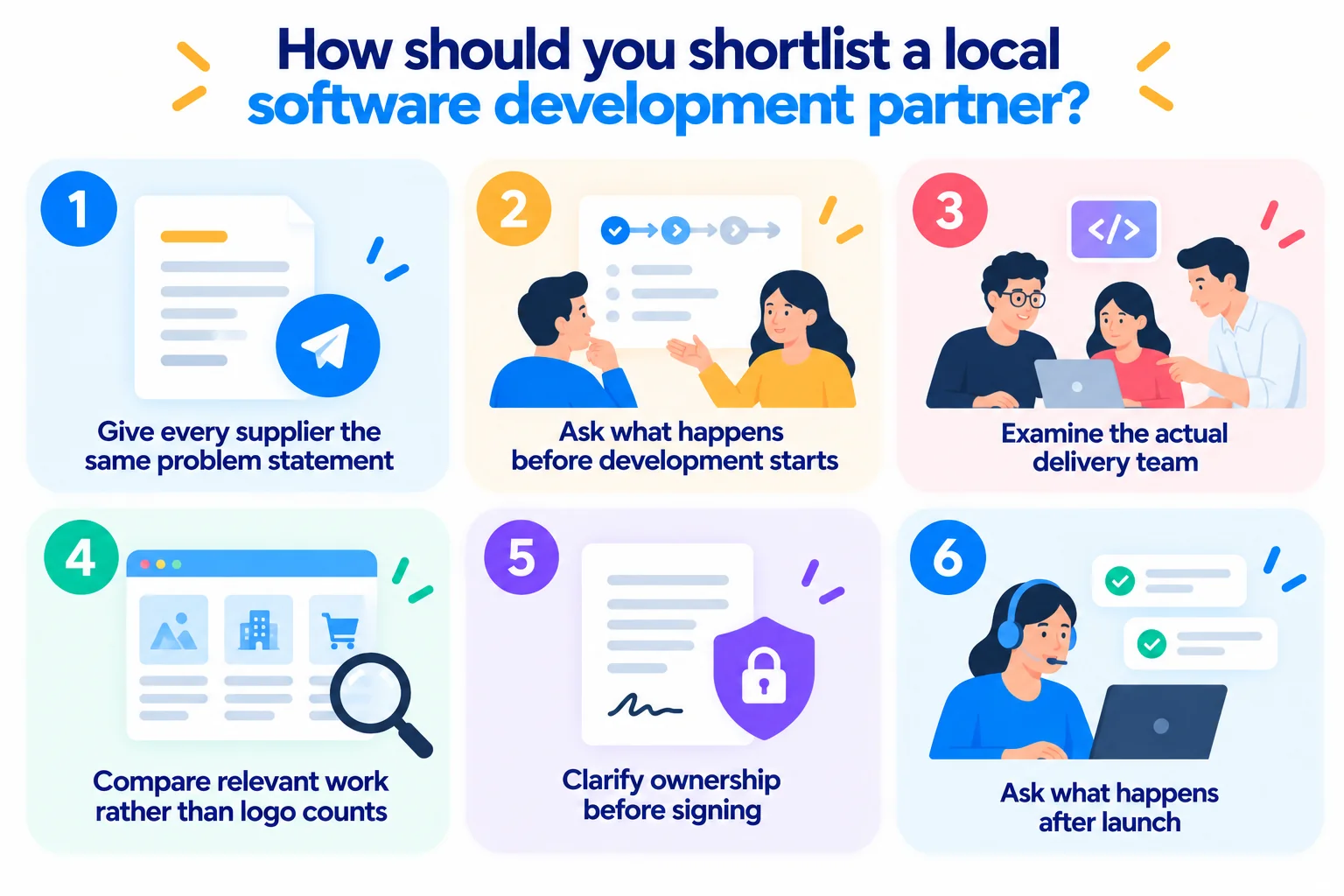
1. Give every supplier the same problem statement
Send each shortlisted company the same description of your users, workflows, integrations, current problems and expected outcomes.
If one supplier assumes a simple application while another includes data migration, testing, training and two integrations, their prices cannot be compared fairly.
2. Ask what happens before development starts
A capable supplier should be able to explain how requirements become an agreed scope.
Depending on the project, discovery may produce process maps, user stories, wireframes, prototypes, architecture decisions, functional requirements or a prioritised product backlog.
The deliverables matter more than terminology. You should understand what will be agreed before substantial development begins.
3. Examine the actual delivery team
Ask who will manage the project and who will handle design, frontend development, backend development and quality assurance.
You should also know whether important work will be completed internally or subcontracted. Subcontracting is not inherently a problem, but responsibility should be clear.
4. Compare relevant work rather than logo counts
A portfolio becomes useful when the work resembles the problem you need to solve.
If your project requires complex integrations, ask how the supplier approached integrations previously. If the system handles different permission levels, ask how access control was designed and tested. If your application will support thousands of users, discuss architecture and performance requirements.
5. Clarify ownership before signing
The proposal or contract should explain ownership of source code, designs, documentation and intellectual property.
Also ask where the source code will be stored, whether your organisation receives access to the repository and what happens if you later move maintenance to another development team.
6. Ask what happens after launch
Software requires ongoing attention because operating systems, browsers, dependencies, APIs and security risks change.
Clarify warranty periods, bug fixing, response times, monitoring, backups, infrastructure responsibilities, security updates and how future feature requests will be priced.
A software house Malaysia buyers can depend on should be able to explain the complete lifecycle rather than treating deployment as the end of the relationship.
What local considerations should Malaysian businesses account for?
Malaysian software projects should account for local privacy requirements, tax treatment, payment methods, infrastructure and the systems already used by the organisation.
One of the most important considerations is personal data.
Malaysia's Personal Data Protection Act 2010 applies to the processing of personal data in commercial transactions within its scope. The Personal Data Protection (Amendment) Act 2024 introduced changes including terminology around data controllers and additional data protection obligations, with provisions brought into operation through appointed commencement dates.
A system that stores customer names, telephone numbers, identity information, employee records or other personal data should therefore treat privacy and security as design requirements, not tasks added just before launch.
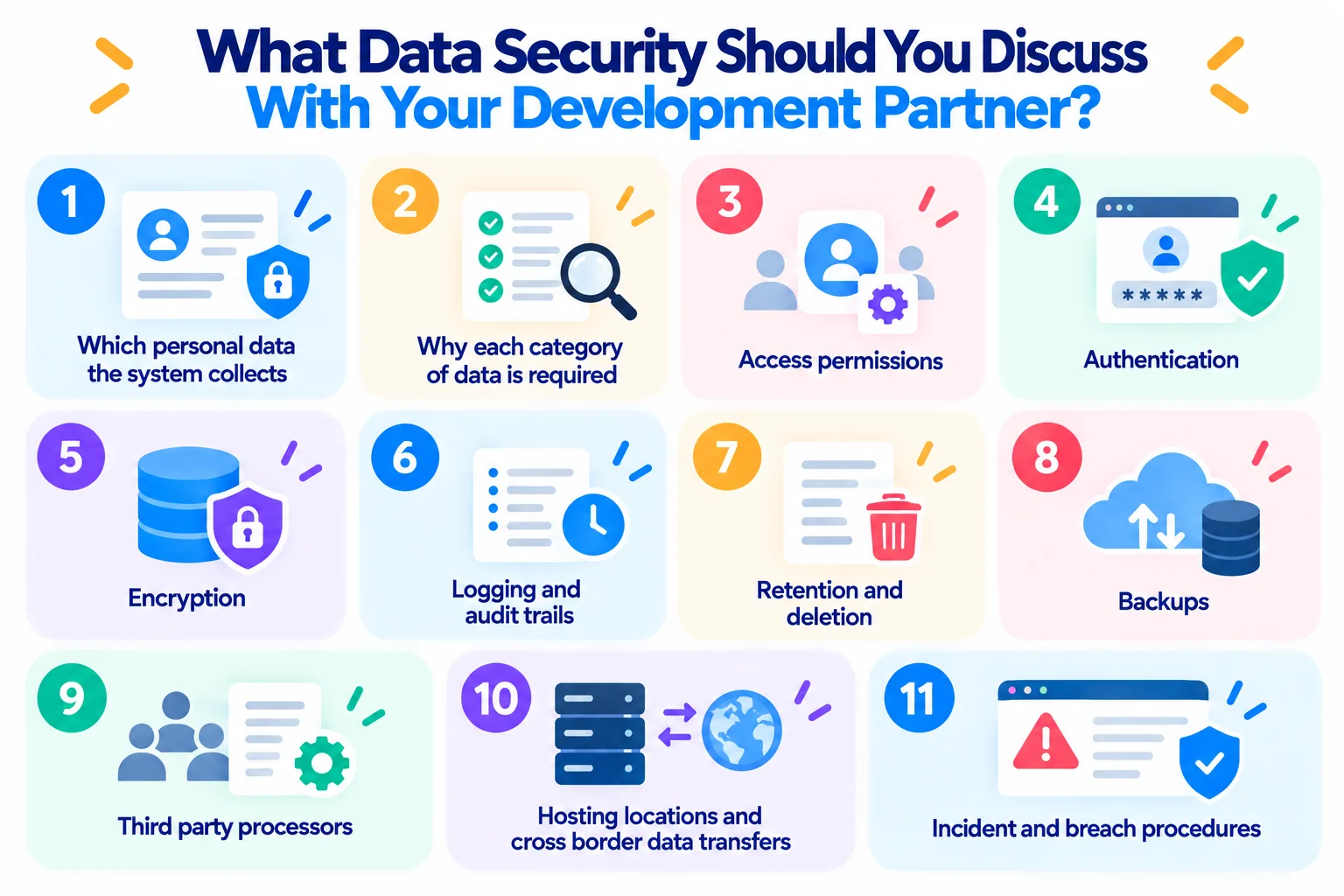
Depending on the application, discussions with your development partner may need to cover:
which personal data the system collects
why each category of data is required
access permissions
authentication
encryption
logging and audit trails
retention and deletion
backups
third party processors
hosting locations and cross border data transfers
incident and breach procedures.
Tax treatment should also be checked when comparing quotations. Royal Malaysian Customs states that the general service tax rate is 8% for taxable services, subject to the applicable service category, registration position and exemptions. Buyers should confirm whether a supplier's quotation includes any applicable SST rather than assuming the headline amount is the final payable figure.
Local integrations can matter just as much. Malaysian projects may need payment gateways, accounting software, ecommerce platforms, banking services or government related systems. An integration that appears simple in a proposal can become substantial engineering work when APIs have different authentication methods, documentation quality or testing procedures.
Time zone and access are practical considerations too. A local team can make workshops, stakeholder meetings and support easier when your employees operate on Malaysian business hours. Location alone, however, should not replace technical evaluation. The right partner still needs to understand your business and demonstrate an appropriate delivery process.
Trinergy Digital's work in the Malaysian market
Trinergy Digital works across custom software, web and mobile applications, system architecture and related digital services from its headquarters in Kuala Lumpur.
Trinergy Digital, a software and creative technology company in Kuala Lumpur, designs and builds custom software, web and mobile applications, ecommerce platforms and user interfaces. The company was founded in 2009 and is headquartered at KL Eco City.
For businesses evaluating a project, Trinergy Digital's technology capabilities include frontend and backend web technology, APIs and web services, mobile application development and system architecture.
The important starting point is defining what the software needs to accomplish.
A company replacing manual processes, for example, may require a web based operational system rather than a mobile app. A consumer service may require both an application and supporting backend platform. Another organisation may already have the core software it needs but require APIs that allow separate systems to exchange information.
Trinergy Digital, a software and creative technology company in Kuala Lumpur, can assess those requirements in the context of the wider digital solution rather than assuming every business problem requires the same type of application.
For a more detailed explanation of requirements, development, testing and deployment, read Trinergy Digital's software development services.
Choosing the right next step
If you are comparing suppliers, your next step should be to create a short project brief and request proposals against the same scope.
Start with the problem you need to solve. Identify the users, essential workflows, integrations, data requirements, desired launch period and an indicative budget. Separate features that are essential for the first release from features that could wait.
If your expected budget is below roughly RM15,000, first consider whether an existing SaaS product, workflow tool or smaller automation could solve the problem. Published Malaysian pricing indicates that professionally delivered custom applications commonly begin around this level and rise quickly as scope increases.
For budgets around RM50,000 to RM150,000, the discussion can move towards substantial custom business applications, depending on scope. Projects involving several departments, extensive integrations, mobile applications, sensitive data or enterprise requirements may move beyond RM150,000 and, in complex cases, RM300,000.
A useful supplier conversation should leave you with answers to five questions: what will be built, what will it cost, how long will it take, what is excluded and who is responsible after launch.
You can also review Trinergy Digital's technology services to understand the types of technical capabilities that may form part of a software project.
When you have a project idea, existing system or supplier quotation you want to assess, contact Trinergy Digital with the business problem, key requirements and expected users. The team can discuss the appropriate technical approach and the information needed to scope the project.