



B2B SaaS is software that one business provides to other businesses through the internet, usually through a subscription or usage-based model. Instead of installing and maintaining software on their own servers, customers access the application online while the SaaS provider manages the product, infrastructure, updates and ongoing maintenance.
Key takeaways
B2B SaaS provides software to businesses rather than individual consumers.
Customers usually access B2B SaaS through a web browser, mobile application or connected software interface.
A B2B SaaS business must manage more than software development because pricing, onboarding, security, retention and customer support all affect the model.
What is B2B SaaS?
B2B SaaS stands for business-to-business Software as a Service. A company develops and operates software that other organisations access online instead of purchasing conventional software and managing the underlying technology themselves.
The B2B SaaS meaning becomes clearer when you separate the two parts.
B2B, or business to business, means the customer is another organisation. The software might be purchased by an SME, multinational company, government contractor or professional services firm rather than an individual consumer.
SaaS, or Software as a Service, describes how the software is delivered. The application runs on cloud infrastructure managed by the provider and customers access its functionality over a network.
The National Institute of Standards and Technology defines SaaS as a model in which consumers use a provider's applications running on cloud infrastructure. The provider manages the underlying networks, servers, operating systems and storage, while users generally control only application-specific settings.
A familiar example is customer relationship management software. Instead of a company buying servers, installing a CRM internally and maintaining each version, employees sign in online. The provider maintains the core application and releases updates centrally.
B2B SaaS can support many business functions, including:
customer relationship management
accounting and invoicing
human resources
project management
inventory management
analytics and reporting
marketing automation
cybersecurity
workflow management
document collaboration
Common B2B SaaS examples include Salesforce for customer relationship management, Slack for workplace communication and Microsoft 365 for business productivity.
The defining feature is not simply that the software has a monthly price. B2B SaaS combines business-focused software with an ongoing service relationship and cloud-based delivery.
Why does B2B SaaS matter now?
B2B SaaS matters because cloud software has become an established way for organisations to access business applications without operating every part of the underlying technology themselves.
The broader cloud market remains substantial. Gartner forecast worldwide spending on cloud application services, its SaaS category, at US$299.1 billion for 2025, compared with US$250.8 billion in 2024.
Malaysia provides useful local context. The Department of Statistics Malaysia reported that ICT and ecommerce contributed RM451.3 billion to Malaysia's economy in 2024, equivalent to 23.4% of the national economy. Malaysia's ecommerce income by establishments also reached RM1.2881 trillion in 2024.
Those figures do not measure B2B SaaS specifically, but they demonstrate the scale of digital economic activity surrounding businesses that increasingly depend on connected systems.
For customers, B2B SaaS can reduce the need to install and maintain applications individually. A business can create accounts, configure the platform and give authorised employees access through the internet.
For founders, SaaS also changes the commercial relationship. Rather than completing a software sale and moving on, the provider must keep delivering enough value for the customer to continue paying.
That recurring relationship is one reason metrics such as monthly recurring revenue, customer acquisition cost, customer lifetime value, retention and churn are closely associated with SaaS businesses.
How does B2B SaaS work step by step?
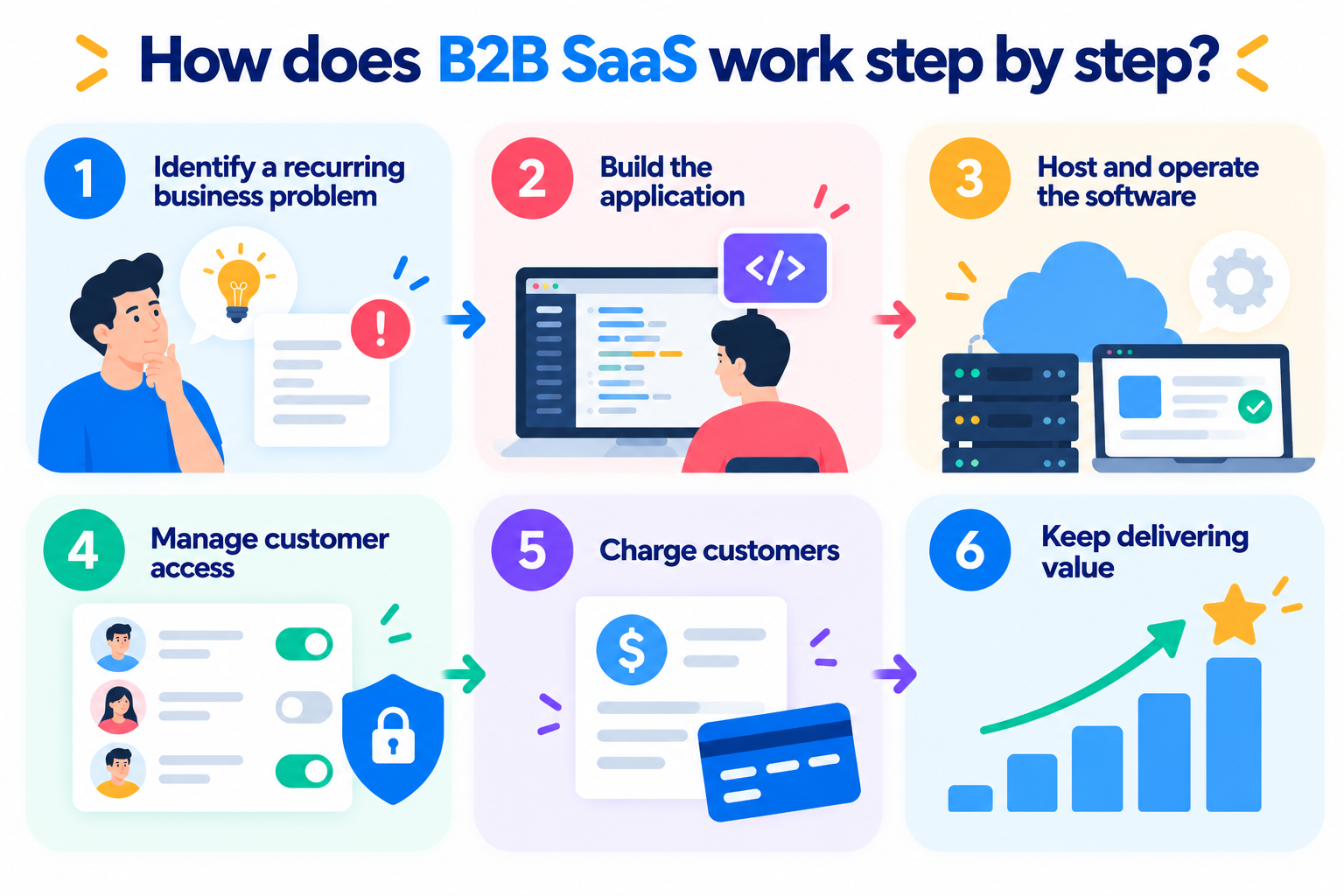
A B2B SaaS product typically moves through six connected stages, from identifying a business problem to retaining paying customers.
Stage | What happens | Example |
|---|---|---|
1. Problem | The company identifies a recurring business problem | Retailers struggle to track stock across outlets |
2. Product | Software is built to solve that problem | A central inventory platform is created |
3. Hosting | The application runs on cloud infrastructure | Users access the system online |
4. Access | Businesses create accounts and permissions | Managers and staff receive different roles |
5. Billing | Customers pay according to the pricing model | RM500 per company each month |
6. Retention | The provider maintains and improves the product | Updates and support keep customers using it |
Step 1: Identify a recurring business problem
Successful B2B SaaS starts with a problem shared by enough businesses to justify building a repeatable product.
Imagine that 100 logistics companies are separately managing delivery schedules in spreadsheets. A SaaS founder might create one scheduling platform that addresses the common workflow rather than developing 100 unrelated systems.
Step 2: Build the application
The development team creates the interfaces, application logic, databases, integrations and administration tools required to deliver the service.
B2B products may also require functions such as user roles, audit logs, organisation accounts, reporting and integration with existing business systems.
Step 3: Host and operate the software
The provider makes the application available through cloud infrastructure. Customers normally use a browser, mobile application or application programming interface, commonly called an API.
The SaaS provider manages the underlying product and its ongoing operation rather than asking each customer to maintain a separate installation.
Step 4: Manage customer access
Business software often requires more detailed access controls than a simple consumer account.
A finance platform, for example, might allow an administrator to approve payments while giving other employees read-only access. Enterprise customers may also require single sign-on, audit histories and integration with their identity management systems.
Step 5: Charge customers
Subscription pricing is common, but it is not the only B2B SaaS revenue model.
A provider could charge RM100 per user each month, RM2,000 per organisation, a fee based on transaction volume, or a combination of a base subscription and usage charges.
Step 6: Keep delivering value
A SaaS provider must continue maintaining the product, addressing security issues, supporting customers and improving useful features.
Recurring revenue depends on recurring customer value. A subscription does not automatically make revenue predictable if customers regularly cancel.
What do most B2B SaaS guides leave out?
The part many introductory guides understate is that B2B SaaS is an operating model as much as a software model. Building the application is only one part of running the business.
A founder also needs to think about onboarding, permissions, integrations, billing, support, uptime expectations, backups, data ownership, security, privacy and what happens when a customer leaves.
Data governance deserves particular attention in Malaysia.
Malaysia's Personal Data Protection Act 2010 regulates the processing of personal data in commercial transactions, and the Personal Data Protection (Amendment) Act 2024 introduced changes to the framework. The Personal Data Protection Commissioner also publishes guidance covering areas such as data breach notification, Data Protection Officer appointments, cross-border transfers and data protection by design.
A Malaysian SaaS provider processing customer or employee personal data therefore needs to consider its legal obligations according to its role, processing activities and circumstances rather than treating privacy as a feature to add after launch.
Product design also needs to account for how business customers buy software.
A five-person company may sign up using a credit card. A large organisation may require procurement approval, security reviews, contracts, integration assessments and internal training before deployment.
The same software can therefore require very different sales and onboarding processes depending on its target customer.
Trinergy Digital, a software and creative technology company in Kuala Lumpur, views this distinction as important when evaluating a SaaS concept: founders should design the product and the operating model together. A technically sound application can still struggle if onboarding costs, pricing or support requirements make each new customer expensive to serve.
What are the common misconceptions about B2B SaaS?
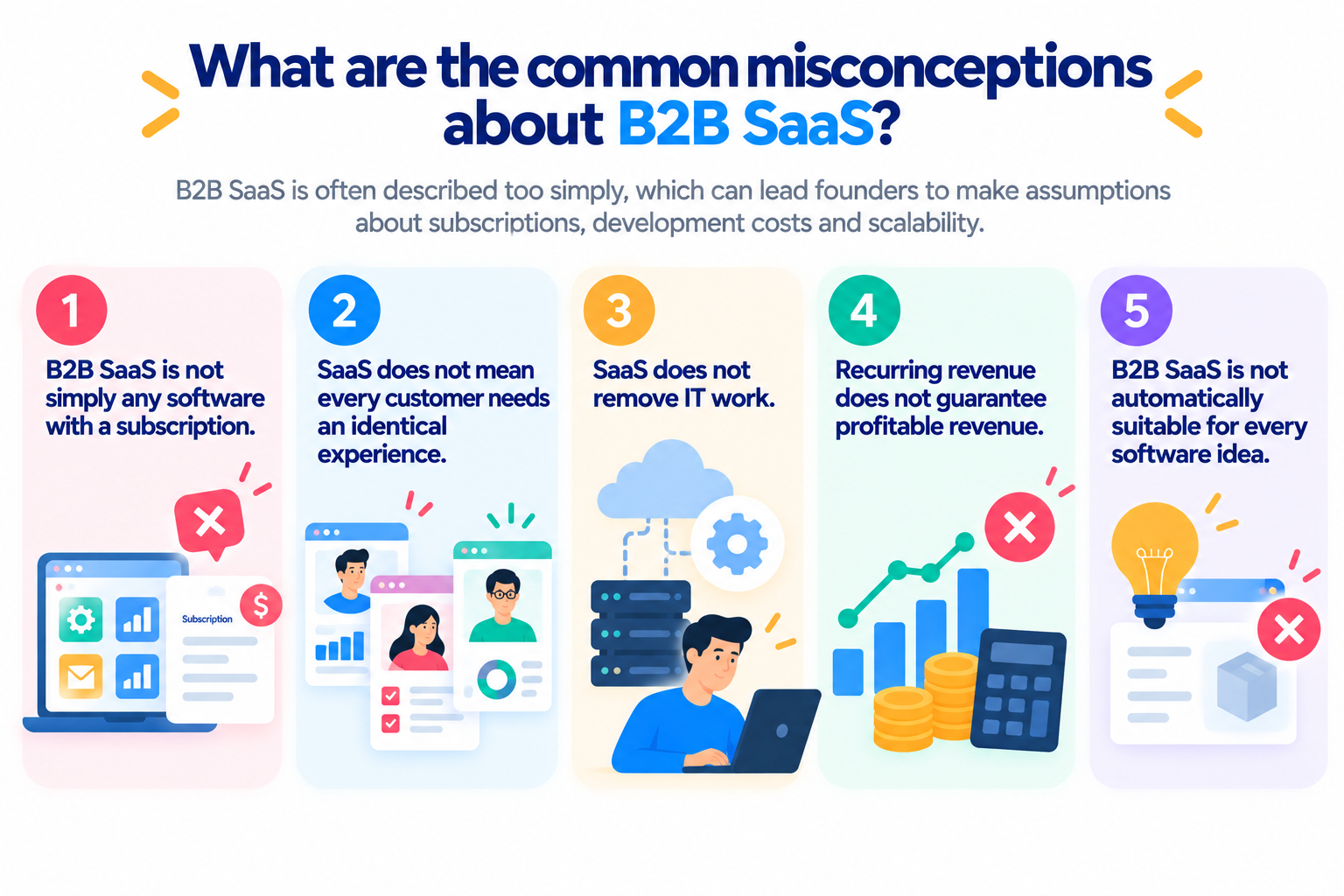
B2B SaaS is often described too simply, which can lead founders to make assumptions about subscriptions, development costs and scalability.
B2B SaaS is not simply any software with a subscription. A conventional product can charge recurring fees without following a true SaaS delivery model. Cloud delivery, centralised operation and ongoing service are important characteristics.
SaaS does not mean every customer needs an identical experience. A shared core product can still offer different plans, permissions, configurations and integrations.
SaaS does not remove IT work. The responsibility shifts. Customers may manage less infrastructure, but the provider still needs to operate, monitor, secure and maintain the application.
Recurring revenue does not guarantee profitable revenue. Support, infrastructure, sales and customer acquisition still cost money. High customer churn can quickly weaken the economics of a subscription model.
B2B SaaS is not automatically suitable for every software idea. Some highly specialised systems may be better delivered as bespoke software when every customer's processes differ significantly.
What could a B2B SaaS business look like in practice?
Consider a fictional Malaysian SaaS company that builds a staff scheduling platform for independent retail businesses. The example shows how product usage, pricing and customer retention connect commercially.
Assume the company charges RM300 per business per month.
With 40 paying customers:
40 customers × RM300 = RM12,000 monthly recurring revenue
If five new customers join during the following month but two existing customers cancel, the business ends the month with 43 customers.
43 customers × RM300 = RM12,900 monthly recurring revenue
The company has added RM900 in monthly recurring revenue, but the two cancellations matter. If customers keep leaving at the same pace, the business must continually replace lost accounts before it can grow.
Now consider infrastructure and support. Suppose each active customer creates an estimated RM45 in monthly hosting, third-party service and direct support costs.
43 customers × RM45 = RM1,935 estimated monthly direct service cost
That leaves RM10,965 before salaries, marketing, sales, administration, tax and other expenses.
The calculation is intentionally simplified, but it demonstrates an important SaaS principle: subscriber numbers alone do not tell you whether the business works.
A founder should understand what it costs to acquire, onboard and serve customers, how long customers stay and how much recurring revenue each account generates.
The same logic affects product decisions. If every RM300 customer requires RM1,000 of manual onboarding work, the pricing model may need to change. The founder could introduce an onboarding fee, increase the subscription price, automate setup or target larger customers.
That relationship between software design and commercial economics is one of the most useful ways to evaluate a B2B SaaS idea.
When should you get help building B2B SaaS?
You should consider specialist help when your B2B SaaS idea has moved beyond the basic concept and you need to turn business requirements into a secure, maintainable software product.
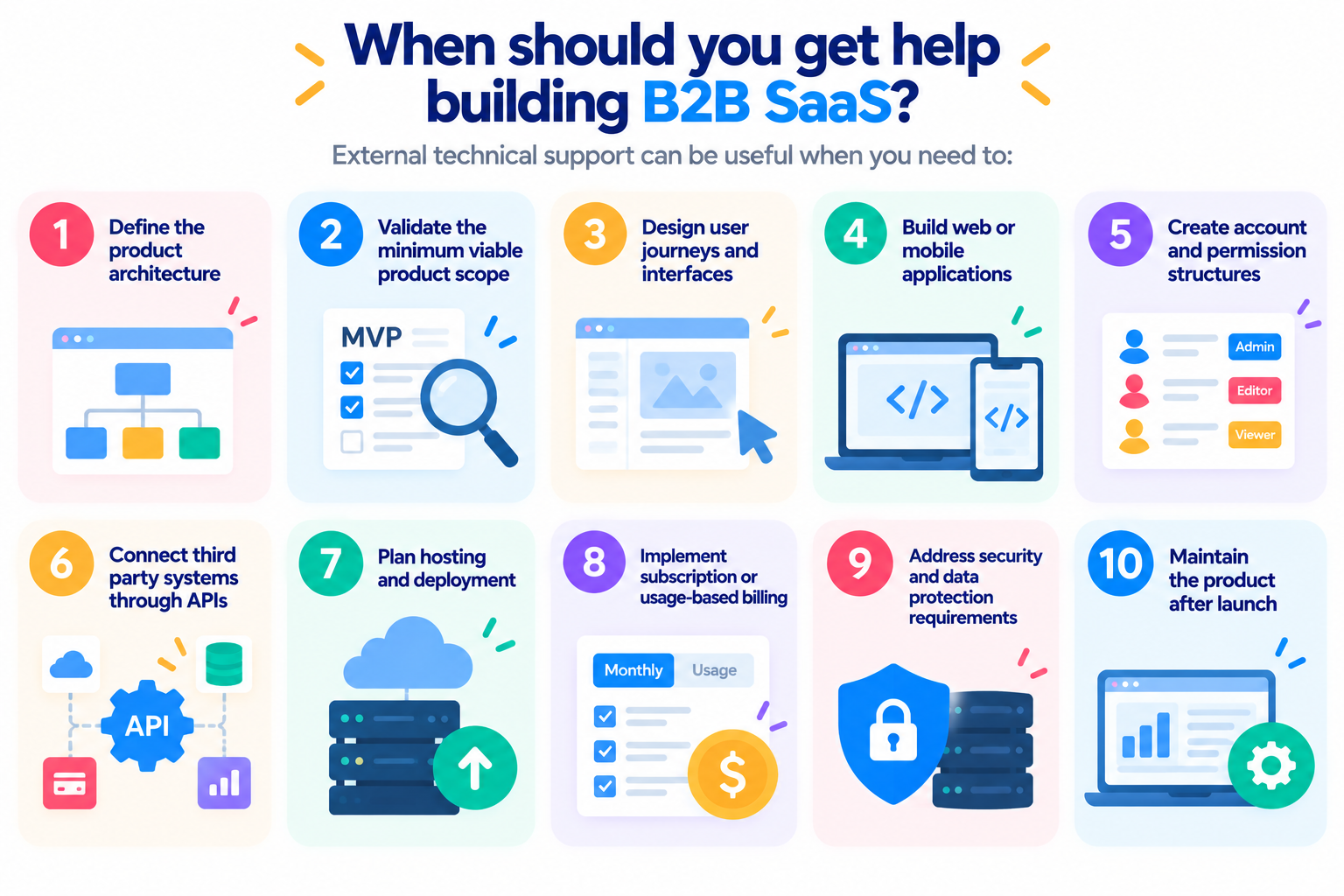
External technical support can be useful when you need to:
define the product architecture
validate the minimum viable product scope
design user journeys and interfaces
build web or mobile applications
create account and permission structures
connect third-party systems through APIs
plan hosting and deployment
implement subscription or usage-based billing
address security and data protection requirements
maintain the product after launch
Founders should ideally seek technical input before committing too much budget to development. Early architecture and scope decisions can affect future integrations, operating costs and the ability to support more customers.
Trinergy Digital, a software and creative technology company in Kuala Lumpur, builds digital solutions including websites, mobile applications and bespoke IT systems. Businesses considering a SaaS product can also review Trinergy Digital's Software as a Service solutions to understand how a custom SaaS project can be approached.
Turning a B2B SaaS idea into a working product
Understanding B2B SaaS is easier when you view it as both software and an ongoing business relationship. The provider builds and operates a cloud-based application, while business customers pay to keep accessing a service that solves a recurring problem.
A strong B2B SaaS concept therefore needs more than a list of features. You need a clear customer problem, sensible pricing, maintainable technology, appropriate data protection, practical onboarding and a reason for customers to keep using the product.
If you are considering building a SaaS platform for your business, speak with Trinergy Digital about your requirements, product scope and technical options.