



Digital transformation strategies work best when you start with a measurable business problem, document your current position, choose changes based on value and feasibility, test them with real users, and measure the result. A clear digital transformation framework keeps technology, processes, people, data and governance moving towards the same business outcome.
Key takeaways
A transformation should start with a business outcome and baseline measurement, not a list of technologies to buy.
A useful transformation roadmap connects each initiative to an owner, deadline, dependency and measurable result.
Testing after implementation is not enough. Security, data protection, usability and performance should be considered throughout the work.
Digital transformation can sound much bigger than it needs to be. A business may need to replace an ageing internal system, connect customer data across departments, automate a repetitive approval process, build a new mobile service or improve an existing website.
The technology changes from one organisation to another. The underlying method is more consistent.
As of September 2026, Malaysia Digital 2030 sets a national target for the digital economy to contribute 30% of GDP by 2030. For individual businesses, however, transformation still needs to make sense at company level. A national push towards digital adoption does not remove the need to prove that a particular investment solves a worthwhile problem.
Trinergy Digital, a software and creative technology company in Kuala Lumpur, approaches digital work from that practical perspective. A transformation plan should connect what your business wants to change with the systems, processes and user experiences required to make that change possible.
What do you need before you start?
You need a defined problem, an accountable owner, access to reliable information and agreement on what success will look like before you start choosing technology.
A common mistake is beginning with a solution: "We need AI", "we should move everything to the cloud" or "we need an app". Those ideas may eventually be correct, but they are not yet a business case.
Start by writing the problem in plain language. For example:
Customer service staff spend too much time switching between separate systems to answer routine account enquiries.
That statement gives you something to investigate. You can measure how much time staff spend switching systems, which enquiries cause delays, what information they need and whether the problem affects customers.
Before starting, establish five things:
Business problem: What needs to improve?
Owner: Who has authority to make decisions?
Users: Who will use or experience the changed process?
Constraints: What budget, systems, regulations and deadlines apply?
Success measure: What observable result would justify the work?
Your team should also identify the systems and data involved. A customer portal, for example, may depend on a CRM, payment provider, identity service and older internal database. Changing the visible interface without understanding those dependencies can move the problem rather than solve it.
Step 1: How do you set the baseline for digital transformation strategies?
Set the baseline by measuring how the current process performs before changing it. Without a baseline, you cannot reliably show whether your digital transformation strategies improved the business.
Map the existing process from beginning to end. Include manual steps, handovers, systems, approval points, delays and repeated data entry.
You do not need a complicated measurement programme. Start with a small set of figures connected directly to the problem.
For an internal approval process, you might record:
average completion time
number of manual steps
number of systems involved
error or rework rate
staff hours required each month
number of approvals that miss their target time
Customer facing projects may need different measures, such as task completion rate, support contacts, conversion rate, abandonment rate or response time.
Talk to the people doing the work as well. Analytics can show that a task takes nine minutes, but an employee may explain that five of those minutes are spent copying the same customer information between two systems.
The baseline should include technology condition too. Record which applications are business critical, which integrations exist, where data is stored, what security controls apply and which systems are approaching the end of their useful life.
Your baseline then becomes the first column of your transformation scorecard.
Area | Current baseline | Target | Measurement |
|---|---|---|---|
Process time | 18 minutes | 10 minutes | Average completion time |
Manual entry | 4 entries | 1 entry | Entries per transaction |
Error rate | 6% | Below 2% | Transactions requiring correction |
Customer completion | 72% | 85% | Successful task completion |
Support demand | 900 cases monthly | 650 cases | Relevant support cases |
Targets in a real project should come from your own baseline, operational capacity and business case. The figures above illustrate the structure rather than universal benchmarks.
Step 2: How do you build a digital transformation framework?
A digital transformation framework turns a broad ambition into coordinated decisions across business goals, people, processes, technology, data and governance. The framework should tell you what changes first, why it matters, who owns it and how each initiative connects to the next.
Digital transformation is wider than software implementation. McKinsey describes transformation as fundamentally rewiring how an organisation operates and notes that transformation is continuous rather than a one-time project. The practical implication is important: buying software does not automatically change how work gets done.
A useful framework can be organised around six connected areas.
1. Business outcome
Start with the outcome that matters enough to justify investment.
Examples include reducing fulfilment time, making a customer service available online, decreasing repetitive administrative work, improving visibility across branches or reducing the cost of processing each transaction.
Keep the outcome specific. "Become more digital" gives a project team almost no guidance.
"Reduce average customer onboarding from five working days to two while maintaining required checks" gives the team a problem it can design around.
2. People and responsibilities
Identify who uses the process, who manages it and who will be affected when it changes.
Digital projects often alter responsibilities. Automation may remove data entry but create a need to review exceptions. A new self-service portal may reduce simple enquiries while making the remaining support cases more complicated.
Include employees early enough for them to explain how work happens. Training should also be part of the transformation roadmap rather than an activity added just before launch.
3. Process
Redesign the process before automating it.
If an existing process contains seven approvals because of decisions made years ago, converting all seven approvals into digital forms preserves the underlying inefficiency.
Ask four questions about each step:
Does the step create value or control a genuine risk?
Can the step be removed?
Can two steps be combined?
Should technology automate or assist the remaining work?
The objective is not automation at any cost. Some decisions still need human judgement, especially where an unusual case, financial consequence or sensitive customer situation requires review.
4. Technology and integration
Choose technology after understanding the outcome and process.
Your options may include improving an existing platform, integrating current systems through APIs, adopting a software service, developing a custom application or replacing a legacy system.
The right choice depends on your requirements rather than novelty.
For example, a business with a capable CRM and accounting platform may gain more from connecting those systems than replacing either one. A company with a highly specialised workflow may instead need bespoke software because standard products cannot represent the process effectively.
Trinergy Digital's overview of digital transformation in software provides additional context on how software choices fit into broader business transformation.
Architecture matters here. Your team should consider system dependencies, expected transaction volumes, integrations, access controls, backup requirements, maintenance and how the platform may need to change later.
5. Data and governance
Treat data as part of the design, not a by-product of the system.
Decide which data the new process needs, where it comes from, who can access it, how long it should be retained and what happens when records are incorrect.
For Malaysian organisations handling personal data in commercial transactions, the Personal Data Protection Act 2010 and its subsequent amendments are particularly relevant. The Personal Data Protection Commissioner now provides guidance covering areas including data breach notification, data protection impact assessments, privacy by design, cross border transfers and automated decision making.
Privacy and security requirements can affect architecture, vendor selection, system permissions and data flows. Reviewing them after development may create expensive rework.
6. Measurement
Every initiative needs a measure linked to the original problem.
Avoid relying only on delivery measures such as "system launched on time". Launch tells you that software exists. It does not tell you whether the transformation worked.
Instead, measure operational or user outcomes. Has processing become faster? Are fewer transactions being corrected? Can customers complete the task without contacting support? Are employees spending less time on repetitive work?
Turn the framework into a transformation roadmap
A transformation roadmap puts the framework into sequence. It should show dependencies rather than simply listing projects by quarter.
A practical roadmap might look like this:
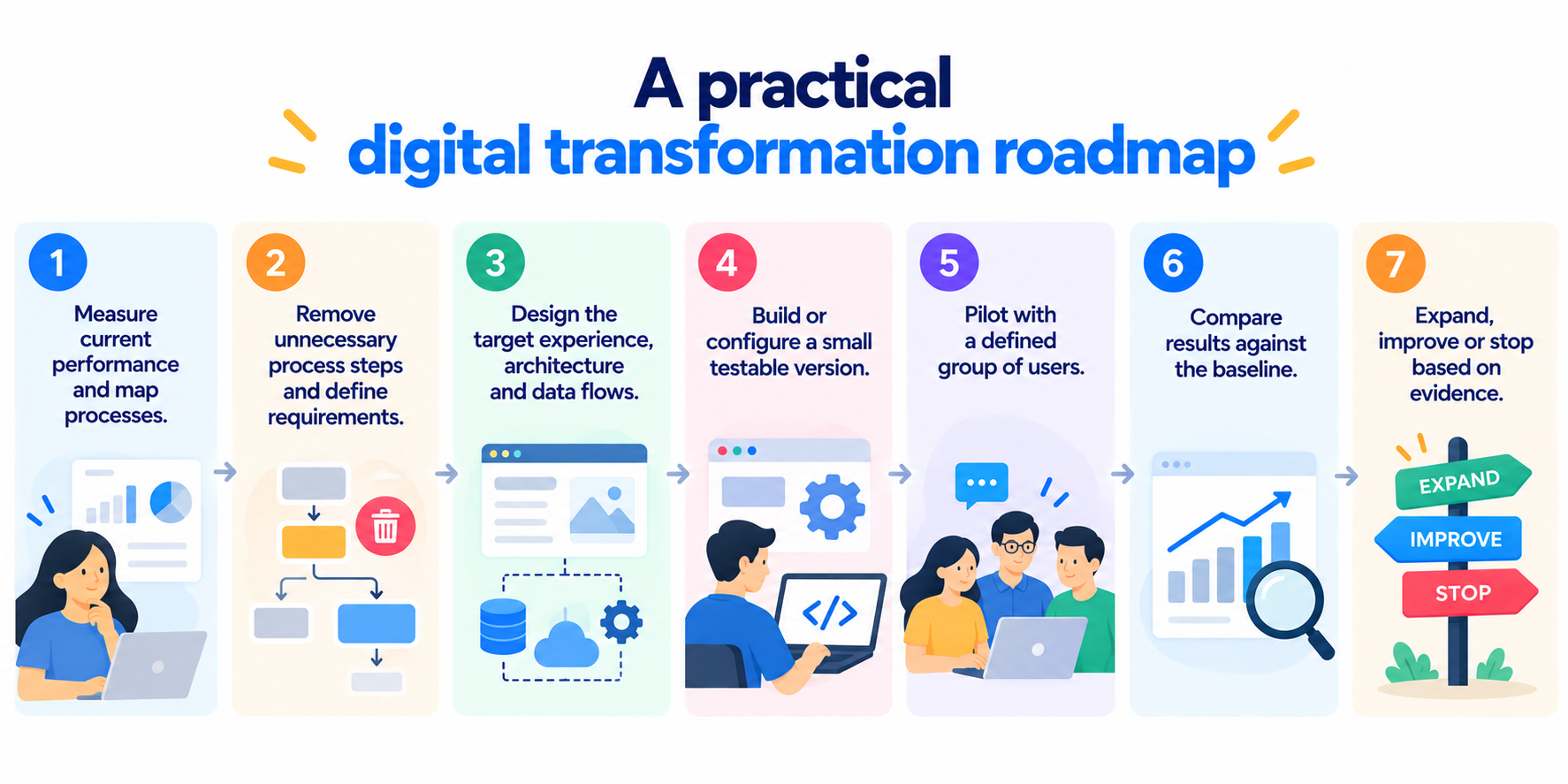
Phase 1: Measure current performance and map processes.
Phase 2: Remove unnecessary process steps and define requirements.
Phase 3: Design the target experience, architecture and data flows.
Phase 4: Build or configure a small testable version.
Phase 5: Pilot with a defined group of users.
Phase 6: Compare results against the baseline.
Phase 7: Expand, improve or stop based on evidence.
A roadmap becomes more useful when every initiative has an owner, target outcome, dependencies, decision date and measurement method.
A worked example: the 600-hour question
Consider a hypothetical Malaysian distributor processing 3,000 customer orders each month.
Suppose employees spend an average of 12 minutes manually transferring order details between an ecommerce platform and an internal order management system.
The calculation is:
3,000 orders × 12 minutes = 36,000 minutes
36,000 ÷ 60 = 600 staff hours per month
If integration reduces manual handling to three minutes per order, the process will require 150 hours instead.
Potential time released = 450 staff hours per month
That figure is not automatically a financial saving. The business still needs to determine what employees do with the released capacity, the cost of integration, ongoing maintenance and whether exceptions still require manual work.
The example shows why good digital strategy examples start with the process. "Integrate two systems" is a technical project. "Reduce repetitive order handling while maintaining accuracy" is a measurable business objective.
Step 3: How do you check that the transformation worked?
Check the transformation against the baseline, user behaviour and technical requirements before declaring it successful. A system can operate exactly as specified and still fail to improve the underlying business process.
Testing should therefore cover more than software defects.
Start with functional testing. Does the system perform the required actions correctly?
Then test the complete user journey. Can an employee or customer complete the intended task without unnecessary help?
Check integration behaviour as well. Confirm that information reaches the correct systems, failed transfers are visible and duplicate transactions do not appear when users retry an action.
Security, privacy and access controls should be tested against the requirements established during planning. For organisations looking for a general cybersecurity reference, NIST Cybersecurity Framework 2.0, published in February 2024, provides outcome-based guidance that organisations of different sizes and sectors can use to manage cybersecurity risk.
Finally, run a controlled pilot where practical. Compare a defined group using the new process with the baseline rather than rolling out to everyone immediately.
If the new process saves time but creates more errors, the project is not finished. If customers complete tasks faster but support requests increase because confirmation messages are unclear, the team has found another problem to solve.
Successful testing asks whether the change produced the intended outcome, not simply whether the software ran.
Step 4: How should you measure and repeat the process?
Measure the same indicators you recorded at the beginning, review them on a fixed schedule and use the results to decide what should change next. Digital transformation becomes sustainable when measurement continues after launch.
Create a small scorecard rather than a dashboard containing every available metric.
A useful review might compare:
baseline performance
target performance
current performance
unexpected effects
user feedback
operational cost
security or compliance issues
next action
Review frequency depends on the system. A new customer journey may need weekly monitoring during its first month. A mature internal process may only need a monthly or quarterly review.
Trends matter more than isolated figures. A one-week improvement may reflect unusual demand. Several months of consistent improvement provide stronger evidence that the change has become part of normal operations.
The same approach helps you decide what to do next. If one integration removes the largest source of manual work, the next investment might address the second largest bottleneck rather than adding more features to the first system.
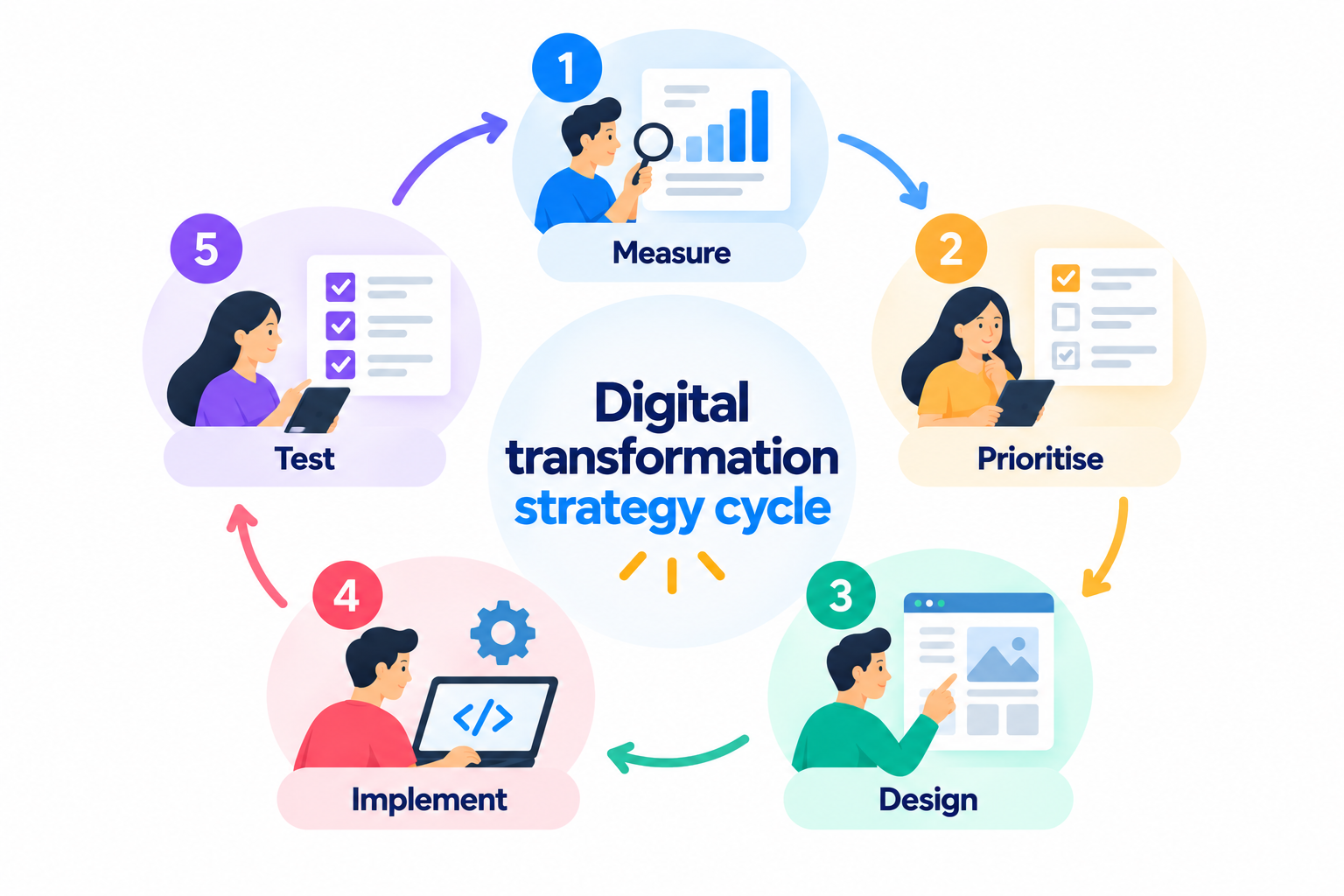
Digital transformation strategies therefore become a cycle:
Measure → prioritise → design → implement → test → measure again.
Which mistakes can undo the work?
Digital transformation usually loses value when businesses choose technology before defining the problem, attempt too much at once or stop measuring after launch. These mistakes separate technology activity from business improvement.
One common mistake is treating transformation as an IT department project. Technology teams are essential, but process owners, users, leadership, security and relevant business functions also need defined responsibilities.
Another is replacing everything at once. Large programmes create dependencies that can make it difficult to identify which change produced which result. Smaller phases give you more opportunities to test assumptions.
Poor data is another warning sign. A new analytics platform cannot fix inconsistent product codes, duplicate customer records or unclear ownership by itself.
Businesses also underestimate adoption. A technically strong platform can fail if employees do not understand why processes changed or if customers find the new journey harder than the old one.
Finally, avoid measuring activity instead of outcomes. The number of features released, workshops held or employees trained may be useful project indicators, but none proves that the business problem improved.
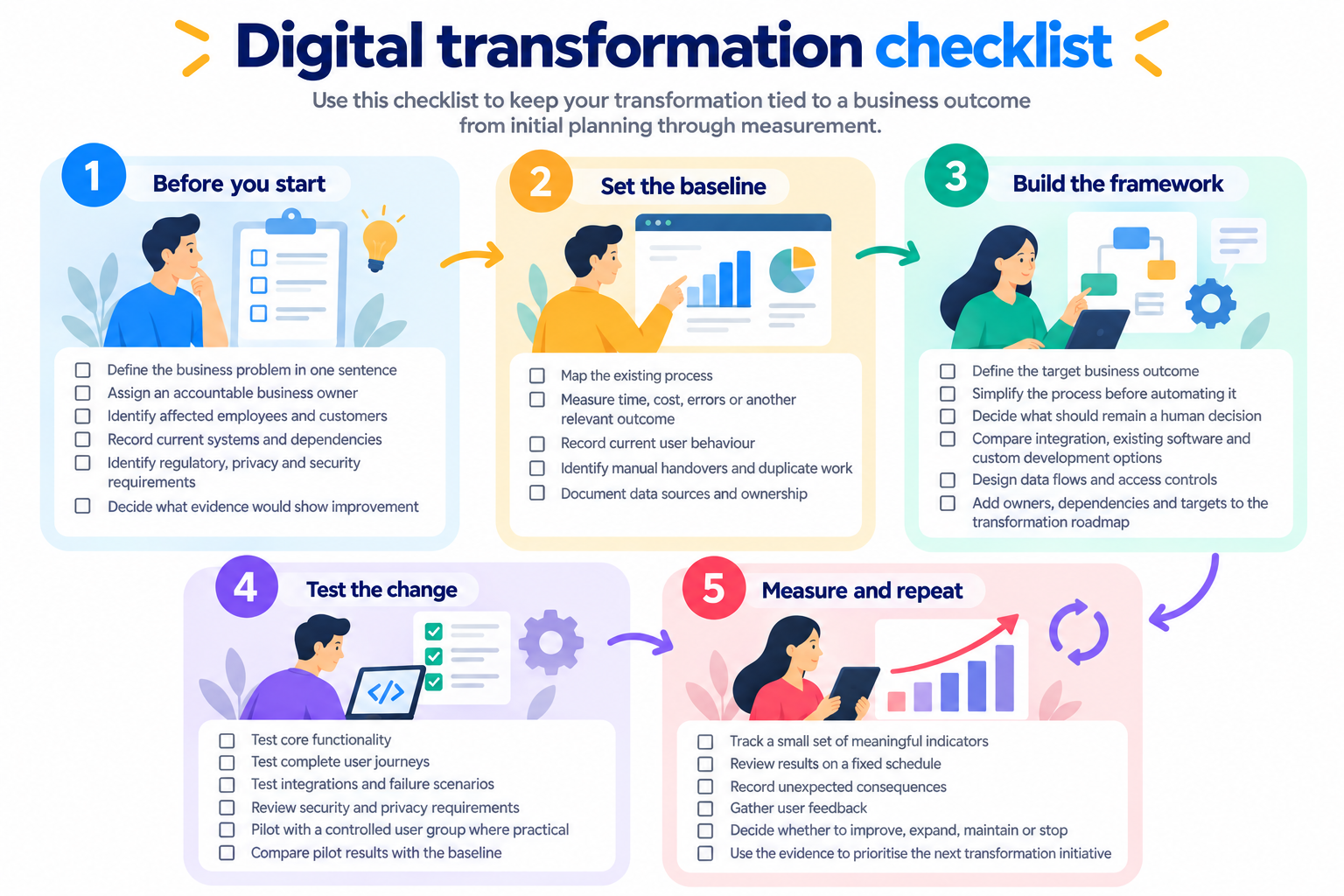
Digital transformation checklist
Use this checklist to keep your transformation tied to a business outcome from initial planning through measurement.
Before you start
☐ Define the business problem in one sentence
☐ Assign an accountable business owner
☐ Identify affected employees and customers
☐ Record current systems and dependencies
☐ Identify regulatory, privacy and security requirements
☐ Decide what evidence would show improvement
Set the baseline
☐ Map the existing process
☐ Measure time, cost, errors or another relevant outcome
☐ Record current user behaviour
☐ Identify manual handovers and duplicate work
☐ Document data sources and ownership
Build the framework
☐ Define the target business outcome
☐ Simplify the process before automating it
☐ Decide what should remain a human decision
☐ Compare integration, existing software and custom development options
☐ Design data flows and access controls
☐ Add owners, dependencies and targets to the transformation roadmap
Test the change
☐ Test core functionality
☐ Test complete user journeys
☐ Test integrations and failure scenarios
☐ Review security and privacy requirements
☐ Pilot with a controlled user group where practical
☐ Compare pilot results with the baseline
Measure and repeat
☐ Track a small set of meaningful indicators
☐ Review results on a fixed schedule
☐ Record unexpected consequences
☐ Gather user feedback
☐ Decide whether to improve, expand, maintain or stop
☐ Use the evidence to prioritise the next transformation initiative
Turn your transformation plan into practical work
Effective digital transformation is a sequence of informed decisions rather than a race to adopt more technology. Start with a measurable problem, understand your baseline, design the process before choosing the system, test the outcome and keep measuring after launch.
The strongest plans also leave room to change direction. Evidence may show that an integration is more valuable than a new platform, that one process should remain partly manual or that the next investment belongs in a completely different part of the business.
Trinergy Digital, a software and creative technology company in Kuala Lumpur, works across digital strategy, software, web and mobile development, system architecture and related technology services. You can review Trinergy Digital's services when considering the capabilities your transformation may require.
If you are planning a new digital initiative or reviewing an existing transformation roadmap, contact Trinergy Digital to discuss the business problem, technical requirements and practical next steps.