



When buying digital transformation consulting, look for a partner who can identify business problems, recommend practical improvements, and explain how success will be measured. Good consulting should give you clear deliverables, realistic costs, implementation priorities, and accountability. Before signing, compare each provider's experience, proposed approach, pricing structure, and ability to support execution.
Key takeaways
Digital transformation consulting can cover business process reviews, technology assessments, implementation planning, and change management.
Consulting fees and technology implementation costs should be evaluated separately to avoid unexpected expenses.
A credible consultant should define measurable outcomes, project responsibilities, and acceptance criteria before work begins.
Digital transformation often begins with a familiar problem. Your employees spend hours transferring information between systems, customers wait too long for updates, or management cannot access reliable data without requesting another spreadsheet.
You know something needs to change. What is less obvious is whether you need new software, better processes, or an outside perspective.
That is where digital transformation consulting comes in.
A consultant should help you understand the underlying problem before recommending a solution. Sometimes the answer involves a new customer relationship management system, a mobile application, or an integrated business platform. In other cases, improving an existing workflow may deliver more immediate value.
The challenge is knowing whether the consulting fees will lead to meaningful improvements.
For Malaysian businesses comparing suppliers, understanding what is included, what costs extra, and what results to expect is essential before making a commitment.
Who is digital transformation consulting for?
Digital transformation consulting is most useful for businesses that recognise operational problems but need help deciding which processes, systems, or investments to prioritise.
You do not necessarily need to be a large corporation. Small and medium enterprises can benefit from consulting when their operations become too complex for existing tools.
Consider a Malaysian wholesale distributor that manages orders through WhatsApp, tracks inventory in spreadsheets, and prepares invoices using separate accounting software.
Each system may work individually, but the overall process creates repeated data entry, delays, and opportunities for mistakes.
A transformation consultant can assess how information moves between departments and recommend improvements based on business priorities.
When consulting makes sense
You may benefit from external advice when:
Your systems no longer work well together. Employees repeatedly enter the same information into different platforms.
Your business is growing faster than its processes. Manual approvals, reporting, and administration are becoming difficult to manage.
You are considering a major software investment. You need an independent assessment before committing to a new system.
Your previous technology projects have struggled. Poor adoption, unclear requirements, or unexpected costs have affected results.
You lack internal technical leadership. Your management team understands the business challenges but needs support evaluating technology options.
Consulting may be unnecessary if your requirements are already well defined and you simply need a supplier to build or configure a specific solution.
For example, if you have completed the requirements for a straightforward corporate website, a website development project may be more appropriate than a broader transformation engagement.
The distinction matters because consulting should reduce uncertainty rather than introduce unnecessary work.
What's included in digital transformation consulting services?
Digital transformation consulting services typically include discovery, business process assessment, technology evaluation, implementation planning, and organisational change support. However, the exact scope varies significantly between providers.
Some consultants focus on strategy and recommendations. Others also design, develop, integrate, and maintain the systems they propose.
Understanding that difference helps you compare quotations fairly.
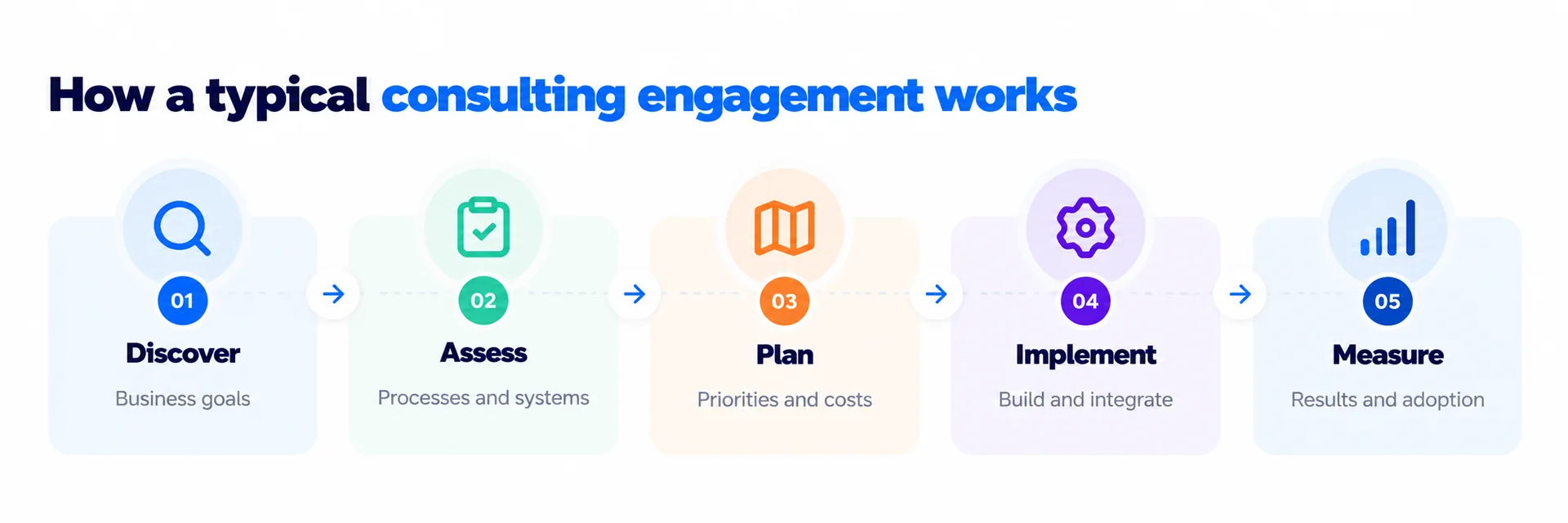
Business discovery and process assessment
The consultant begins by understanding how your business operates.
This may involve stakeholder interviews, reviewing existing workflows, examining system documentation, and identifying where delays or duplicated effort occur.
The output should include a clear assessment of current problems and their business impact.
For example, a consultant might discover that your sales team manually transfers customer orders into an inventory system, creating unnecessary administrative work.
Technology assessment and recommendations
The next step is determining whether your current technology can support your business goals.
A consultant may review your existing software, data quality, integration capabilities, security controls, and infrastructure.
Recommendations should consider whether you can improve existing systems before replacing them.
For Malaysian businesses, this assessment should also consider applicable data protection obligations, including the Personal Data Protection Act 2010 and subsequent amendments where relevant.
Transformation roadmap
A transformation roadmap explains what should happen, in what order, and why.
A useful roadmap should identify:
Projects ranked by business impact and urgency.
Estimated budgets and implementation periods.
Dependencies between systems and departments.
Internal and external responsibilities.
Measurable success criteria.
A roadmap that simply recommends purchasing several software products is not enough. You should understand the reasoning behind each recommendation.
Implementation and change management
Some consulting engagements stop once the strategy is delivered. Others include project management, software development, system integration, testing, and employee training.
If implementation is included, establish who will configure or build the solution, who will approve changes, and who will provide ongoing support.
Employee adoption deserves particular attention. Even a technically successful system may deliver limited value if employees continue using their previous manual processes.
How consulting models compare
Consulting model | Best suited for | Typical deliverables | Potential drawback |
|---|---|---|---|
Strategy focused consultancy | Businesses requiring independent direction | Assessment, roadmap, business case | Implementation requires another supplier |
Technology implementation partner | Businesses with defined technical needs | System configuration, integration, deployment | May focus on specific technology platforms |
End to end transformation partner | Businesses needing planning and execution | Discovery, roadmap, development, rollout | Scope and total costs can be substantial |
Specialist transformation consultant | Businesses solving a focused problem | Targeted assessment and recommendations | May lack expertise outside the specialist area |
No single model is automatically better. The right choice depends on how much internal expertise you have and whether your organisation needs strategic advice, technical delivery, or both.
For example, Trinergy Digital, a software and creative technology company in Kuala Lumpur, develops websites, mobile applications, and bespoke IT systems. Businesses considering these solutions should establish whether their immediate requirement is technology development or a broader assessment of their operations.
How do you shortlist the right consulting partner?
The best way to shortlist a digital transformation company is to compare how well it understands your business, defines project outcomes, and explains its recommendations. A polished presentation or impressive client list should not replace evidence of relevant expertise.
Start with three to five potential providers, then assess each against the same criteria.
Look for relevant business experience
A consultant who understands your industry may identify operational requirements that a general technology supplier overlooks.
For example, a manufacturing business may prioritise production visibility and inventory accuracy, while a financial services company may focus on customer data, approval workflows, and regulatory obligations.
Ask providers to explain how they would approach a business problem similar to yours. Relevant case studies can help, but pay attention to the consultant's reasoning rather than the size of the client.
Assess technical and strategic capabilities
A strong consulting partner should connect business objectives with practical technology decisions.
Check whether the provider can evaluate your existing systems, explain integration requirements, identify security considerations, and develop realistic implementation plans.
You should also establish whether the consultancy provides independent advice or primarily recommends products it sells.
A provider that earns revenue from implementation is not necessarily unsuitable. However, it should be transparent about commercial relationships and explain why its proposed technology is appropriate.
Evaluate the people doing the work
The consultant presenting the proposal may not be the person managing your project.
Ask who will conduct discovery, prepare recommendations, oversee implementation, and communicate with your internal team.
You should understand the proposed team's responsibilities and availability before committing.
Use a consistent evaluation scorecard
Consulting partner scorecard
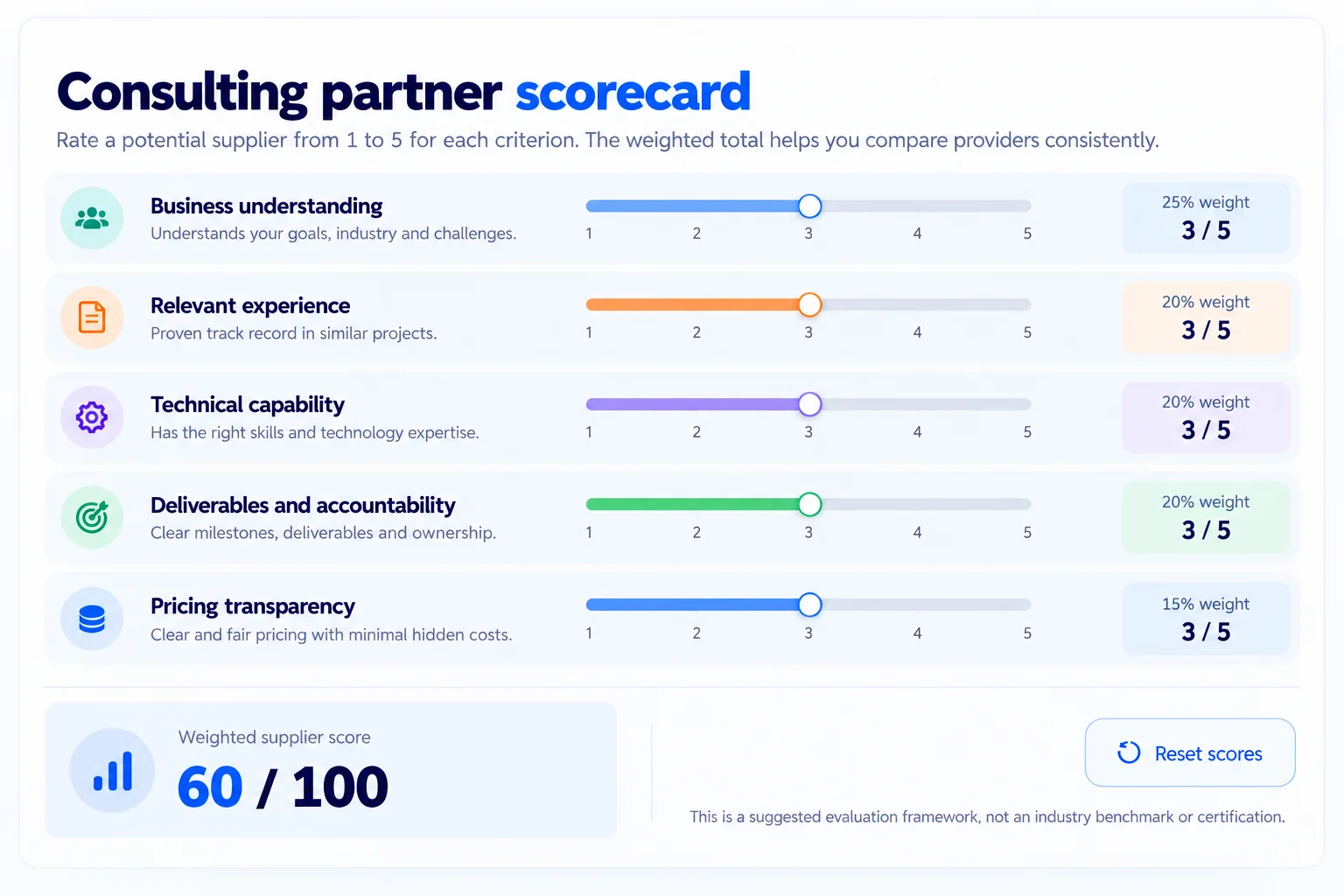
Business understanding receives the highest weighting because technology recommendations are only useful when they address the right problems.
Use the scorecard alongside interviews, reference checks, and written proposals. A high score does not replace proper commercial and technical due diligence.
What questions should you ask before signing?
Before signing a consulting agreement, ask questions that establish exactly what you are buying, who is responsible for delivery, and what happens if requirements change.
A good proposal should make these details clear without requiring you to interpret vague consulting terminology.
Here are seven questions worth asking.
1. What will we receive at the end of the engagement? Request a deliverables list covering reports, technical documentation, recommendations, and implementation plans.
2. How will you measure success? Agree on measurable indicators such as processing time, error rates, employee adoption, or reporting accuracy.
3. Who will work on our project? Confirm the delivery team, project manager, technical specialists, and decision makers.
4. What is excluded from your quotation? Check whether software licences, development, integrations, training, and ongoing support are included.
5. How will you handle changes in scope? Understand how additional requirements affect pricing and timelines.
6. Who owns the project documentation and deliverables? Clarify ownership, licensing, access rights, and handover arrangements.
7. What happens after the consulting engagement ends? Establish whether you can implement the recommendations internally or with another supplier.
Ask for a sample deliverable
A sample assessment report or transformation roadmap can reveal more than a sales presentation.
Look for clear findings, prioritised recommendations, estimated costs, dependencies, and specific next steps.
You should also ask how the consultant handles confidential information. Where personal data is involved, appropriate contractual safeguards and compliance requirements should be considered before granting access.
Malaysia's Personal Data Protection (Amendment) Act 2024 introduced changes to the country's data protection framework, with provisions commencing in stages during 2025. Businesses should assess the obligations relevant to their processing activities.
What are the red flags when choosing a consultant?
The biggest warning sign is a consultant who recommends expensive technology before understanding your business. Other concerns include unclear deliverables, unrealistic promises, and quotations that hide implementation costs.
A reliable consultant should be willing to explain assumptions, acknowledge risks, and identify situations where a proposed investment may not be worthwhile.
Recommendations before discovery
Be cautious if a supplier immediately recommends replacing your enterprise resource planning system or adopting artificial intelligence without reviewing your existing processes.
Technology selection should follow an assessment of business requirements.
Promises without measurable outcomes
Claims about dramatic productivity improvements mean little without a baseline.
If a consultant promises to reduce administrative work by 50%, ask what activities were measured, how the estimate was calculated, and what assumptions support the projection.
Unclear pricing and responsibilities
A low initial quotation may exclude essential work such as data migration, integration, testing, or training.
Request an itemised scope and a clear process for approving additional costs.
No plan for employee adoption
New software can create frustration when employees do not understand how their responsibilities will change.
Consultants should account for communication, training, testing, and feedback during implementation.
Dependence on one supplier
Avoid arrangements that leave your organisation unable to access its own data, documentation, or systems without the original consultant.
Check data export options, administrator access, intellectual property terms, and transition support.
These precautions are particularly relevant when replacing business critical systems that employees use every day.
What affects the final cost digital transformation consulting cost in Malaysia?
Consulting fees generally increase when your project involves multiple departments, complex existing systems, extensive stakeholder interviews, or detailed technical assessments.
Other cost factors include:
The number of business processes being reviewed.
The complexity of existing software and integrations.
The quality and accessibility of business data.
The level of technical documentation required.
The amount of employee training and change management.
The duration of implementation oversight.
Software licences, cloud hosting, system development, and maintenance may be charged separately.
A worked example of potential savings
Consider a Malaysian distributor with eight administrative employees who each spend 45 minutes daily entering information between separate systems.
If a proposed integration reduces this work to 15 minutes per employee, the potential time saving would be:
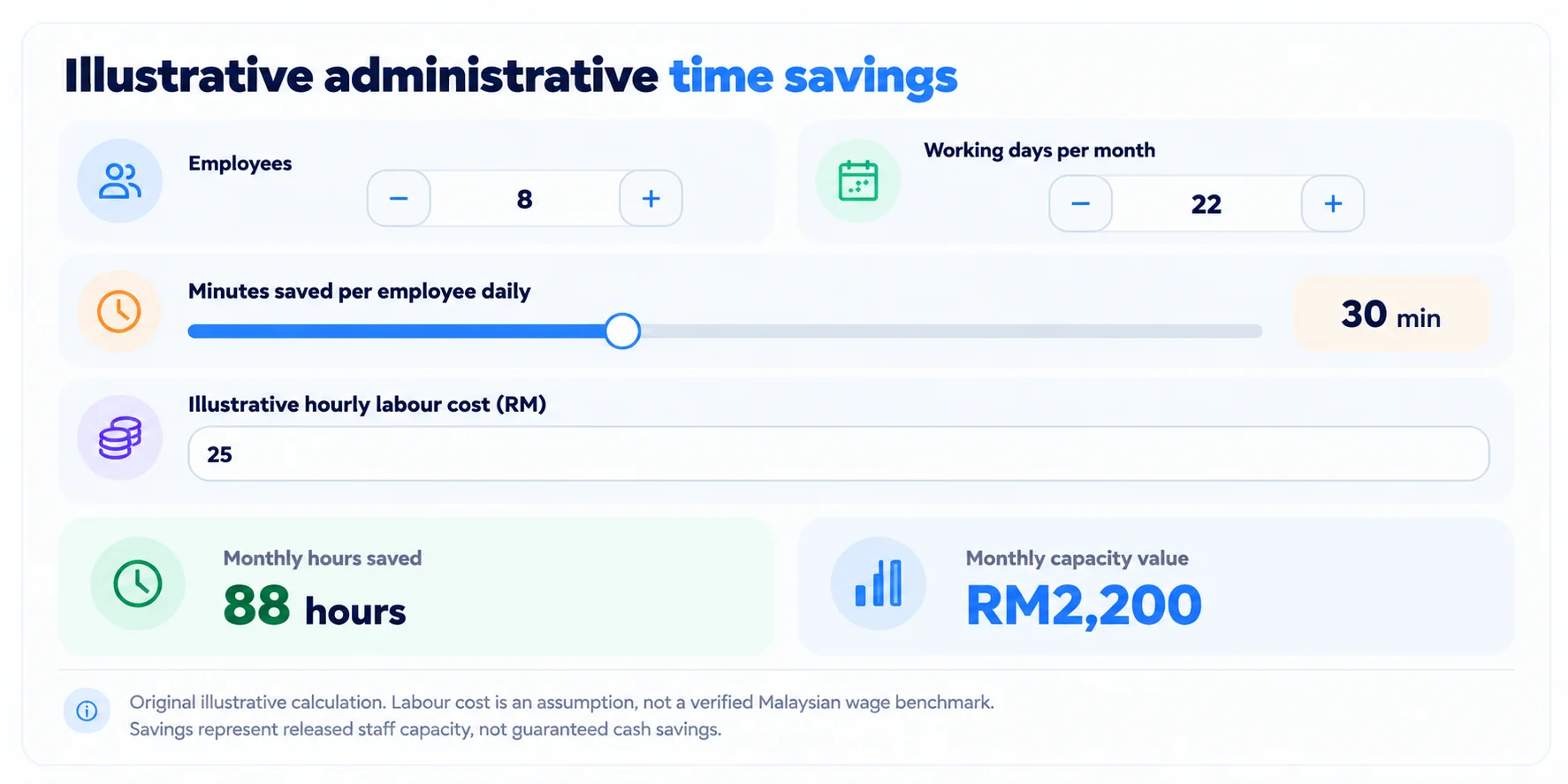
Under the default assumptions, the improvement releases 88 employee hours monthly, equivalent to RM2,200 in labour capacity at RM25 per hour.
Over 12 months, that represents RM26,400 in potential capacity value, assuming the improvement is sustained.
However, the calculation does not account for consulting fees, software development, maintenance, or training. It also does not mean the business will automatically reduce payroll costs.
A responsible consultant should explain these limitations when presenting return on investment projections.
How long should a transformation project take?
A focused assessment may take a few weeks, while a programme involving software development, data migration, testing, and employee training may run for several months.
The implementation schedule should depend on technical complexity and business readiness.
For larger projects, consider dividing delivery into phases. This allows your organisation to test improvements, gather feedback, and review results before expanding the investment.
Making your consulting investment count
The value of digital transformation consulting should be measured by the decisions it improves and the business outcomes it helps achieve, not simply by the number of reports or workshops delivered.
Before committing to a provider, establish your priorities, request a clearly defined scope, and compare proposals using consistent criteria.
You should know what the consultant will deliver, how much the work will cost, and what responsibilities remain with your organisation.
For businesses planning new websites, mobile applications, integrated platforms, or bespoke software, choosing the right technical partner is equally important.
Trinergy Digital, a software and creative technology company in Kuala Lumpur, provides digital strategy, technology development, and creative technology services. Explore our digital services to understand the available capabilities.
Ready to discuss your digital transformation requirements? Contact Trinergy Digital to discuss your business challenges, project scope, and potential next steps.