



AI overview tracking starts by choosing the searches that matter to your business, recording your current visibility, monitoring which pages Google cites, and comparing the results over time. Use Google Search Console alongside a dedicated tracking tool when you need query level monitoring, then review changes regularly rather than treating a single citation as success.
Key takeaways
Google Search Console now reports impressions from generative AI features including AI Overviews and AI Mode.
AI Overview citations can change, so useful monitoring depends on repeated checks rather than a single search.
Track pages and business outcomes alongside citations because visibility without relevant traffic or enquiries has limited commercial value.
AI Overviews have changed what search visibility can look like. A page can rank in conventional results while also appearing as a supporting source within an AI-generated response. That gives marketing teams another visibility layer to measure.
As of September 2026, Google provides a dedicated generative AI performance report in Search Console. Google announced the report on 3 June 2026 and states that the insights had rolled out to websites worldwide by 31 August 2026. The report covers impressions from AI Overviews and AI Mode and can break performance down by page, country, device and date.
That makes AI overview tracking more measurable than it was previously. The challenge is connecting Google's site-level data with the actual questions your customers ask, and the pages Google chooses to cite.
What do you need before you start?
Effective tracking needs a defined query set, access to reliable data and a baseline against which you can measure change.
Start with access to Google Search Console for your website. Google requires property ownership verification before performance data becomes available. You should also have a spreadsheet or reporting dashboard and, for more detailed monitoring, access to an AI search tracking platform.
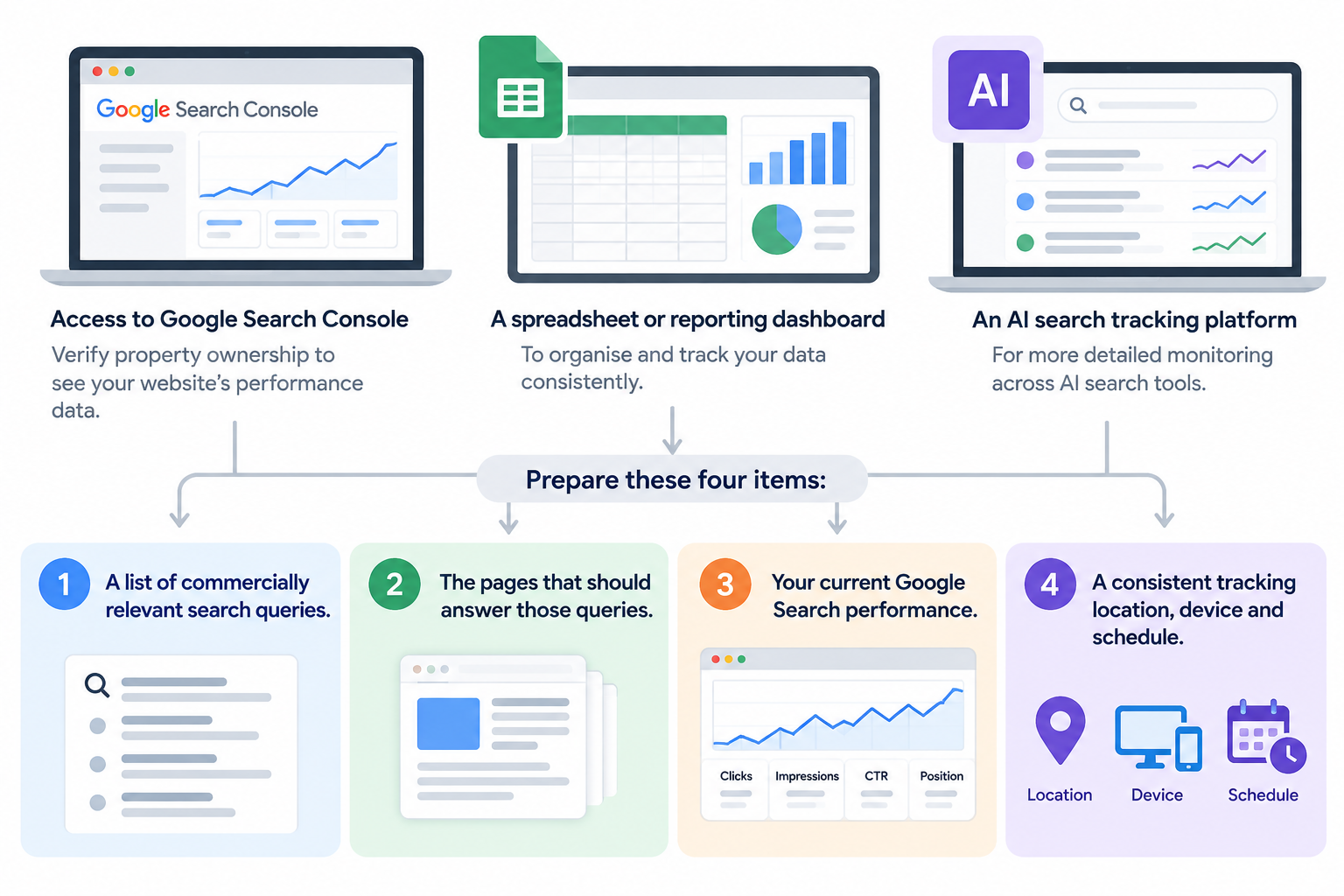
Prepare these four items:
A list of commercially relevant search queries.
The pages that should answer those queries.
Your current Google Search performance.
A consistent tracking location, device and schedule.
Avoid building the query list entirely around your company name. Someone researching a supplier is more likely to ask a question such as "What should a business website cost in Malaysia?" than search for a company they have never encountered.
For a Kuala Lumpur software company, useful prompts might cover website development costs, mobile application development, software suppliers, ecommerce systems and questions about choosing a technology partner in Malaysia.
The objective is to monitor the questions connected to a buying decision.
Step 1: Set the baseline
Your baseline should record what Google shows before you make changes, giving you a reference point for future comparisons.
Choose a manageable group of high-value queries first. For a small or medium business, 20 to 50 queries can provide a useful starting sample without creating an unnecessarily large reporting exercise.
For each query, record:
Metric | What to record | Why it matters |
|---|---|---|
Query | Exact search or question | Keeps each check consistent |
AI Overview | Present or absent | Shows whether the query triggers an AI answer |
Your site cited | Yes or no | Measures your direct visibility |
Cited URL | Exact page | Shows which content Google selected |
Competitors cited | Domains shown | Reveals competing sources |
Search Console impressions | Current figure | Adds first-party Google data |
Date and location | Malaysia and check date | Makes comparisons more meaningful |
Google explains that a Search Console impression records when a link to your site is shown to a user. Its generative AI report now provides a dedicated view of impressions generated by AI features.
Do not treat conventional ranking position and AI citation visibility as the same metric. A page may perform differently across these search experiences, and Google says AI features can use a technique called query fan-out to run related searches across subtopics and data sources.
Your baseline therefore needs to record both conventional search performance and AI visibility.
Step 2: How do you track AI Overviews?
To track AI Overviews properly, combine first-party Search Console data with repeated query monitoring so you can see both overall visibility and individual citation behaviour.
Start with Google Search Console
Open the generative AI performance report for your verified property. Review impressions, pages, countries, devices and dates.
As of September 2026, Google says the report includes AI Overviews and AI Mode. It does not turn every AI appearance into a conventional keyword ranking report, so use it as your first-party measurement layer rather than your only source of information.
Look for three signals.
First, identify pages receiving generative AI impressions. These URLs show you which parts of your site Google already considers useful within AI search experiences.
Second, compare performance over time. Weekly or monthly comparisons are more useful than reacting to one day because search results can change.
Third, filter geographically where relevant. A Malaysian company serving local customers should pay particular attention to Malaysian visibility rather than assuming results observed elsewhere represent its target market.
Track your priority queries consistently
Next, track AI overviews for the query set created during your baseline.
Run the same questions on a regular schedule and record whether an AI Overview appears, whether your domain is cited and which page receives the citation.
Consistency matters. Search experiences can vary according to the query, location and other contextual factors. Google also states that AI Overviews do not appear for every search.
For commercial monitoring, weekly checks usually provide a practical starting point. Businesses with frequently changing products, prices or content may need more frequent monitoring.
Use a tracking platform when the query set grows
Manual monitoring becomes inefficient once you are checking dozens or hundreds of queries.
Dedicated tools can automate parts of Google AI overview rank tracking. For example, Ahrefs Brand Radar supports Google AI Overviews and AI Mode alongside other AI platforms. Its custom prompt tracking starts at US$50 per month for 2,500 checks as of September 2026, while broader AI visibility products carry higher prices.
The calculation behind these tools matters.
Suppose your team tracks 40 prompts across Google AI Overviews every day:
40 prompts × 30 days = 1,200 monthly checks
If you add a second location, such as Malaysia and Singapore:
40 prompts × 2 locations × 30 days = 2,400 monthly checks
That simple calculation shows why you should define your monitoring scope before paying for a platform. More prompts, platforms, locations and update frequencies can quickly increase usage.
This is also where supplier comparisons should go beyond software fees. A platform can collect observations, but someone still needs to decide which prompts matter, interpret changes, improve content and connect visibility to commercial outcomes.
Record the source page, not only the brand mention
A citation is more useful when you know which URL earned it.
If Google repeatedly selects a detailed service guide rather than your service page, that tells you something about the type of information it finds useful for that query.
Review cited pages for clear answers, evidence, tables, definitions, useful examples and logical headings. Google's own guidance says there are no special technical requirements for AI Overviews beyond being indexed, eligible to appear in Search with a snippet and following established Search requirements and best practices.
Do not create awkward pages solely for an AI crawler. Create pages that answer the reader's question clearly and can also be understood easily by search systems.
Trinergy Digital, a software and creative technology company in Kuala Lumpur, can approach AI overview monitoring as part of the wider SEO and website measurement process rather than treating it as an isolated metric.
Step 3: How do you check whether the work succeeded?
Check success by comparing your new results with the baseline and looking for sustained improvement across visibility, cited pages and business outcomes.
After making content or technical changes, allow enough time for Google to crawl, index and reassess the page. Then rerun the same query set.
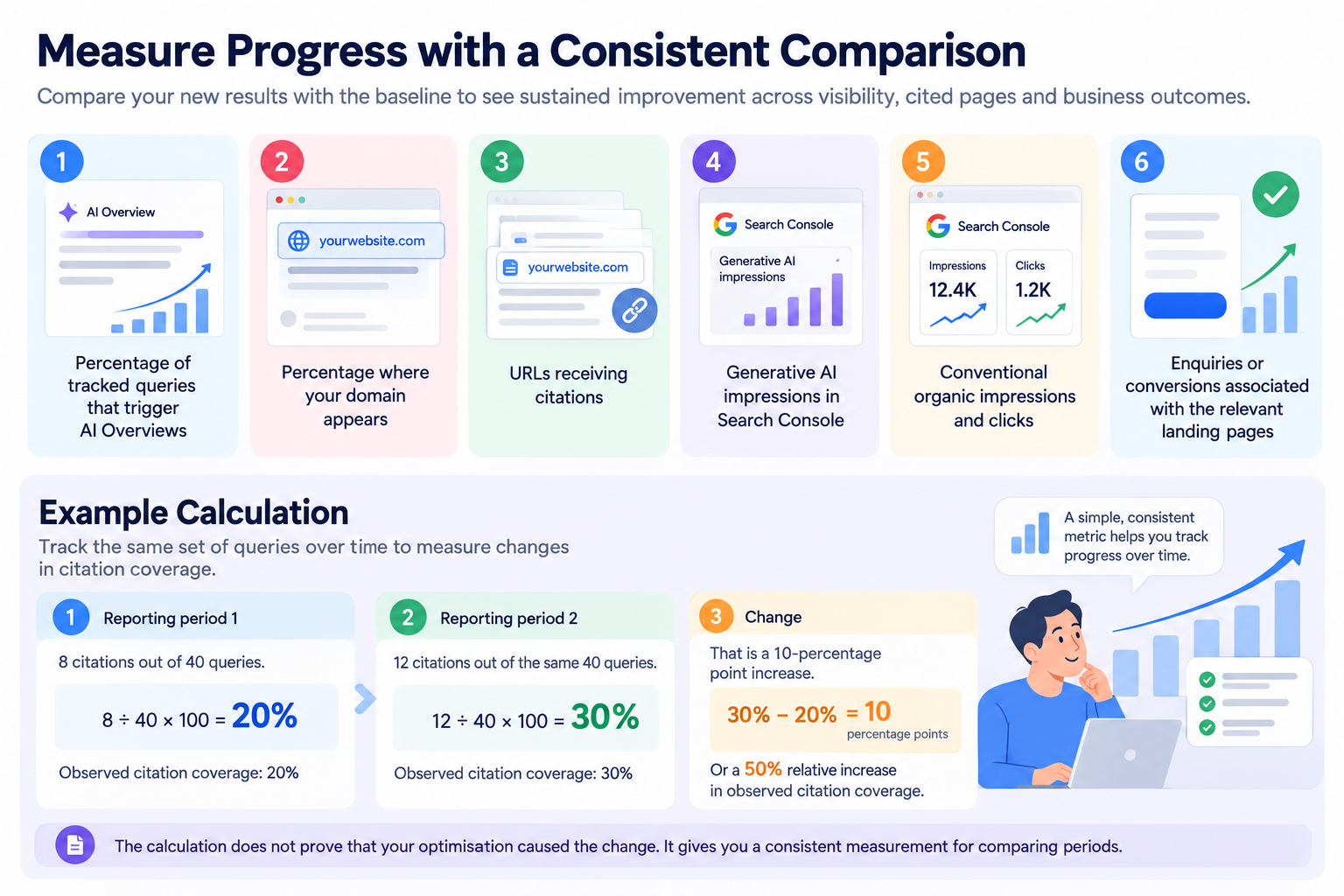
Compare:
the percentage of tracked queries that trigger AI Overviews
the percentage where your domain appears
the URLs receiving citations
generative AI impressions in Search Console
conventional organic impressions and clicks
enquiries or conversions associated with the relevant landing pages
Here is a useful internal metric.
If you monitor 40 queries and your site appears as a cited source for 8, your observed citation coverage is:
8 ÷ 40 × 100 = 20%
If the next reporting period produces 12 citations across the same 40 queries, coverage becomes 30%.
That is a 10-percentage point increase, or a 50% relative increase in observed citation coverage.
The calculation does not prove that your optimisation caused the change. It gives you a consistent measurement for comparing periods.
Step 4: Measure and repeat
AI Overview monitoring works best as a recurring process because search results, competing pages and Google's AI features continue to change.
Use a monthly reporting cycle for strategic decisions, supported by weekly tracking where the query set justifies it.
Separate the metrics into three levels.
Visibility metrics include AI impressions, citation coverage and the number of cited URLs.
Engagement metrics include organic clicks, click-through rate and activity on the landing page.
Commercial metrics include enquiries, qualified leads and conversions.
For a Malaysian B2B company, the distinction matters. A page appearing frequently for broad international searches may generate more visibility than a page answering a specific Malaysian purchasing question, but the local page could generate more relevant enquiries.
Trinergy Digital recommends treating AIO tracking as one part of a wider measurement framework rather than using citation counts as the sole performance target.
Mistakes that undo the work
The biggest tracking mistakes come from inconsistent measurement and from chasing citations without considering the user behind the search.
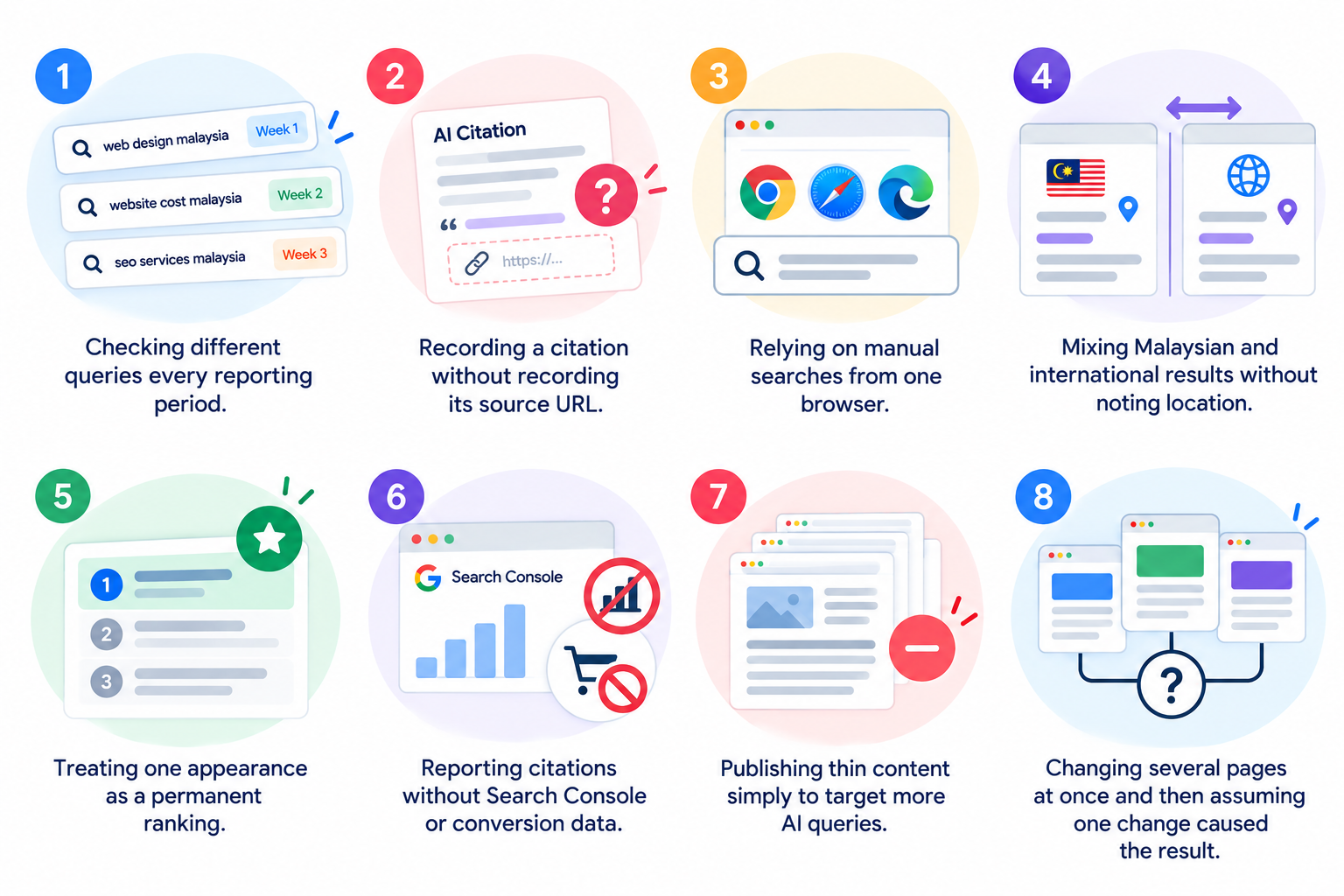
Common problems include:
checking different queries every reporting period
recording a citation without recording its source URL
relying on manual searches from one browser
mixing Malaysian and international results without noting location
treating one appearance as a permanent ranking
reporting citations without Search Console or conversion data
publishing thin content simply to target more AI queries
changing several pages at once and then assuming one change caused the result
Another mistake is expecting special AI optimisation tricks to replace basic SEO. Google states that its established SEO best practices remain relevant for AI features and that there are no additional technical requirements for appearing in AI Overviews or AI Mode.
Good tracking should tell you what happened. Good analysis should help you decide what to improve next.
AI Overview tracking checklist
Use this checklist for each reporting cycle.
Confirm Search Console access.
Choose 20 to 50 priority queries.
Record the target page for each query.
Check whether each query triggers an AI Overview.
Record whether your domain appears.
Save the cited URL.
Record important competing sources.
Review generative AI impressions in Search Console.
Segment Malaysian data where relevant.
Compare results with the previous period.
Review organic clicks and landing page behaviour.
Record enquiries or conversions.
Prioritise pages with strong commercial relevance.
Improve content where the evidence identifies a genuine gap.
Repeat the same query set on the next reporting date.
The checklist keeps AIO tracking focused on comparable evidence rather than screenshots collected without a measurement plan.
Turn AI visibility into measurable search performance
AI overview tracking is most useful when it answers a business question: are the pages that matter becoming more visible when potential customers research your services?
Start with Search Console and a small, fixed query set. Establish your baseline, monitor citations consistently, measure changes and connect those observations with clicks and enquiries. Add paid software when the volume of prompts makes manual monitoring inefficient.
Software provides one pricing signal. As of September 2026, Ahrefs lists custom prompt tracking from US$50 per month, while larger AI visibility packages cost more. Managed AI SEO work should be compared on scope, including research, tracking volume, content work, technical changes and reporting, rather than software access alone.
If you want help building a measurement framework around SEO and AI search visibility, review Trinergy Digital's services and speak with the team about the searches, pages and markets that matter to your business. Contact Trinergy Digital to discuss your requirements and the appropriate next step.