



How much does web design cost in Malaysia? As of September 2026, a business website can cost roughly RM1,500 to RM50,000 or more. A straightforward SME website commonly sits around RM3,000 to RM10,000, while custom ecommerce, integrations and complex functionality can push the budget well above RM20,000.
Key takeaways
Published Malaysian web design prices vary considerably because a five-page template website and a custom business platform are fundamentally different projects.
A lower initial quote can cost more later when hosting, maintenance, content, licences, integrations or additional revisions sit outside the quoted scope.
The best way to compare suppliers is to compare deliverables, ownership, support and exclusions rather than the headline price alone.
Web design price Malaysia ranges in 2026
As of September 2026, published Malaysian pricing suggests that you can spend from around RM1,500 on a basic website to RM50,000 or more on a substantial custom project. The important question is not simply what a website costs, but what you receive for the money.
Current published Malaysian prices illustrate how wide the market is. One provider lists packages from RM1,888 to RM3,888, while other 2026 guides put professional agency projects anywhere from RM2,500 to RM50,000 or more. Corporate sites with more substantial scope can reach RM12,000 to RM45,000, while ecommerce and catalogue-heavy projects can exceed RM25,000.
A useful starting point for budgeting is:
Website tier | Indicative price as of September 2026 | Typical scope | Suitable for | Main drawback |
|---|---|---|---|---|
Basic template site | RM1,500 to RM3,000 | Around 3 to 5 pages, template-based design, contact form | Micro businesses and simple company profiles | Limited customisation |
SME business site | RM3,000 to RM10,000 | Around 5 to 15 pages, responsive design, CMS, basic SEO setup | Established SMEs | Advanced features usually cost extra |
Custom corporate site | RM10,000 to RM25,000+ | Custom UI and UX, larger content structure, integrations | Larger businesses | Higher initial investment |
Ecommerce site | RM6,000 to RM30,000+ | Product catalogue, checkout, payment integration, order functions | Online retailers | Complexity grows quickly with requirements |
Bespoke digital platform | RM25,000 to RM50,000+ | Custom functionality, databases, integrations and workflows | Businesses with specific operational needs | Requires detailed planning and ongoing support |
These ranges are market guidance rather than a fixed rate card. Published prices differ substantially between Malaysian providers, so treat them as budgeting bands rather than a guarantee of what any particular supplier will quote.
A Web design package Malaysia businesses receive for RM3,000 should therefore not be compared directly with a RM20,000 custom project unless both proposals contain equivalent deliverables.
Trinergy Digital, a software and creative technology company in Kuala Lumpur, approaches web design around business objectives, target audiences, information architecture, UI and UX design, wireframing and prototyping. Those elements illustrate why the number of visible pages is only one part of a website quotation.
What pushes the price up?
Website prices rise when your project requires more original design, content, functionality, integrations, testing or specialist development work. Page count matters, but complexity usually has a greater effect on cost than the number of pages alone.
A five-page corporate website containing text, images and an enquiry form is relatively predictable. A five-page website containing a customer login, product database, quotation calculator and connection to an internal system is a different development project.
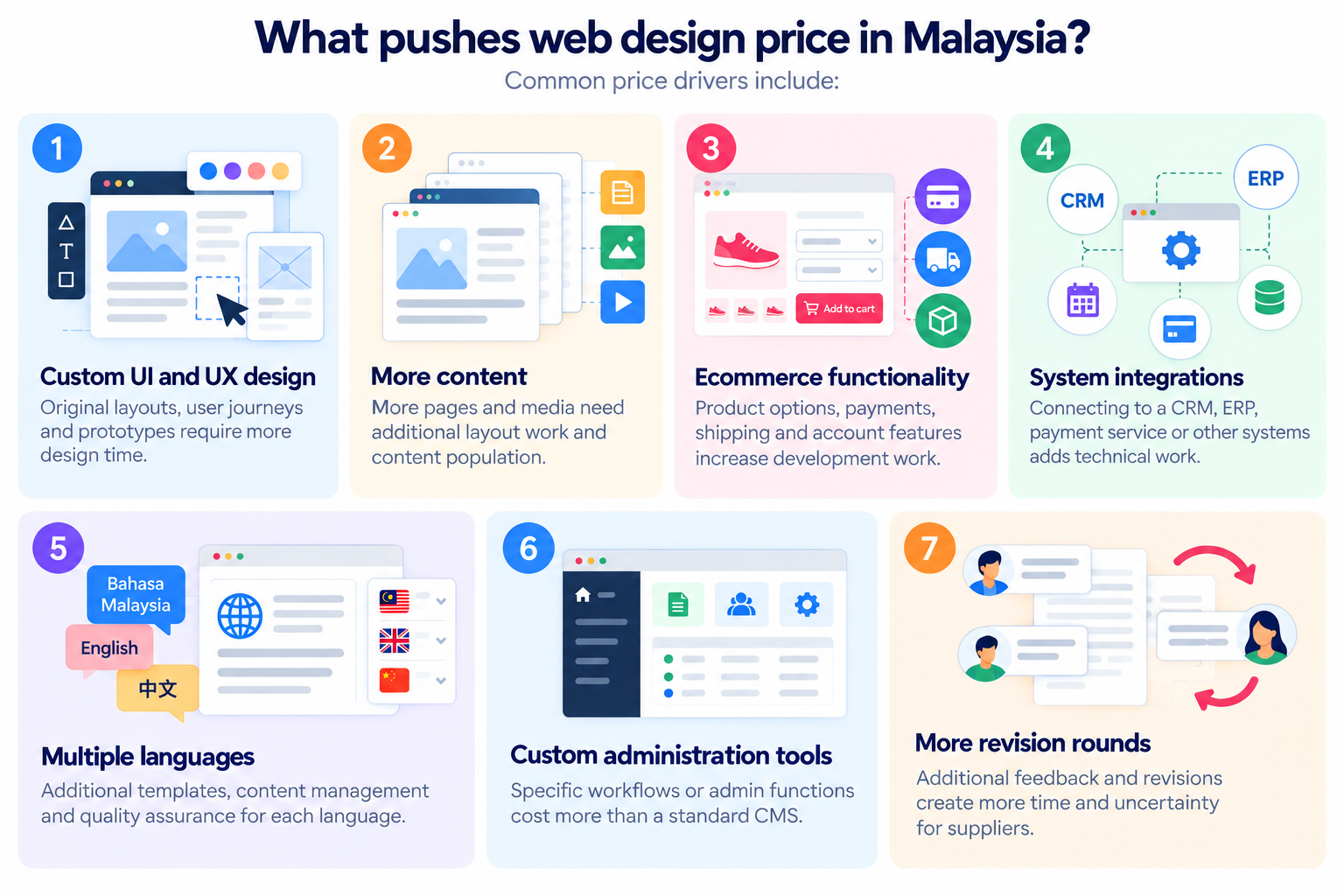
Common price drivers include:
Custom UI and UX design. Original layouts, user journey planning, prototypes and multiple design states require more design time than modifying an existing template.
More content. Twenty unique service pages require more layout work, content population and testing than five pages. Copywriting, photography, illustration and video may also be separate services.
Ecommerce functionality. Product variations, payment gateways, shipping rules, vouchers, stock management and customer accounts increase development and testing requirements.
System integrations. Connecting your website to a CRM, ERP, booking platform, payment service or internal database introduces technical work beyond standard website development.
Multiple languages. A Bahasa Malaysia, English and Mandarin website requires additional templates, content management and quality assurance even when you supply all translations.
Custom administration tools. A standard content management system is generally cheaper than building specific workflows or administration functions around your organisation.
More revision rounds. Unlimited revisions sound attractive to buyers but create uncertainty for suppliers. A well-scoped proposal will normally state how feedback and revisions are handled.
Performance requirements also matter. Google recommends good Core Web Vitals, including Largest Contentful Paint within 2.5 seconds, Interaction to Next Paint below 200 milliseconds and Cumulative Layout Shift below 0.1. Meeting performance targets can require careful development, image optimisation and technical testing rather than simply installing a theme.
What brings the price down?
The most reliable way to reduce your website cost is to reduce scope and uncertainty, not simply find the cheapest supplier. A focused website with clear requirements is easier to quote, design, build and approve.
You can control your budget by preparing before asking for quotations.
Start with a clear sitemap. Decide whether you need five pages or fifteen before suppliers estimate the work. Remove pages that repeat the same information.
Prepare your content early. Supplying approved copy, logos, brand guidelines and suitable photography reduces the amount of production work required from your web partner.
Use established functionality where it meets your needs. A standard contact form is cheaper than a custom quotation engine. A proven content management system can also be more economical than creating administration functions from scratch.
Limit integrations to systems that provide a clear business benefit. Connecting a website to every tool your company uses can increase both the initial cost and future maintenance.
You should also separate requirements from preferences. A mobile-friendly layout is a requirement for a modern business site. A complicated animated transition between every page may be a preference.
Cheap web design Malaysia packages can make sense for a new business that needs a simple online presence. Problems arise when you buy a low-scope package and expect it to perform the role of a custom corporate website.
Affordable web design Malaysia businesses can depend on is therefore better understood as appropriate scope at a sustainable price, rather than the smallest number on a quotation.
Which website costs are often left out of the quote?
Hosting, domains, licences, maintenance, content and post-launch changes are among the costs most likely to sit outside the initial website build price. Ask suppliers to state these items before you compare totals.
A quotation that says "website design: RM5,000" does not tell you your actual first-year website cost.
Check whether the proposal includes:
Domain registration and renewal
Web hosting and renewal
SSL configuration
Premium plugins, fonts or software licences
Stock photography or custom photography
Copywriting and content migration
Search engine optimisation work
Analytics and tracking configuration
Email services
Security monitoring and backups
Software updates
Technical maintenance
Additional design revisions
Training for your internal team
Post-launch support
New pages after launch
Privacy requirements deserve attention as well. Malaysia's Personal Data Protection Act 2010 applies to organisations processing personal data in commercial transactions, and the Personal Data Protection Commissioner states that data controllers must comply with relevant data protection requirements. Guidance under Section 7 also covers written notice about how personal data is collected, used, disclosed and processed.
If your website collects names, email addresses, telephone numbers or other personal information, discuss privacy requirements during scoping rather than treating them as an afterthought.
A worked first-year cost example
Consider a fictional Malaysian SME comparing a RM6,500 website quotation.
The proposal includes design, development and 12 months of hosting, but excludes copywriting, photography and maintenance after a 30-day support period.
The company needs eight pages of professionally prepared copy. Assume, purely for this budgeting exercise, that it allocates RM300 per page:
8 pages × RM300 = RM2,400
It also allocates RM1,500 for photography and RM1,200 for the first-year of additional technical support.
The internal budgeting calculation becomes:
RM6,500 + RM2,400 + RM1,500 + RM1,200 = RM11,600
The useful number for management is therefore not the RM6,500 build quote. It is the RM11,600 planned first-year cost.
The RM300, RM1,500 and RM1,200 figures above are illustrative assumptions created for the scenario, not quoted Malaysian market averages. The exercise shows why every supplier comparison should calculate total required expenditure rather than comparing one line on each proposal.
Three sample website budgets
A sensible website budget depends on what the site needs to achieve, so three businesses can reasonably receive very different quotations. The following examples show how scope changes the budget you should prepare.
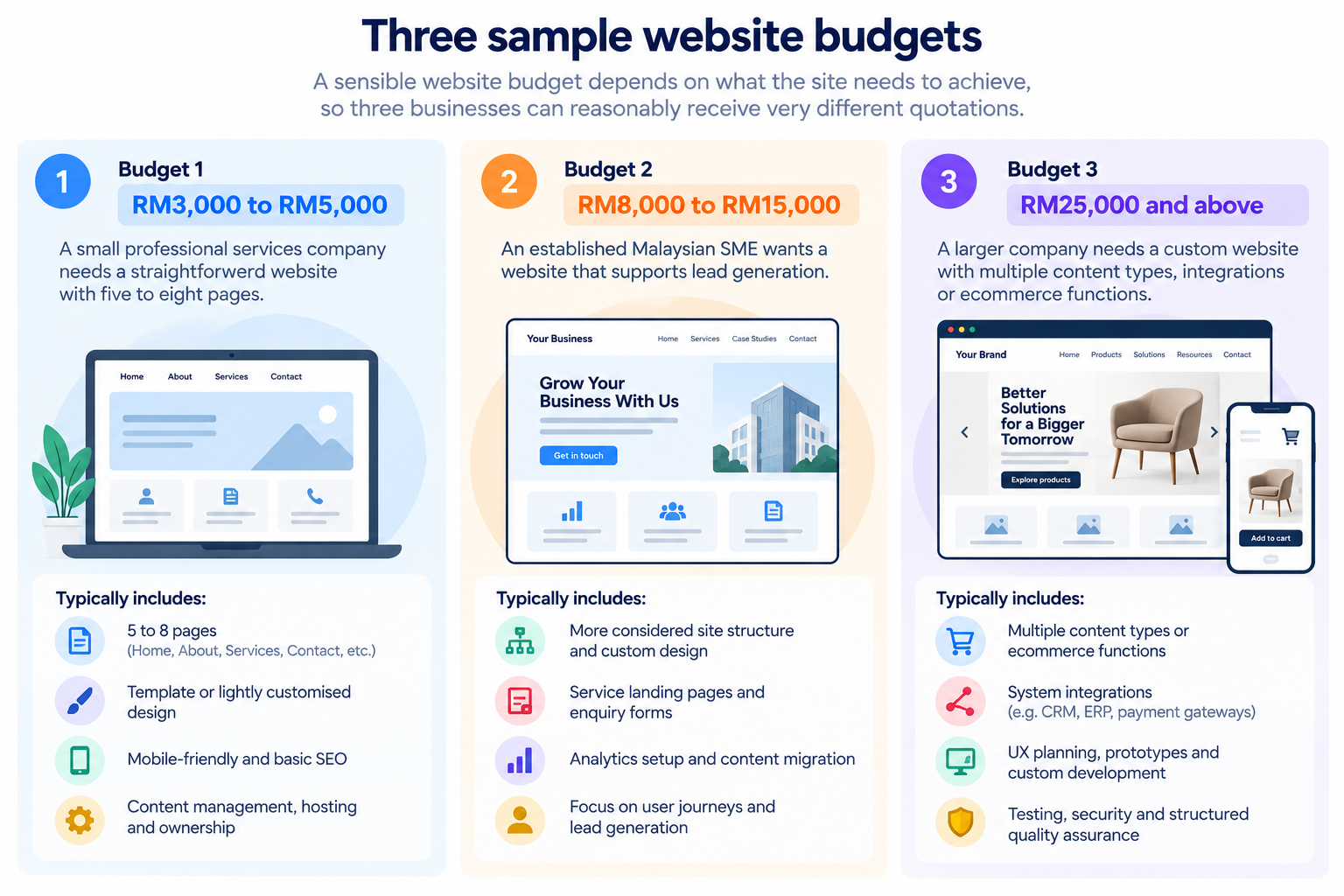
Budget 1: RM3,000 to RM5,000
A small professional services company needs a straightforward website with five to eight pages.
The company supplies its logo, copy and photographs. It needs Home, About, Services, Contact and several supporting pages. There are no customer accounts, payment functions or external system integrations.
A template or lightly customised build may fit this budget. The business should pay particular attention to mobile presentation, content management, basic technical SEO, hosting arrangements and ownership.
Budget 2: RM8,000 to RM15,000
An established Malaysian SME wants its website to support lead generation rather than simply act as an online company profile.
The scope includes a more considered information architecture, custom page designs, service landing pages, enquiry forms, analytics setup, content migration and stronger attention to user journeys.
At this level, the buyer should expect the supplier to explain its design and development process clearly rather than simply present a Malaysia web design package with a page allowance.
Budget 3: RM25,000 and above
A larger company needs a custom website with multiple content types, integrations, sophisticated interfaces or ecommerce functions.
The project may involve stakeholder workshops, UX planning, prototypes, custom development, integration testing, security work and structured quality assurance before launch.
Trinergy Digital, a software and creative technology company in Kuala Lumpur, provides web UI and UX design alongside broader technology services. For businesses comparing suppliers at this level, the relevant question is whether the team can handle the required design and technical scope, not whether it offers the lowest cost per page.
How do you compare web design quotes fairly?
Compare web design quotations line by line using the same scope, because two suppliers can use the word "website" to describe very different deliverables. Price becomes meaningful only after you establish what each supplier includes.
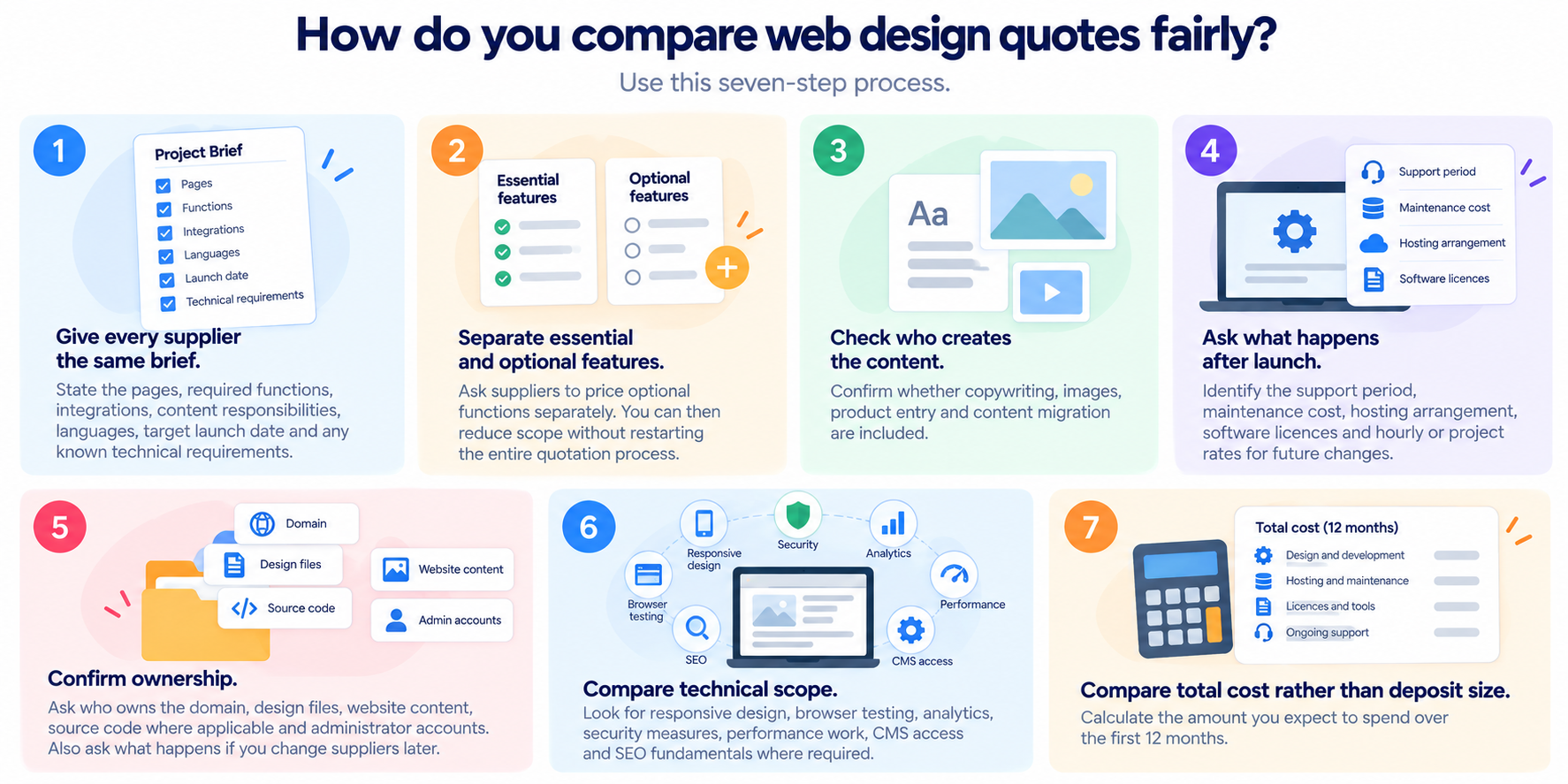
Use this seven-step process.
Step 1: Give every supplier the same brief. State the pages, required functions, integrations, content responsibilities, languages, target launch date and any known technical requirements.
Step 2: Separate essential and optional features. Ask suppliers to price optional functions separately. You can then reduce scope without restarting the entire quotation process.
Step 3: Check who creates the content. Confirm whether copywriting, images, product entry and content migration are included.
Step 4: Ask what happens after launch. Identify the support period, maintenance cost, hosting arrangement, software licences and hourly or project rates for future changes.
Step 5: Confirm ownership. Ask who owns the domain, design files, website content, source code where applicable and administrator accounts. Also ask what happens if you change suppliers later.
Step 6: Compare technical scope. Look for responsive design, browser testing, analytics, security measures, performance work, CMS access and SEO fundamentals where required.
Step 7: Compare total cost rather than deposit size. Calculate the amount you expect to spend over the first 12 months.
A useful pricing signal is specificity. A quotation that identifies deliverables, exclusions, revision limits, responsibilities, milestones and post-launch costs gives you more information to evaluate than a one-page proposal promising a "complete website".
A very low quotation is not automatically poor value, and an expensive quotation is not automatically better. The commercial question is whether the proposed scope matches what your business needs.
If one supplier quotes RM4,000 and another quotes RM9,000, ask both to explain the difference before deciding. You may discover that the RM9,000 proposal includes copywriting, custom UI design, analytics, content migration and post-launch support that would otherwise become additional costs.
Choosing a budget that fits the job
The right web design budget is the amount required to build the website your business needs without paying for unnecessary complexity or discovering major omissions after work begins.
As of September 2026, Malaysian businesses can find website offers from the low thousands of ringgit through to RM50,000 or more. The range is wide because the projects themselves are different.
Before selecting a supplier, define what the website needs to accomplish, issue the same brief to each company and compare the resulting scope line by line. Pay particular attention to content, custom functionality, integrations, ownership, maintenance and recurring costs.
If you are currently comparing suppliers, the next useful step is to prepare your required pages, functions, content responsibilities and target budget before requesting a proposal.
Trinergy Digital can discuss your website requirements and help determine the design and technical scope appropriate for your project. Contact Trinergy Digital today.