


Introduction to AI and traditional software in business
In 2026, the debate around AI vs traditional software has become central to how organisations plan their digital strategies. Businesses are no longer choosing software only for basic functionality. Instead, they are evaluating how systems contribute to long term efficiency, scalability, and competitiveness through digital transformation software.
Traditional software has been the backbone of business operations for decades. These systems are built on fixed logic, meaning they follow predefined rules to complete tasks. They are widely used in finance, operations, human resources, and customer management because they provide consistency and stability. However, as business needs evolve, many organisations are now reassessing AI solutions vs traditional systems to determine whether they can achieve higher efficiency through smarter technologies.
AI driven systems work differently. Instead of relying only on fixed instructions, they analyse large datasets, identify patterns, and generate predictions or recommendations. This shift has accelerated interest in AI adoption business strategies, where companies aim to reduce manual effort and improve decision making speed.
According to industry insights from research firms such as McKinsey and Gartner, organisations that integrate AI into core processes often experience measurable improvements in productivity, decision speed, and customer experience. These findings have made AI business applications a key focus for companies investing in future of software planning.
How AI systems differ from traditional software
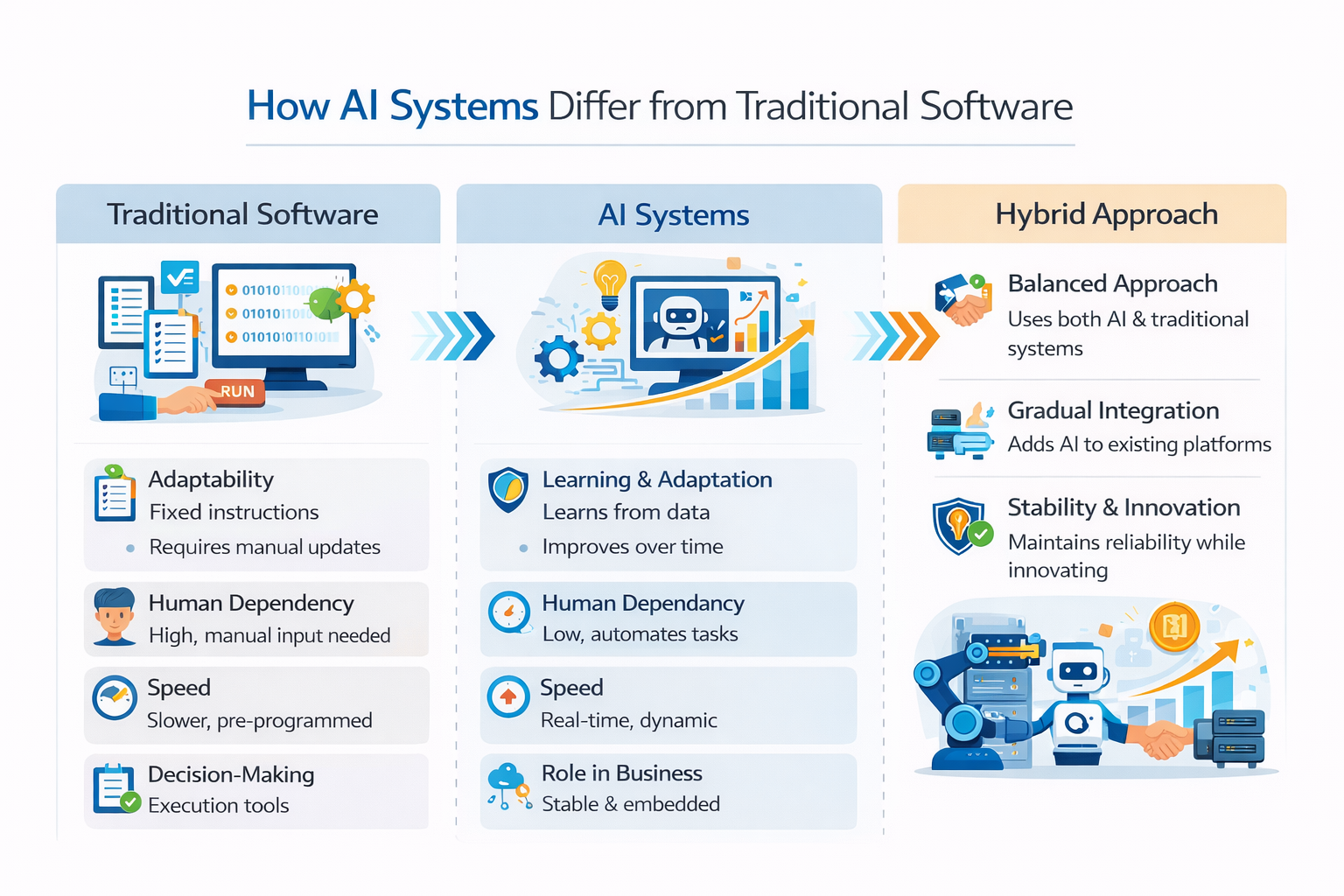
When comparing AI systems vs legacy systems, the most important difference lies in adaptability. Traditional software is designed to execute fixed instructions. If conditions change, the system does not adjust unless manually reprogrammed. This makes it reliable but limited in dynamic environments.
AI systems, on the other hand, are designed to learn from data. They improve over time as they process more information, making them far more flexible. This is why AI tools comparison studies are becoming essential for businesses evaluating new technology investments.
A clear distinction can also be seen in AI vs manual processes. Traditional systems often depend heavily on human input for reporting, analysis, and decision making. This increases workload and slows down operations. AI systems reduce this dependency by automating repetitive tasks and providing real time insights, allowing teams to focus on higher value work.
Despite these advantages, traditional systems limitations still play an important role in enterprise decision making. Many legacy platforms are deeply embedded in business operations and cannot be replaced easily without significant cost and disruption. They are also trusted for their stability, especially in regulated industries where predictable outcomes are critical.
Because of this, many organisations now adopt a hybrid approach when evaluating AI vs automation tools. Instead of replacing existing infrastructure entirely, they layer AI capabilities on top of traditional systems. This allows businesses to modernise gradually while maintaining operational continuity.
Business impact of modern software decisions
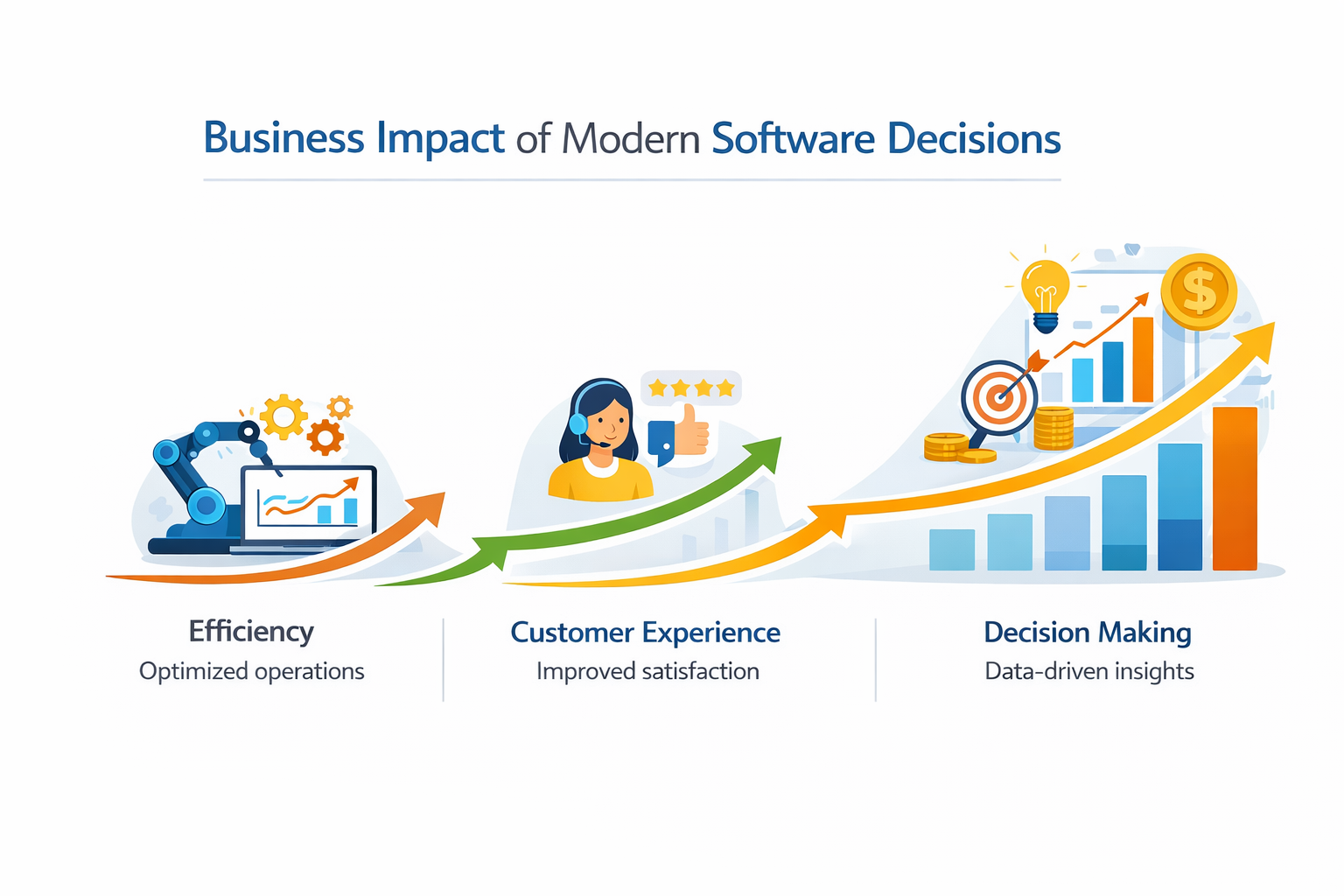
The comparison between AI enterprise tools and traditional platforms is not just technical. It directly affects business performance, scalability, and long-term growth. Companies adopting modern software solutions are typically focused on improving efficiency, enhancing customer experience, and enabling faster decision making.
AI systems are especially powerful in areas such as forecasting, customer service, and supply chain management. They help businesses respond quickly to changes and reduce operational delays. This is why AI platform comparison discussions are now common at leadership level when planning technology investments.
However, implementing AI is not without challenges. Many legacy systems were not designed to support modern data driven workloads. This creates integration issues, particularly around data access and system compatibility. These challenges often appear in enterprise software comparison evaluations, where businesses must decide whether to upgrade, replace, or extend their existing systems.
As business technology trends continue to evolve, organisations are increasingly moving towards systems that combine intelligence with stability. This shift reflects a broader movement in software innovation where static tools are being replaced by adaptive, data driven ecosystems.
Cost, scalability, and long term value of AI vs traditional software
When evaluating AI vs traditional software, cost is often one of the first considerations for decision makers. Traditional systems usually involve lower initial complexity, especially when businesses are already familiar with their infrastructure. However, hidden costs often appear over time through maintenance, manual processes, and limited scalability.
In contrast, AI software benefits are more closely tied to long term value rather than short term cost savings. AI systems may require higher upfront investment, particularly in data preparation, integration, and training. However, they can significantly reduce operational costs by automating repetitive tasks and improving decision accuracy. This is why many organisations now include automation vs AI analysis when planning budgets for digital upgrades.
Scalability is another key difference. Traditional systems often struggle to scale efficiently because they rely on fixed rules and manual updates. AI driven platforms scale more naturally because they improve performance through data. This makes them particularly suitable for fast growing organisations that rely on AI enterprise tools to manage increasing complexity.
Industry reports from sources such as Deloitte suggest that businesses investing in AI driven infrastructure often achieve faster scaling in customer operations and data processing capacity compared to those relying solely on legacy platforms. These findings reinforce the importance of considering future of software trends when making long term investment decisions.
Risks, challenges, and limitations in AI adoption
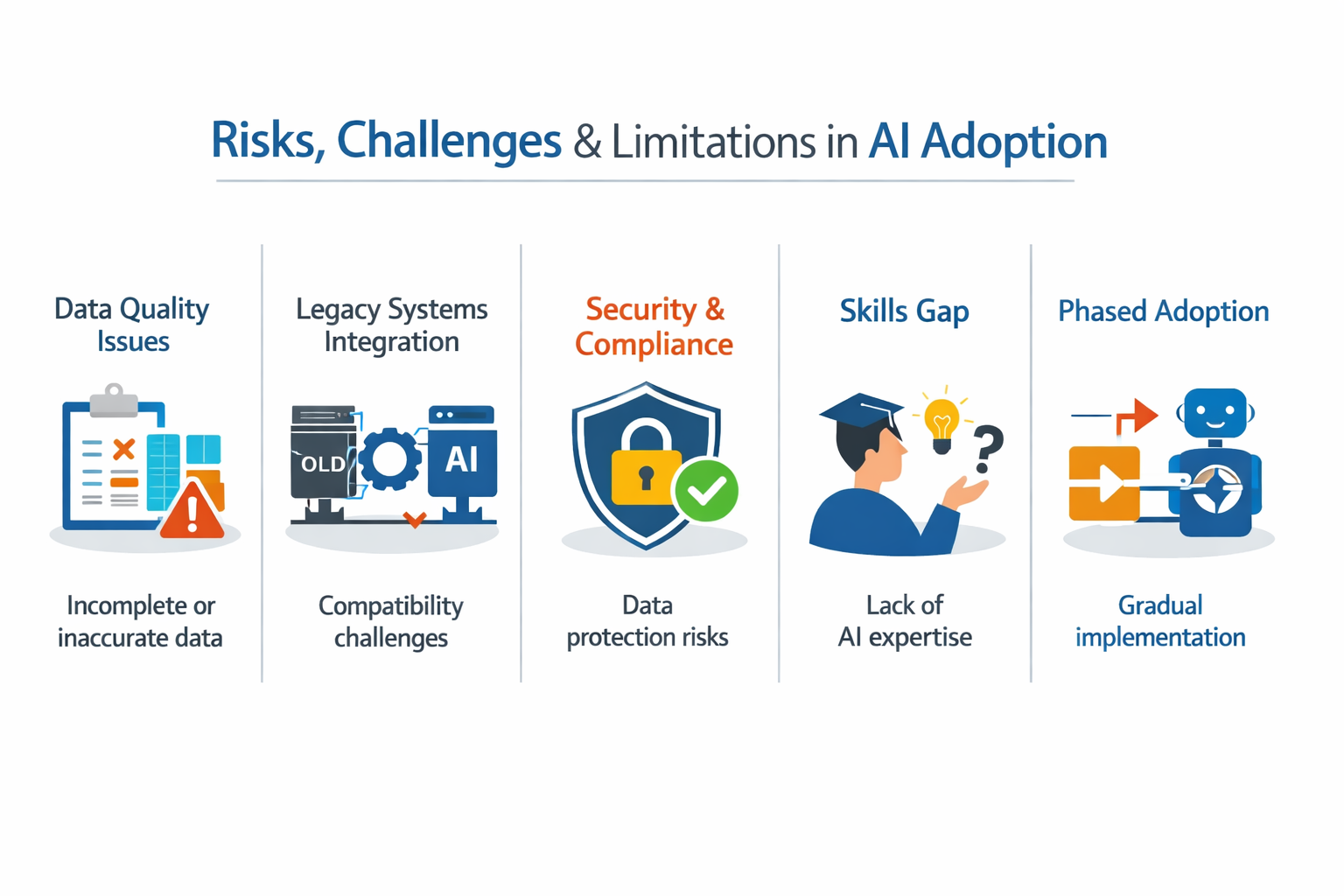
Despite its advantages, AI adoption business strategies come with challenges that organisations must carefully manage. One of the main concerns is data quality. AI systems depend heavily on accurate and structured data. If the input data is incomplete or inconsistent, the output quality will also be affected.
Another challenge is integration. Many companies still operate on AI systems vs legacy systems, where older platforms were not designed to support modern AI workloads. This creates technical barriers that can slow down implementation and increase costs. As a result, businesses often need middleware or custom integration layers to connect systems effectively.
Security and compliance also remain critical considerations. AI systems process large volumes of sensitive data, which increases the importance of governance frameworks and cybersecurity controls. Traditional systems, while less flexible, are often easier to audit due to their predictable structure.
There is also a skills gap issue. Implementing AI requires specialised knowledge in data science, machine learning, and system architecture. Many organisations underestimate this requirement when comparing AI tools comparison options during procurement.
Because of these challenges, companies often take a phased approach to digital transformation software adoption. Instead of replacing all systems at once, they gradually introduce AI capabilities into specific workflows such as customer support or analytics.
Strategic approach to choosing between AI and traditional systems
The decision between AI solutions vs traditional systems is not simply about replacing old technology. It is about aligning technology choices with business goals. Companies must assess where AI can deliver the most value and where traditional systems still provide stability.
A common strategy involves identifying processes that are repetitive, data heavy, and time sensitive. These areas are ideal for AI business applications, as they benefit most from automation and predictive insights. Meanwhile, mission critical systems that require strict control and compliance may continue running on traditional infrastructure.
This balanced approach is often reflected in enterprise software comparison frameworks used by IT leaders. These frameworks evaluate systems based on cost, performance, scalability, and risk. Increasingly, they also include AI readiness as a key evaluation factor.
Organisations that successfully adopt AI tend to follow a structured implementation model:
Assess current workflows and identify inefficiencies
Evaluate where AI vs manual processes can deliver improvement
Start with pilot projects in low-risk areas
Integrate AI gradually with existing systems
Scale successful use cases across the organisation
This step-by-step approach reduces disruption while allowing businesses to gain measurable value early in the process.
Conclusion: balancing innovation and stability
The comparison of AI vs automation tools and traditional software shows that there is no one size fits all solution. Traditional systems still provide reliability, control, and predictability. However, AI driven platforms offer adaptability, intelligence, and long-term efficiency gains.
As business technology trends continue to evolve, organisations are shifting towards hybrid environments that combine the strengths of both approaches. This reflects a broader movement in modern software solutions, where intelligence and automation are no longer optional but expected.
Businesses that carefully evaluate AI platform comparison options and align them with strategic goals will be better positioned for long term success. The key is not choosing between AI and traditional systems but understanding how to integrate them effectively to support growth, innovation, and operational stability.
Next Steps for Your Business
Choosing between AI and traditional systems depends on your business goals, existing infrastructure, and readiness for change. The most successful organisations are those that integrate AI strategically while maintaining the stability of legacy systems where needed.
Ready to modernise your business systems and explore AI driven solutions? Contact Trinergy Digital today so we can help you build smarter, scalable, and future ready software solutions.