



When buying UI UX design services, look for clear deliverables, a defined research and design process, relevant project experience, usability testing, developer handover and transparent pricing. The strongest proposal should explain who will work on your project, what you will receive, how decisions will be validated and what happens when requirements change.
Key takeaways
UI UX pricing should be compared against deliverables, research depth and project complexity rather than screen count alone.
A credible design proposal should define research, wireframes, interface design, prototyping, testing, revisions and developer handover.
Published Malaysian pricing varies considerably, so businesses should compare scope and exclusions before comparing the final RM figure.
Buying UI UX design can be surprisingly difficult because two proposals that appear similar can represent very different amounts of work.
One supplier might quote primarily for visual screens. Another might include stakeholder workshops, user research, information architecture, interactive prototypes, usability testing, a reusable design system and support for developers. Comparing those proposals only by price can therefore produce the wrong conclusion.
Trinergy Digital, a software and creative technology company in Kuala Lumpur, approaches UI UX as part of the wider digital product process. Whether you are planning a website, mobile application or bespoke system, understanding what sits behind the quotation helps you compare suppliers on substance rather than presentation.
Who is UI UX design services for?
UI UX design services are most valuable when your digital product needs to make a task easier, clearer or more effective for a defined group of users. That can include a new product as well as an existing website, application or system that users find difficult to use.
You may need professional UI UX support if you are:
building a website or mobile application from the ground up
redesigning an existing product with usability problems
replacing an outdated internal business system
developing a customer portal or self-service platform
preparing a minimum viable product for testing
creating an ecommerce or transactional experience
introducing new features into an established digital product
trying to standardise inconsistent interfaces across a product
The distinction between UI and UX matters when comparing suppliers. UX focuses on how people complete tasks, move through information and interact with a product. UI focuses more closely on the interface itself, including layouts, typography, colours, controls and visual states.
A full engagement should connect both disciplines. Attractive screens cannot compensate for a confusing user journey, while a logical journey still needs a clear and usable interface.
Businesses commissioning more complex platforms may also encounter product design services. Product design typically takes a wider view of the digital product, connecting user needs with business requirements, functionality, technical considerations and the product's development over time.
What is included in UI UX design services?
Good UI UX design services should give you more than finished screens. You are paying for a process that identifies user needs, organises functionality, tests assumptions and turns the resulting decisions into designs that developers can implement.
A good UI UX process starts with understanding your users and what they need to accomplish. The designer can then turn those findings into user journeys, wireframes and interface designs, test important interactions, and refine the experience before development begins. The exact process will depend on the size and complexity of your project.
A typical engagement can contain the following stages:
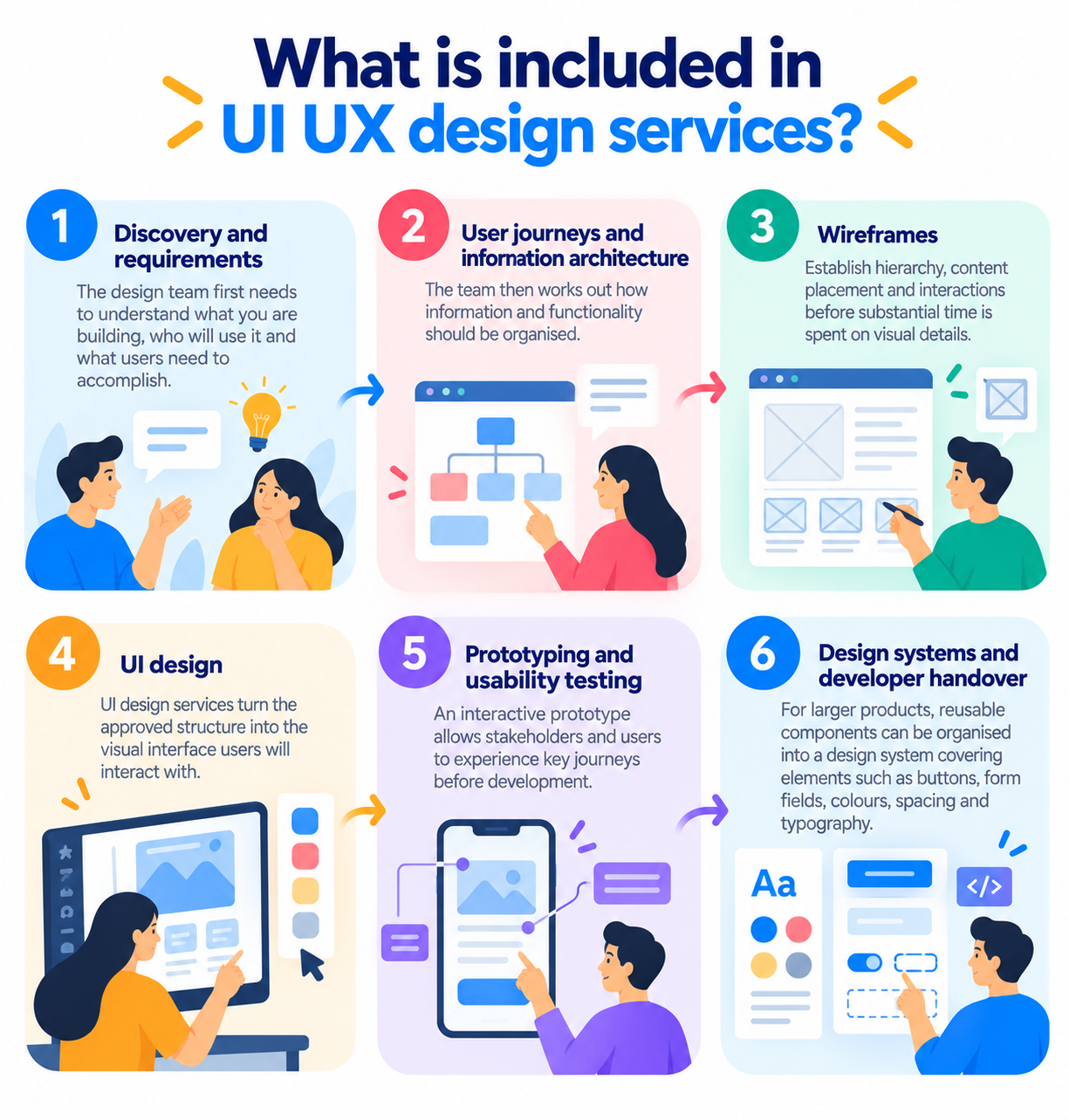
1. Discovery and requirements
The design team first needs to understand what you are building, who will use it and what users need to accomplish.
Discovery can include stakeholder interviews, workshops, reviews of existing analytics, competitor research, user interviews and examination of current customer journeys.
The output should be a clearer problem definition rather than a collection of aesthetic preferences.
2. User journeys and information architecture
The team then works out how information and functionality should be organised.
For a customer portal, for example, that might involve mapping how someone registers, verifies an account, views information, submits a request and receives confirmation.
Information architecture defines where content and functions belong. User flows define how people move between them.
3. Wireframes
Wireframes are simplified representations of screens. They establish hierarchy, content placement and interactions before substantial time is spent on visual details.
Wireframes make changes cheaper to discuss. Moving a section or reconsidering a workflow at this stage usually requires less effort than rebuilding a polished interface later.
4. UI design
UI design services turn the approved structure into the visual interface users will interact with.
Deliverables can include typography, colours, buttons, form controls, navigation, icons, cards, tables, alerts and responsive screen layouts.
Ask whether the quotation covers only selected screens or all required screen states. A login form, for example, may require default, loading, validation error, incorrect password and successful states.
5. Prototyping and usability testing
An interactive prototype allows stakeholders and users to experience key journeys before development.
Usability testing goes further by observing representative users completing tasks. The purpose is not to ask whether they like the design. Testing should reveal where people hesitate, misunderstand labels, miss actions or fail to complete a task.
Trinergy Digital's published creative services include UI UX design research, web design, mobile design, interactive screen design and bespoke solution design. Its research service includes user research, information architecture, consultation and usability testing.
6. Design systems and developer handover
For larger products, reusable components can be organised into a design system covering elements such as buttons, form fields, colours, spacing and typography.
Handover should also give developers enough information to reproduce the intended behaviour. Ask whether the UX design agency will remain available to answer implementation questions and review the built interface.
Accessibility should also be discussed early in the design process. Ask how the agency will make the interface easier to use for people with different visual, physical and cognitive needs, including considerations such as colour contrast, keyboard navigation, form labels and button sizes.
How should you shortlist a UX design agency?
Shortlist agencies by comparing their process, relevant experience, team, deliverables and ability to work with development rather than choosing the portfolio you find most attractive.
A polished portfolio shows visual ability. It does not automatically tell you whether the agency can understand a complex workflow, conduct useful research or prepare designs developers can build.
Use a comparison such as this:
Criterion | What to look for | Why it matters | Potential drawback if missing |
|---|---|---|---|
Research | Defined research methods and intended participants | Reduces decisions based purely on assumptions | Design may reflect stakeholder preferences rather than user needs |
Relevant work | Projects with similar complexity or user journeys | Shows experience solving comparable problems | A visually similar portfolio may hide limited functional experience |
Named team | Clear roles and responsibilities | Shows who will perform the work | Senior staff may sell the project while junior staff deliver it |
Testing | Prototype reviews and usability testing | Finds problems before development | Usability issues may appear after expensive development work |
Design system | Reusable components and documented patterns | Supports consistency as the product grows | Future screens can become inconsistent |
Handover | Specifications and developer collaboration | Reduces interpretation during implementation | Finished software may differ from approved designs |
Scope | Defined deliverables and revision terms | Makes quotations easier to compare | Extra rounds and screens can increase the final cost |
A useful shortlist might contain three suppliers rather than ten. Give each supplier the same core brief so you can compare responses fairly.
A practical scoring method is to assign 30 points to process and research, 25 to relevant experience, 20 to deliverables, 15 to team and collaboration, and 10 to commercial clarity. The resulting 100-point framework is an original procurement example, not an industry standard. Its purpose is to stop price or presentation quality from dominating your decision.
For example, a RM18,000 proposal with research, testing and developer handover may represent better scope than a RM12,000 proposal covering only wireframes and polished screens. The RM6,000 difference should therefore be evaluated against the additional work rather than treated automatically as a premium.
What questions should you ask before signing?
Ask questions that expose exactly how the supplier will work, what you will receive and where additional charges could arise. Clear answers before signing can prevent scope disputes later.
Start with these questions:
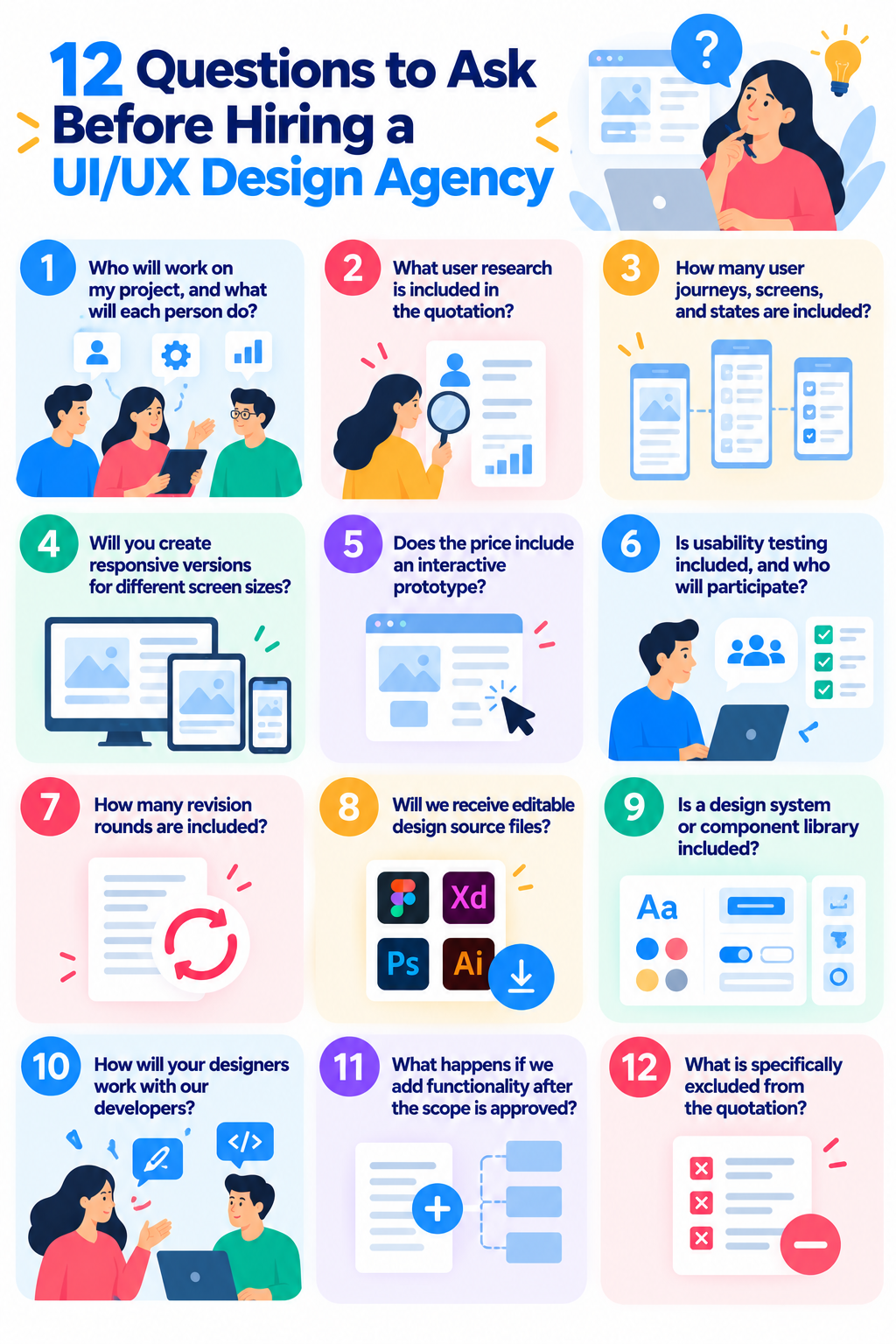
Who will work on my project, and what will each person do?
What user research is included in the quotation?
How many user journeys, screens and states are included?
Will you create responsive versions for different screen sizes?
Does the price include an interactive prototype?
Is usability testing included, and who will participate?
How many revision rounds are included?
Will we receive editable design source files?
Is a design system or component library included?
How will your designers work with our developers?
What happens if we add functionality after the scope is approved?
What is specifically excluded from the quotation?
Ask about ownership as well. Your agreement should state what files and design assets you receive and what rights apply to third party fonts, photographs, icons or other licensed material.
A strong proposal should also identify assumptions. If a quotation assumes 20 unique screens, two review rounds and no original user research, you should know that before comparing it with a proposal containing 40 screens and usability testing.
What red flags should you watch for?
The biggest warning sign is a proposal that promises an attractive interface without explaining how the supplier will understand users, validate decisions or prepare the design for development.
Watch for vague deliverables such as "complete UX" without a list of outputs. UX is not one file or phase. You should be able to see what activities and deliverables sit behind the term.
Be cautious when:
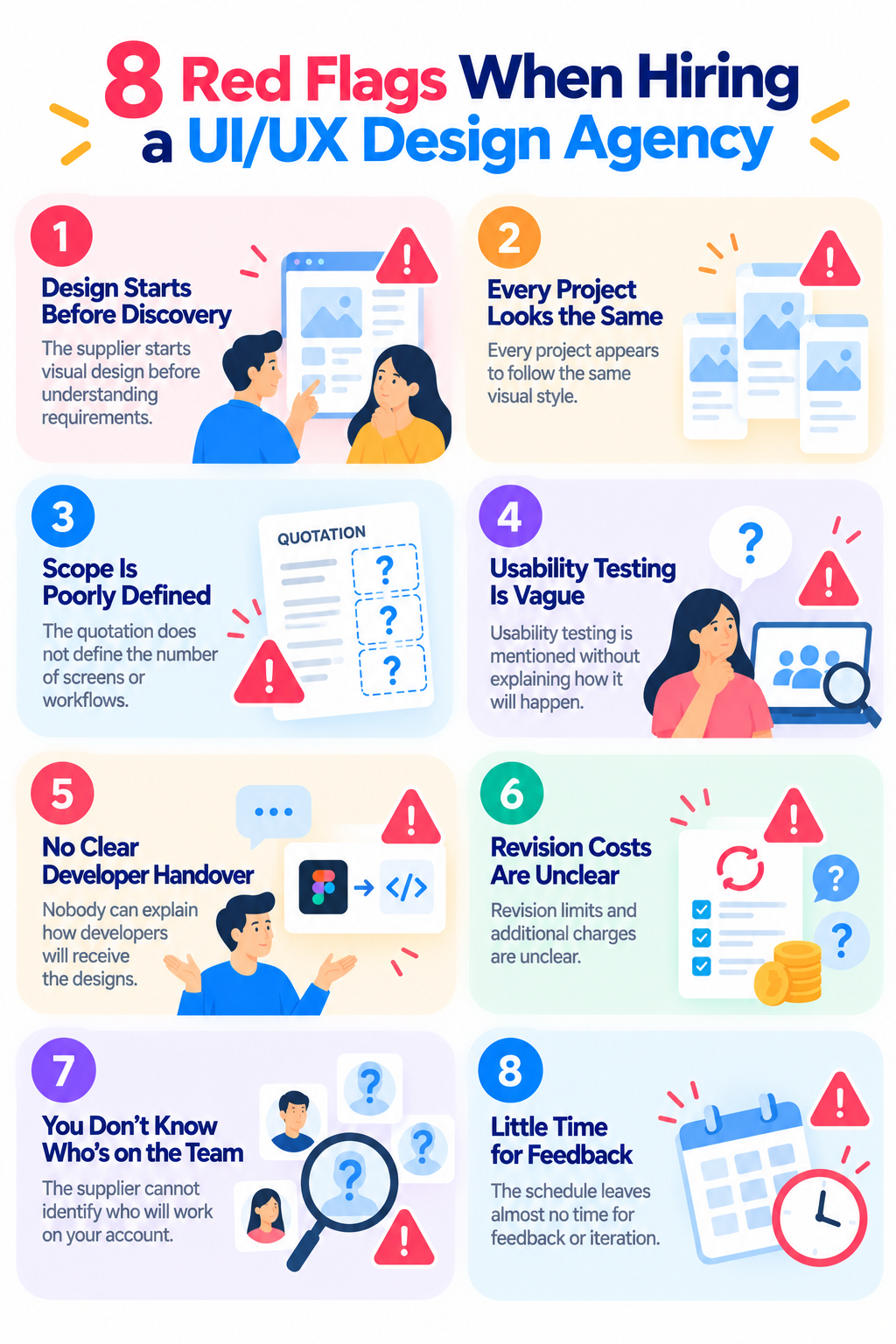
1. Design Starts Before Discovery
The supplier starts visual design before understanding requirements.
2. Every Project Looks the Same
Every project appears to follow the same visual style.
3. Scope Is Poorly Defined
The quotation does not define the number of screens or workflows.
4. Usability Testing Is Vague
Usability testing is mentioned without explaining how it will happen.
5. No Clear Developer Handover
Nobody can explain how developers will receive the designs.
6. Revision Costs Are Unclear
Revision limits and additional charges are unclear.
7. You Don't Know Who's on the Team
The supplier cannot identify who will work on your account.
8. Little Time for Feedback
The schedule leaves almost no time for feedback or iteration.
Another warning sign is an unusually cheap quote that appears to include everything. Ask what has been omitted rather than assuming you have found the same service at a lower price.
The reverse also applies. A high quotation does not prove that research or design quality will be better. Request a breakdown of activities, people, outputs and assumptions.
What do UI UX design services cost in Malaysia?
Malaysian UI UX design costs vary significantly according to scope, research depth, screen count, complexity, testing and the seniority of the team involved. Published market examples therefore work better as pricing signals than as fixed industry rates.
As of September 2026, one Malaysian provider publishes a broad project range of RM3,000 to RM30,000 plus for UI UX work, depending on factors including scope, number of screens, research and prototyping. Another Malaysian provider publishes dedicated mid-level UX UI designer rates of RM7,000 to RM10,000 per month and senior rates of RM10,000 to RM15,000 per month.
These figures should not be interpreted as a standard tariff. They demonstrate how widely the commercial model can vary.
A practical buyer framework as of September 2026 is:
Engagement | Indicative market signal | Typical scope consideration | Main cost driver |
|---|---|---|---|
Small defined project | From around RM3,000 | Limited screens or focused design task | Number of screens and design depth |
Broader project engagement | Up to RM30,000 plus in published Malaysian pricing | Research, multiple journeys, prototypes and wider UI work | Complexity and research |
Dedicated mid-level resource | RM7,000 to RM10,000 per month | Ongoing design capacity | Duration and responsibility |
Dedicated senior resource | RM10,000 to RM15,000 per month | More complex or senior design responsibilities | Seniority and involvement |
For a worked comparison, suppose Supplier A quotes RM12,000 for design and Supplier B quotes RM18,000. Supplier B includes five moderated usability sessions, an interactive prototype and developer handover, while Supplier A excludes all three.
The apparent difference is RM6,000, or 50 per cent of Supplier A's price. Your procurement question should not be "Is Supplier B 50 per cent too expensive?" It should be "Are those additional activities worth RM6,000 for this project, and what would it cost us to obtain or perform them separately?"
Timeline varies for the same reason. A small defined interface may take several weeks, while a product involving research, complex journeys, testing and multiple stakeholder reviews can take several months. Ask each supplier to separate working time from client review time so you can see which party controls each milestone.
Choosing the right design partner
The best next step is to compare suppliers using the same brief and ask each one to itemise research, design, testing, revisions and handover. That gives you a much clearer picture of what each RM quotation buys.
Trinergy Digital, a software and creative technology company in Kuala Lumpur, provides creative services covering areas such as UI UX research, web design, mobile design and bespoke digital experiences. You can review Trinergy Digital's creative services and its guide to UI UX for gamified interfaces for more context on its approach to digital interface design.
If you are currently comparing suppliers, prepare your core requirements, target users, required platforms, expected launch date and approximate budget before requesting proposals. Then ask each supplier to show exactly what its price includes.
To discuss your project requirements and obtain a scope based on what you are actually building, contact Trinergy Digital.